

Australians at 1948 Henley Royal Regatta
Diamond Challenge Sculls
Champion
NSW Police Rowing Club (NSW) - Mervyn T Wood
Round 1 - Wood defeats B Piessens from Belgium easily.
Round 2 - Wood defeats A D Rowe of Leander by 1 1/2 lengths. See below for race description.
Semi-final - Wood defeats past champion J Sepheriades by 2 lengths
Final - Wood defeats B H T Bushnell of Maidenhead Rowing Club by 5 lengths in a good time. The final was reported in the Henley Regatta Records 1939-68 Volume 1 as follows. Bushnell started at 39½, but Wood at 35 led by ½ length at the ¼ mile and by I¾ lengths at the ½ mile. Bushnell kept going at 27, but Wood sculled a steady 24 and drew away to 4 lengths at the Mile.
R D Burnell in his 1957 history of the Henley Royal Regatta reported this race as follows: The Australian, M. T. Wood, had already beaten B. H. T. Bushnell, who was thought to.be our only hope in the Diamonds, at Marlow, and it seemed that the outcome must lie between Wood, and Sepheriades. But in the end Wood's hardest race, and perhaps the hardest race he ever had in this country, came against A. D. Rowe, of Leander, a newcomer to the Diamonds. Both men started at forty, and at the Barrier Rowe led by half a length. At the three-quarter mile Wood went by him, but Rowe answered at once, and went on attacking, even when Wood crossed over into his water. Rowe lost by a length and a half, and Wood's time was 8 min. 10 sec.- second only to Burk's record.
Bushnell reached the final on the other side of the draw, but, giving away more than two stone, he was no match for the Australian.
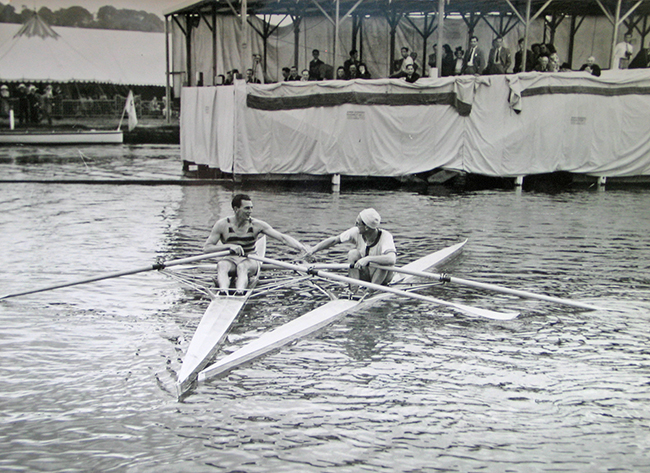
Wood is congratulated by Bushnell after the final of the Diamonds
Silver Goblets & Nickalls' Challenge Cup
Finalists
Mosman Rowing Club (NSW) - Bow: F Spencer Grace and Str: Edward R Bromley
Having received a bye in the first round, Mosman defeated Nottingham Britannia Rowing Club's Booth and Booth in the second round. Grace and Bromley led from the start and won easily.
In the semi-final they easily defeated Billyard and Tinegate from Loughborough Boat Club and again leading from the start.
The final was a different race. The Henley Regatta Records 1939-68 Volume won reported as follows. Bromley and Grace started at 36, Laurie and Wilson at 35, and both Pairs settled to 32. Bromley and Grace led by ¾ length at the 1/4 mile and by 1 1/4 lengths at the ½ mile, but then Laurie and Wilson closed up, were level at Fawley and led by a length at the ¾ mile. They drew ahead fast after the Mile.
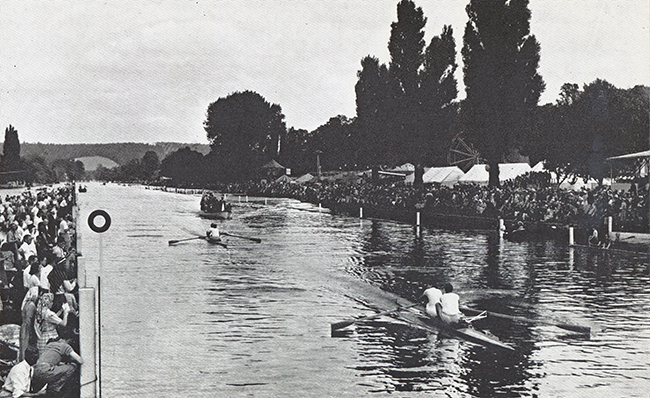
Finish of the final with Bromley and Grace in the rear
R D Burnell in his 1957 history of the Henley Royal Regatta reported this race as follows: The Goblets were distinguished by the return of W. G. R. M. Laurie and J. H. T. Wilson, who had not raced at Henley since they equalled the Goblets' record in 1938. After nearly ten years in the Sudan Civil Service, they had now contrived to arrange their leaves so as to be able to row together once more. At Marlow they failed against a strong Australian pair, F. S. Grace and E. R. Bromley, and the inevitable conclusion was that the veterans were unfit. But in the final at Henley, Laurie and Wilson went right away to win by three lengths. It is only fair to record that one of the Australian pair was unwell, but the subsequent Olympic racing confirmed Laurie and Wilson as an invincible pair.
In a letter to the trustees of the Bromley Fund to promote pair oared rowing in Australia in 1998, Ted Bromley stated as follows:
It had been announced that the next Olympics would be held in 1948 in London and Spencer Grace, who had been a member of our 1939 Henley crew, suggested that we should start rowing together in the pair and try for selection. (John Burrell's right arm had been injured in the war during the defence of Tobruk and he was not available.)
By early 1948 our pair was the only one rowing in NSW, and, as far as I am aware, there was no other coxless pair in use in Australia. We were selected in the Olympic Team with the proviso that we should first compete in the Henley Regatta and reach the final of the pair-oared race (the last two) which we did.
…[British coach Derek Ivors-Smith] taught us a lot about pair-oared rowing. …He required us to "brighten up”…... Our bodies had to remain almost perpendicular, the hands had to be struck away smartly after the finish. Nearly all the work was with the legs.
Before long we had the opportunity of trying out our new style at the Marlow Regatta (ten days before Henley). In the first heat we were drawn against Laurie and Wilson of Leander who were the nominated British Olympic pair and later winners of the Olympic gold medal. We got away very smartly rating well over forty strokes to the minute and did not drop below about thirty eight. We won the race by over two lengths. Later we won the final against Thames Rowing Club by three and a half lengths. At the Henley Regatta we won our first two races "easily" and joined Laurie and Wilson in the final.
Due to injury to Grace, the Australians finished second at Henley and their Olympic efforts were also upset with injury, changing styles and lack of experience in pair oared rowing. Ted Bromley continues –
I returned to Australia convinced that Australia should adopt a policy of giving a high, or even top, priority to the development of pair-oared rowing in preference to the past practice of first selecting an eight and two spare men ("they can row in the pair") when the Olympics came along every four years and paying no attention to the fact that such selections did not take into account the possibility that amongst those ten men there might have been two capable of winning a gold medal as a pair.
Sources
- Henley Regatta A History by R D Burnell published by Oxford University Press 1957, pages 181 and 182
- Images from the Guerin Collection
- Letter from Ted Bromley to the Bromley Fund Trustees
- Henley Royal Regatta 1939-68 Volume 1