

History of Rowing Victoria Inc
- Introduction
- 1: Rowing in a young Victoria 1838-1859
- 2: Formation of the Association 1860-1875
- 3: Growth of the Sport 1876-1889
- 4: Years of great success 1890-1899
- 5: The rise of Australian Henley 1900-1909
- 6: The War Years 1910-1919
- 7: Women's rowing and the modern era 1920-1929
- 8: The Depression Rebuild 1930-1939
- 9: War and rebuilding 1940-1949
- 10: Expansion years 1950-1959
- 11: The search for international success 1960-1969
- 12: Combining the Associations and lightweight success 1970-1979
- 13: The new national program 1980-1989
- 14: Golden years 1990-1999
- 15: Professionalism 2000-2009
- 16: Yet More Growth 2010-2019
- 17: Changing Times 2020-2026
- 1: Life Membership and other important awards
- 2: Patrons and Presidents
- 3: Office Bearers
- 4: Clubs and their histories
- 5: The Oarsmen's Centotaph and WWI Roll of Honour
- 6: WWII Roll of Honour
- 7: Premierships
- 8: State Championships
- 9: Hall of Fame Inductees
- 10: Victorian Olympians
- 11: International representation
- 12: Intercolonial and Interstate Racing
- 13: School rowing
- 14: University rowing
- 15: Histories of Victorian Rowing
- 16: Annual Reports
9. War Years and Recovery 1940-1949
This page is under construction.
WWII brought the sport largely to a halt as a far greater number of rowers enlisted than in WWI and sadly more did not return alive. Many suffered as prisoners of war.
The sport lost a generation of rowers. Despite most rowers returning to their clubs after war service, many did not return to competition after the war. Even school rowing was significantly curtailed.
1939-40
When the 1939 season came to an end, ambitions for the immediate future of Victorian Rowing were bright and full of promise. However, with the onset of Global War, the Victorian Rowing Association and its constituents had no choice but to put these hopes to the side for the present and focus on keeping the sport of rowing alive despite the growing enlistment of oarsmen and athletes across the nation. Challenging and worrying times were undoubtedly to ensue, but spirits remained high.
Taking the circumstances into consideration, the numbers of competitors across the limited racing opportunities this year were satisfactory. Good racing was observed at the Colac Annual Regatta. In place of Easter Regattas, a Pennant Regatta was conducted in April and attracted an entry of 139 competitors. Likewise the Eleventh Annual Metropolitan Regatta in October attracted a decent entry of competitors and quality racing was observed.
No races for the King’s or President’s Cups were held this year, and those Championships were abandoned for the duration of the War.
Melbourne University were victorious in the Oxford and Cambridge Cup, and would hold the title for the duration of the War, as it was decided that no more Inter-Varsity sport would be held until peace had returned.
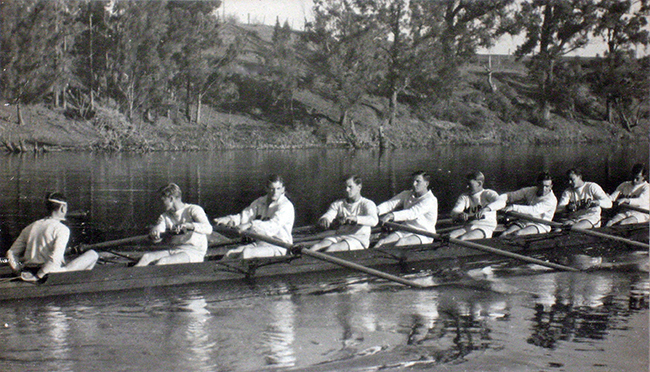
MUBC Inter Varsity winning eight
Albert Park Rowing Club were successful in winning the Senior Premiership, and Footscray City Rowing Club took the Junior Premiership.
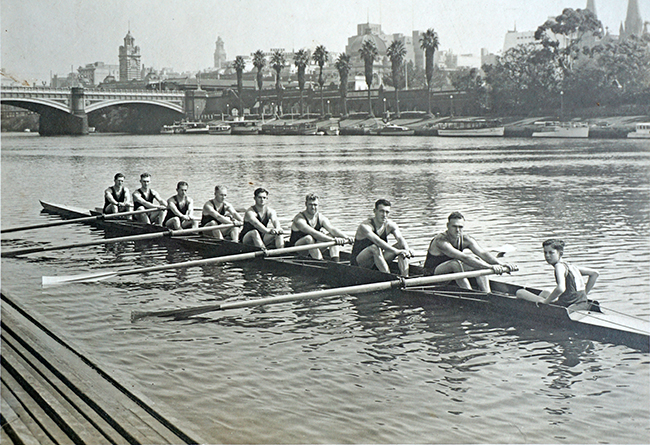
1939-40 Albert Park Rowing Club Senior Eight
Bow: K Anderson, 2: A L Cooper, 3: F Glover, 4: E M Lyne, 5: J Mearns, 6: J P Gaskin, 7: S J Elder, Str: M Gaskin, Cox: J Wiltshire
The women kept the Interstate Championships with the Interstate Four Championship continuing on the Port River in Adelaide. Victoria finished in last place.
1940-41
Under very disheartening circumstances, Victorian Rowing Clubs and their members continue to operate to the best of their ability to keep their beloved sport afloat. The call up and steady enlistment of oarsmen for military service overseas has been a challenge and cause for a good deal of worry and anxiety to family members and club executives. Dark times were indeed ahead, but the words spoken by Winston Churchill to the British Parliament during the dark days of the war of 1914-1918 ring true-
“There is no reason to be disheartened about the progress of the War. We are passing through a bad time now, and it will probably be worse before it is better. But that it will be better, if we only endure and persevere, I have no doubt whatever.”
As no regatta was arranged for Australia Day the South Melbourne Rowing Club arranged a function consisting of Combination Fours and Combination Pairs. An excellent afternoon’s sport was enjoyed and the quality of rowing was magnificent.
In the absence of Victorian Championship races, the Open Eight-Oared race was held on the Lower Yarra in April over two miles and was won by Footscray City Rowing Club.
The R.A.A.F. Regatta arranged by the Royal Australian Air Force Authorities for men of the Air Services saw an entry of 131 competitors and witnessed great racing. An Army regatta was also conducted.
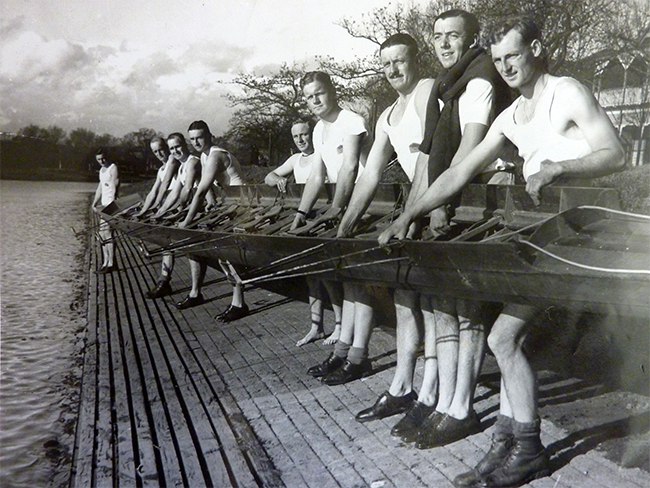
28 Armoured Regiment Crew at the Army Regatta 1941
Alan Jacobson, Frank Fogarty, Tom Fogarty, John McCallum, David Knox, Dr Mick Dunn, Ken Kennedy, Keith Laycock, Cox unknown
Scotch College were also victorious in the Head of the River Regatta. The Metropolitan Rowing Committee staged its Thirteenth Annual Regatta in November, attracting an entry of 145 competitors, and included Challenge Eights and Fours.
That these celebrations of rowing continued to be staged so successfully is a testament to the emotional and spiritual endurance of the Victorian Rowing Association during most challenging times.
Our women rowers maintained their Interstate Championship in 1941, but not thereafter. Victoria won the ULVA Trophy, their last win until 1966. A period of NSW women's rowing domination was to follow post war.
Such was the impact of the war and the paucity in numbers of women rowers generally, their Interstate Championships did not return until 1949.
1941-42
The spirit of Victorian Rowing was tested in earnest this season as the state of international affairs continued to deteriorate, and more and more clubs were forced to “shut up shop” until peace was once again the order of the day. Despite this, participating clubs and members continued to do their best to ensure the health of the sport survived and would flourish once the war was over.
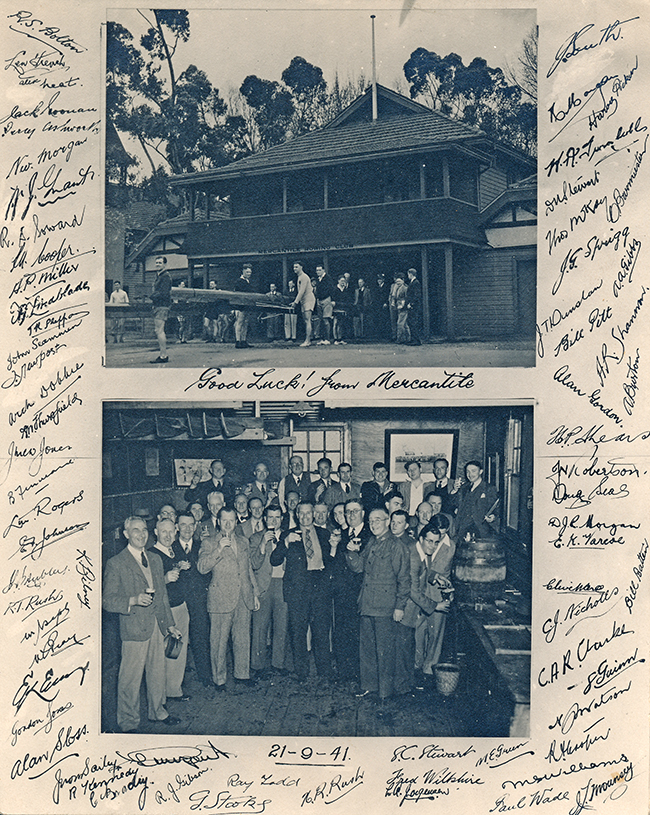
Clubs sent cards to their serving members such as this one from Mercantile
What could not be ignored however, was how quick returning oarsmen made their way to the banks of their respective clubs once they had returned from serving oversees. Such tendencies highlight the strength of the oarsmen’s identity through tumultuous times.
112 entries were received for the Victorian Rowing Association’s one organized regatta in April. The Upper Yarra Regatta Association modified its programme to the extent that it comprised only Challenge Pairs and Combination Fours. The South Melbourne Rowing Club conducted a highly successful regatta on the Yarra in January, and the winning trophies were donated by the President and Vice President of the club. The proceeds were donated to the “Sporting Globes” and “Fags for Fighters Fund.”
In June, the United Services Regatta Association held a regatta for Service Crews not at the time on their battle stations, and comprised Eights, Fours, Pairs and Sculls.
To compensate for the absence of Championship Races, arrangements were made for an Open Eight-Oared Race to be held in April over a two mile course on the Lower Yarra, open to all classes of oarsmen. The event was won by Footscray City and would continue to be staged until wartime had finally ended.
1942-43
Regardless of many clubs being unable to function due to members of Victorian Rowing being greatly depleted, the sport of rowing was still being carried on. Enlistment of oarsmen for active service grew from 542 to 779. Club Executives and members worked tirelessly year round to keep clubs afloat and their efforts were highly regarded.
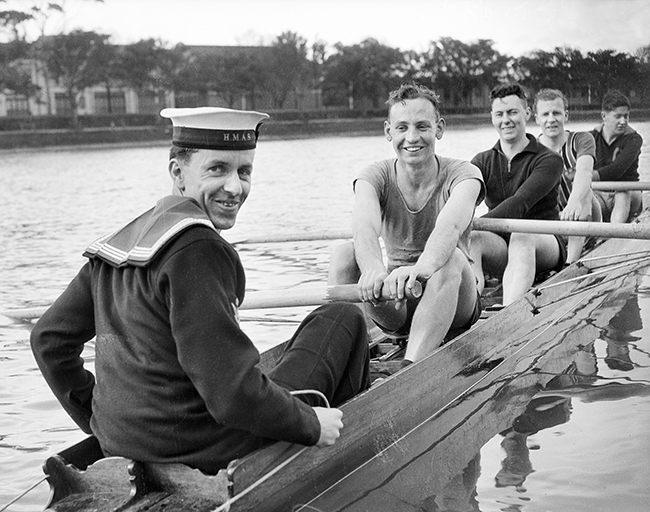
On leave down on the Yarra Christmas 1942
Cox: Colin Wilkinson, Str: Arthur Atkins, later awarded DFC for his piloting of Lancasters over enemy Europe with the RAF, 3: unknown, 2: S Anderson, Bow: unknown
In spite of these challenges, the Association was able to successfully stage a regatta which saw sixty six competitors in February, and the Upper Yarra Association again conducted its annual regatta in April. The Metropolitan Rowing Committee was also credited with providing racing opportunities with the staging of their regatta in March.
The Open Eight Event was held over a mile course on the Lower Yarra in May, and was won by the crew from Melbourne Rowing Club. The United Services Regatta Association also held a regatta for Service Crews in May, attracting an entry of 117 competitors and an entry of eight crews in the eight-oared event.
1943-44
Taking the current affairs of the world into consideration, the consensus amongst the Victorian Rowing Community was that the position of the sport was a good one, and would not experience much difficulty in picking up where it left off when the world would return to its normal mode of life. That being said, five years of conducting the sport of rowing in Victoria during wartime proved to be an incredibly demanding feat, and members of the Victorian Rowing Association were eagerly awaiting positive developments in the Allied Nations’ battle against the Axis Powers.
Boosting spirts was the number of Victorian comrades in the Services who were able to visit their respective clubs, and in doing so were assured that the sacrifices they were making on Australia’s behalf were deeply and profoundly appreciated.
This season regattas were conducted by the Victorian Rowing Association, the Upper Yarra Regatta Association and Metropolitan Rowing Committee. The Open Eight-Oared, Four-Oared and Pair-Oared Events were rowed over a mile course on the Lower Yarra, providing ample opportunity for oarsmen who were not enlisted in the services to race and delightful entertainment for rowing enthusiasts to enjoy on the banks of the Yarra.
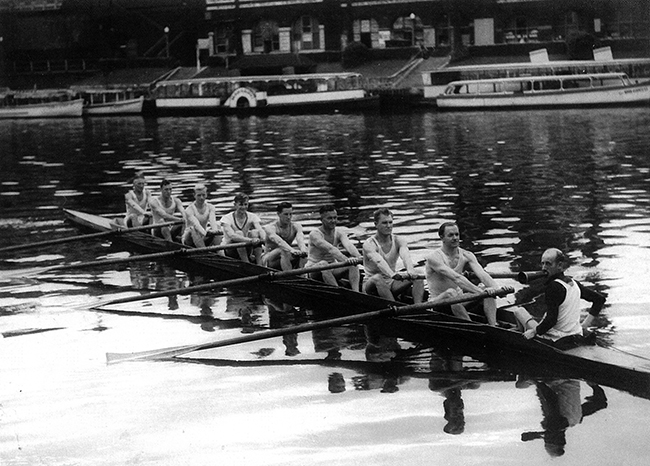
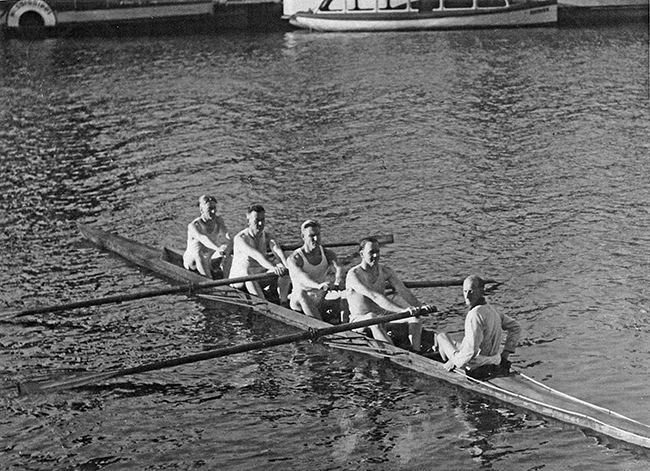
Melbourne Rowing Club's 1944 open eight and four - both stroked by Ken Grant of future WA fame
On a sombre note, this season the death was witnessed of President Sir Stephen Morell, who had held the office with dignity and distinction since 1936. A distinguished member of the Melbourne City Council and former Lord Mayor of Melbourne, he was an active and successful oarsman in his racing years and upon stepping out of the boat, fully committed himself to the administrative side of the sport and the assistance of novice and senior oarsmen alike for the rest of his days. His work on behalf of rowing and the Yarra River was legendary. The sport had an active supporter with Sir Stephen. His work was recognised during his lifetime with the Monier construction Bridge at Anderson Street being named in his honour.
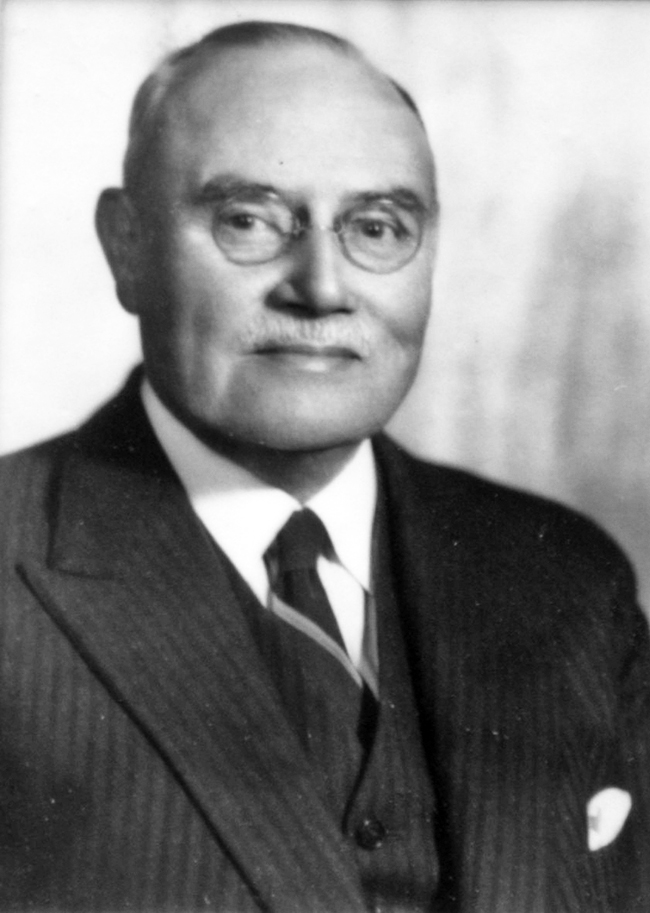
Sir Stephen Morell
The invisible influence behind the scenes who protected the interests of Victorian rowing
1944-45
One cannot discuss the rowing-related highlights of the 1945 season without first acknowledging the palpable sense of relief experienced by oarsmen and civilians alike as a consequence of the victory gained by the Allied Nations after nearly six years of war. Thus began the steady return of serving oarsmen to Australia, civil life and the rowing families to which they belong. There were those that gave their life away in defence of the land of their birth, and left the Victorian Rowing Community with treasured memories and the ultimate examples of committed sportsmen.
Appendix 6 to this history contains the author's best list of serving rowers (well over 1000) and those who died. The list is very large.
The annual report also reported as follows. Many of our oarsmen comrades in the services have returned to Australia and a number of them have either gone back to civil life or are in the process of returning thereto. To these your Committee on your behalf, offers sincere congratulations on their safe return to theri homeland. Many have yet to return, and their advent is being abxiously awaited by the Clubs to which they belong, and it is certain that a warm welcome awaits them. Unfortunately there are some who gave their all for the land of their birth, and for those they loived so dearly. For those we are left with treasured memories of splendid comrades and thorough sportsmen who played the game to the hilt and were prepared to play the greater game to the same extent.
The Secretary also made the following poignant comments which are still true today. To hope that there will be no more wars is to perhaps hope for the impossible, but it is hoped that the aggressor nations will think wisely and well before again deciding that armed might can triumph over right. If they do this it is felt that there will be a long era of peace in which to mould a new and better world.
The season in question, in its limited capacity, was considered a successful one. The only organised regatta scheduled by the Victorian Rowing Association was in February, with a programme consisting of Novice Pairs, Fours, Lightweight Fours, Challenge Fours, Pairs and Handicap Sculls. The event attracted an entry of 130 competitors and was held in ideal weather conditions.
Furthermore, the Upper Yarra Regatta Association conducted its annual regatta in January and a successful and enjoyable function was the result. To provide more opportunities for oarsmen to race, the Beaufort Division Rowing Club, and Nestanglo Rowing Club in turn organised racing events throughout the season.
A crew worth discussing was the R.A.A.F. eight oared crew, who after the surrender of Germany in May, 1945, was formed in England and raced at Henley-on-Thames in July. The Australian representatives, featuring M Hutton, H A Jowett and coach L Rentoul from Victoria, finished second to Imperial College in the final of the race for the Danefield Cup, substituted for the usual Grand Challenge Cup. A full scale regatta was impossible and so racing was conducted on one day only, over a shortened distance of about one mile starting at the barrier, with three crews abreast. There were only three events, for specially presented trophies. The Open Eights race for the Danesfield Cup attracted 23 crews, including two RAAF crews. It was a narrow miss from repeating 1919 Henley Peace Regatta win by the AIF No 1 crew. After the racing at Henley on Thames and following some crew changes, the R.A.A.F. crew were victorious in the final of the eight-oared race at Hammersmith Regatta by a canvas from Barnes Club, and a week later won the open eights at Weybridge Regatta. Spectators reported the Australian crew demonstrating eight-oared rowing at its best.
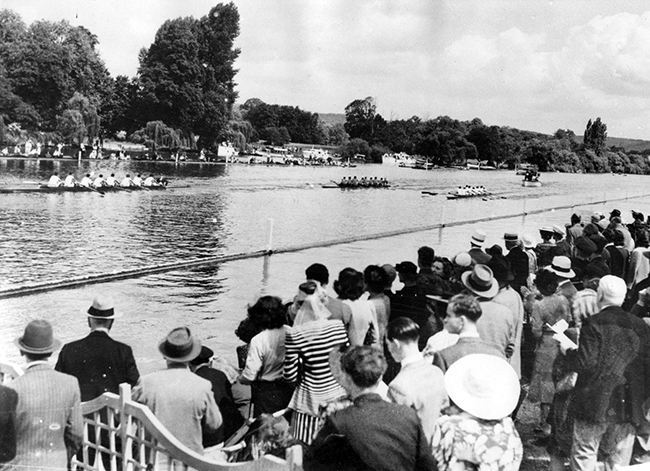
1945 Henley Regatta with three crews across on a shortened course
1945-46
Life for Victorian oarsmen and their families looked set to return to a level of normalcy not seen for many years this season, as with very few exceptions all who ventured to war had returned to Australia and were back in civilian life. The majority of them once again becoming active members of their clubs and participating in the return to racing throughout the domestic calendar.
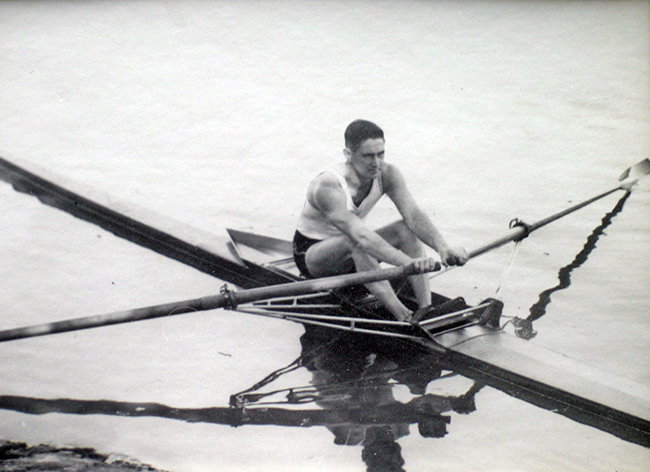
1945 Herald Shield Winter Sculling winner Keith Bilney of Mercantile
Keith went onto be a noted coach of scullers in Victoria
After not featuring for six years because of the War, the first post-war Australian Eight-Oared Championship and Australian Sculling Championship were rowed this year. Victoria undoubtedly started the post-war era of Australian rowing as a dominant force. The eight-oared crew were credited with a triumphant row to win the coveted King’s Cup by one and three quarter lengths from New South Wales. The crew contained may influential people in post war rowing. For example it was stroked by Richmond's Wally Lambert who was to lead many Victorian crews post WWII, laconic Jack Webster from South Melbourne in the bow seat who became a 1948 Olympian, Melbourne's Jack Mulcahy in the six seat who assisted many Victorian crews and clubs for decades afterwards, Ken Grant in two seat who moved to WA and became their leading coach and of course Ray Todd as coach who continued his noted coaching career. Unfortunately the Victorian representative in the President’s Cup, Ron V Rawlins of Melbourne Rowing Club, had no choice but to withdraw upon suffering a poisoned heel and leg before the race.
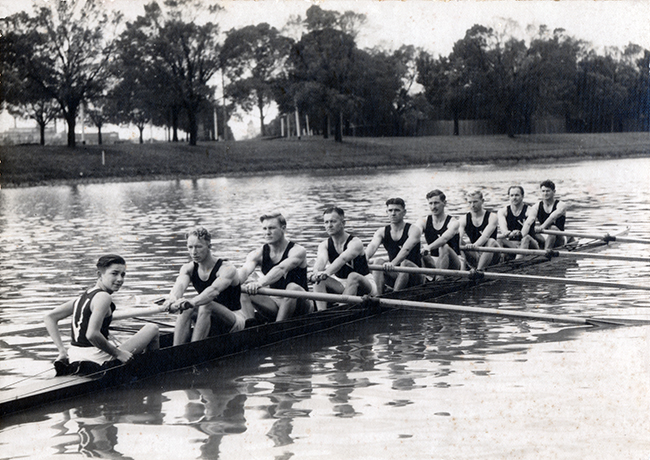
1946 Victorious Victorian Men's Eight
Bow: Jack W Webster, 2: Ken D Grant, 3: Richard J Boynton, 4: A Hugh G Clarke, 5: Les A J Wilkinson, 6: Jack J Mulcahy, 7: Michael L Foote, Str: Walter J Lambert, Cox: Peter Wilding, Coach: W Ray B Todd, Selectors: Lachlan J Thompson, Jack South and coach, Mgr: Harry E Butler
Moreover, the Melbourne University Boat Club crew of bow: M J Scriven, 2: M G Whiteside, 3: James M Ferguson, 4: K B Nelson, 5: W L M Armstrong, 6: H Stretton, 7: J A McCallum, Str: Colin D Smith, Cox: A L Bennett, Cch: Gerry J Duane were successful in winning the Oxford and Cambridge Cup at Mannum, South Australia, in the first Australian Universities’ Boat Race since 1940, owing to the War. Their stroke man went on to represent Australia in 1948 Olympic Games.
1946-47
The 1947 season was a most pleasing year for the Victorian Rowing Association.
Victorian Rowing was undoubtedly in a healthy condition, owing to club memberships jumping dramatically from 906 to 1382 over the year. The standard of rowing at regattas, which were well attended, was excellent.
After being absent since 1940 owing to the War, Victorian oarsmen were relieved to see Championship Rowing resume. Consequently the events were well supported and proved to be memorable for athletes and spectators alike.
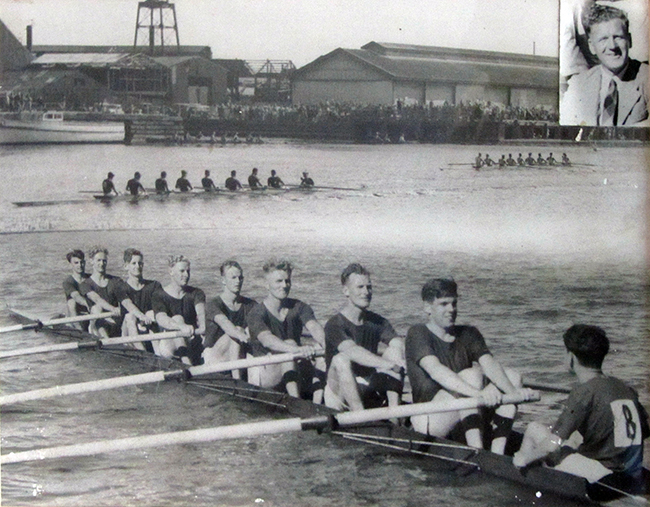
1947 Victorian Champion Eight from Corio Bay - 22nd Feb 1947 on the Lower Yarra
Bow: D Bridges, 2: S Rau, 3: R Wilson, 4: S Thomas, 5: G Craven, 6: R Barrow, 7: Tom Hoffman, Str: Ian Everist, Cox: D Salmon, Cch: Albert Bell
The Senior Premiership was won by Corio Bay Rowing Club without significant competition, but the Junior Premiership proved to be a battle right up to the Champion Junior Eight-Oared Race in April. The decisive win by Mercantile in the race saw them clinch the Premiership in spectacular fashion, seeing off the campaigns from Melbourne and Mildura Rowing Clubs. The crew contained several future Victorian oarsmen and future VRA and Rowing Australian President Bob Aitken.
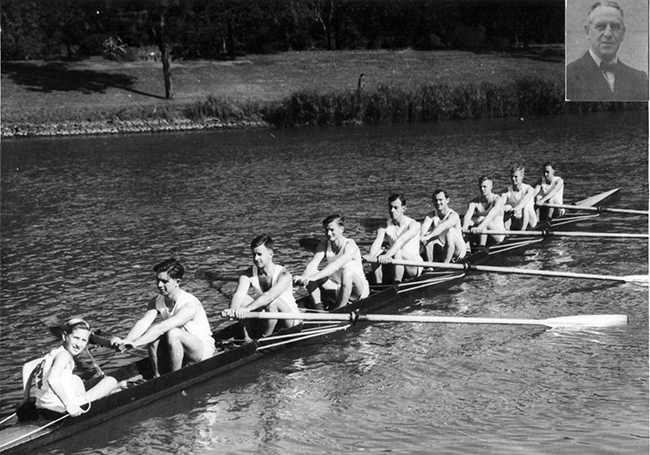
1947 Victorian Champion Junior Eight from Mercantile
Cox: B Jeffries, Str: Herb Shears, 7: J S Neil, 6: Robert R Aitken, 5: Laurie M Moll, 4: J Farmer, 3: Harry Duncan, 2: J Fletcher, Box: B Johnson, Cch: P M Wade
The King’s Cup Regatta was held on the Swan River, Perth in May. Following multiple postponements due to increment weather, the race had to be rowed on a two mile course in Crawley Bay, an inlet of the Swan River, to ensure states would make it back home in suitable time.
The Victorian Eight have a grand exhibition of rowing throughout the race, establishing an early lead in the race only to lose it to the tenacious crew from New South Wales. The stroke man Walter Lambert responded bravely to lead his crew back to the front, eventually winning by one and a quarter lengths. Tasmania had the misfortune of being swamped by the wash of a passing motor launch and suffered irreparable damage to their boat, consequently not finishing the race. Ron V Rawlins sculled well in the Presidents Cup but was unable to challenge Merv T Wood from New South Wales for victory.
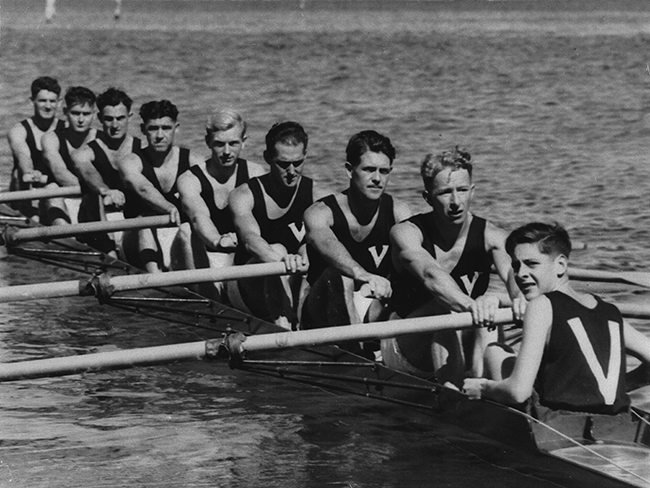
Winning 1947 Victorian Crew
Bow: Jack W Webster, 2: C Gibbs, 3: Kenneth A McWilliam, 4: Les A J Wilkinson, 5: Richard J Boynton, 6: L G Slorach, 7: Hugh T Lambie, Str: Walter J Lambert, Cox: David R Salmon, Coach: W Ray B Todd
Worth highlighting was the excellent hospitality the Victorian team received from Swan River Rowing Club, who took the Victorians for a run around the beaches and nearby beauty sports of Perth, as well as looking after them splendidly in their boat house. Significantly, for the first time in the history of Victorian Rowing, the Eight and Sculler were both transported by air.
1947-48
Perhaps the most important rowing event of the 1948 season was the Olympic Test Race held at Ballarat in January. The winners of their respective events would be honoured with the chance to represent Australia at the Olympic Games in London.
Victoria were successful in what was described as a gruelling four-oared race, winning by three-quarters of a length from New South Wales. The crew comprised of J W Webster from South Melbourne Rowing Club, C D Smith of Melbourne University, H T Jamie of Banks, and W Lambert representing Richmond Rowing Club. The crew was coached by W Ray B Todd, also of Banks Rowing Club. Unfortunately the crew were unable to make a measurable impact at the Games, finishing second in the Losers’ final.
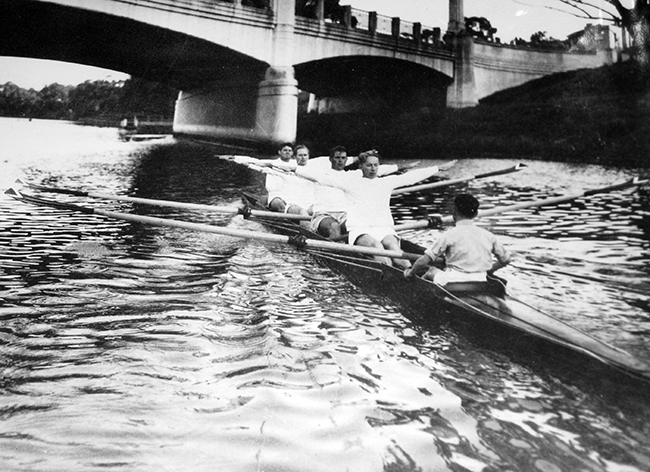
Coach Ray Todd was ahead of his time with rowing drills. In the image above, the 1948 Olympic four does what became known as a "Toddy", named of course after their coach.
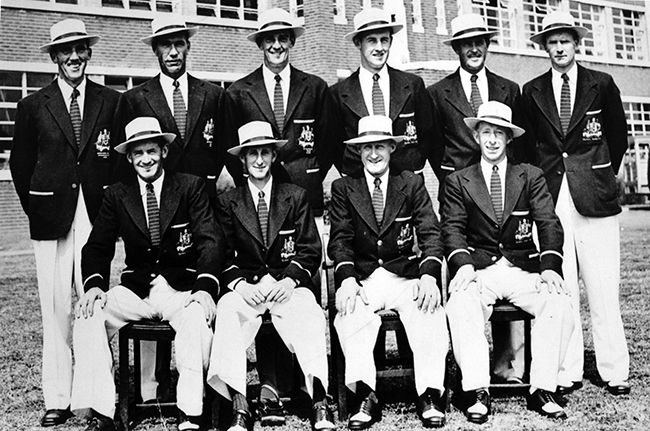
1948 Olympic Rowing Team
Back row: Ted Bromley (NSW), Spencer Grace (NSW), Merv Wood (NSW), Bruce Goswell (VIC), Hugh Lambie (VIC), Colin Smith (VIC)
Front row: Jack Webster (VIC), Tom Darcy (VIC), Ray Todd (VIC), Wally Lambert (VIC)
Also held at Ballarat was the Interstate Lightweight Four-Oared race in which New South Wales saw off the Victorian Challenge.
Domestically, the Senior Premiership was won easily by Corio Bay Rowing Club, whilst Banks secured a straightforward win in the Junior Premiership. With a view to encouraging rowing in the country centres, It was decided to institute an event for Provincial Fours at Ballarat coinciding with the Test Races, three entries were received of which Corio Bay were the victors. After having lapsed for some years, the Albert Park Lake Regatta was revived and witnessed incredible support and assistance.

Interestingly, the King’s Cup Regatta rowed on the Derwent River at Hobart in April almost never happened, as increment weather and poor communication caused a great deal of confusion amongst state crews as to when or whether at all they should launch to race.
When the race eventually got under way, Victoria were unfortunate in that their 6 man, R B Barrow, collapsed approximately half way through the race and again as they approached the finish line, consequently finishing in last position. It was discovered post-race that he was suffering from a kidney infection.
1948-49
The season saw much competition and development in domestic competition and racing. The Senior Premiership was won by Melbourne Rowing Club after a keen struggle and a series of close races with Mercantile Rowing Club.
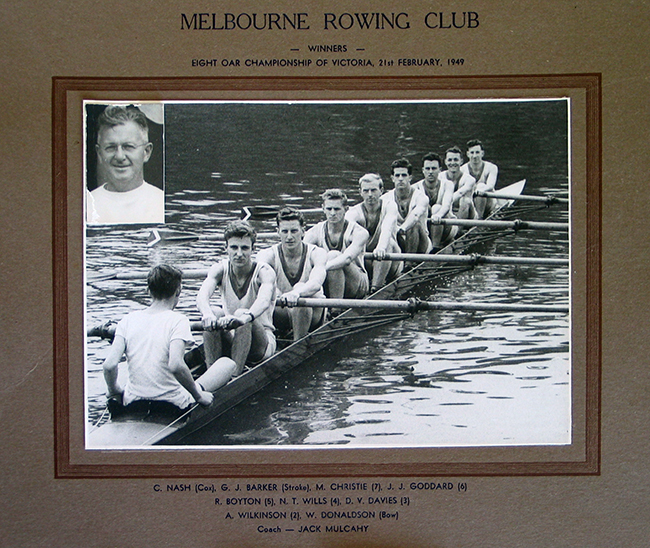
Mercantile however had no issue in winning the Junior Premiership. In accordance with the decision made at the Annual General Meeting of the Victorian Rowing Association the year previous, the first Lightweight Premiership was introduced and thus won convincingly by Corio Bay Rowing Club.
Moreover, two new Victorian Championship events were introduced during the 1949 season, the Championship Lightweight Junior Pairs and Championship Lightweight Junior Fours. The introduction of these many new championships, premierships and regattas were no doubt partly reasonable for the large increase in membership of the Victorian Rowing Association this season, increasing from 1316 to 1532.
In a proud moment for VRA Vice-President (and future President) Mick Williams, his son John won the Victorian Championship Scull and represented his State in the President's Cup. Merv Wood of NSW was too good for him in the Australian Championship race.
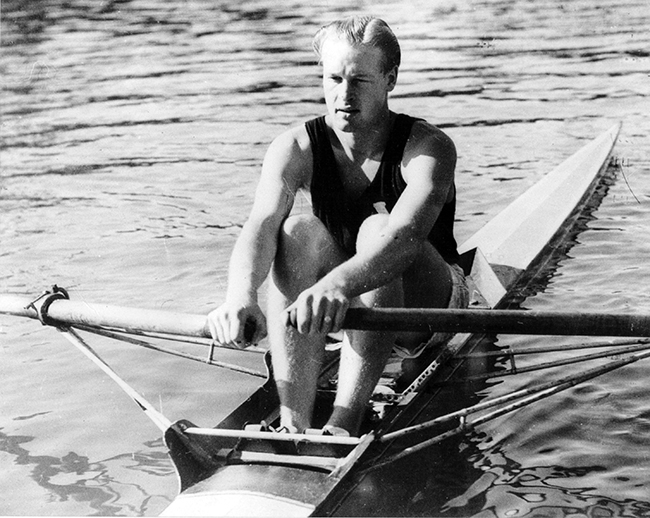
Victorian sculler John Williams
The Yarrawonga Rowing Club staged its first regatta in December on the Weir, which proved to be well organized and most enjoyable.
Victorian oarsmen, athletes and sporting enthusiast alike were thrilled to learn of the news that the 1956 Olympic Games were to be awarded to Melbourne. The foreshadowing of this magnificent event would keep rowers in Victoria keenly interested in their sport and association for the years leading up to the Games.
During the year, a suggestion was made that night rowing might prove successful in popularizing the sport. Thus, it was arranged that three crews row over a course from Queen’s Bridge to the Melbourne University Boat Club on a moonlit night, with extra lighting being furnished by the headlights of motor cards on the South Bank of the River. The supplied lighting did not prove satisfactory so the suggestion was put aside for the time being.
The King’s Cup Regatta was rowed at Murray Bridge in a strong headwind in May. New South Wales were in a class of their own, winning by four and a half lengths from Western Australia. Victoria were third, but worth highlighting was their tremendous exhibition of rowing over the final stages of the race to reduce a gap of three lengths to Western Australia to just a foot as the crossed the line.
The Women's Interstate Four Championship returned after a break over the war. They were held on the Town Reach of the Brisbane River in Queensland. Victoria was represented but finished last and were hampered by poor steering.
Footnotes
- Victorian Rowing Association annual reports
- Images from the Guerin collection which has been largely sourced from Victorian clubs
< previous Chapter 8
> next Chapter 10