

History of Rowing Victoria Inc
- Introduction
- 1: Rowing in a young Victoria 1838-1859
- 2: Formation of the Association 1860-1875
- 3: Growth of the Sport 1876-1889
- 4: Years of great success 1890-1899
- 5: The rise of Australian Henley 1900-1909
- 6: The War Years 1910-1919
- 7: Women's rowing and the modern era 1920-1929
- 8: The Depression Rebuild 1930-1939
- 9: War and rebuilding 1940-1949
- 10: Expansion years 1950-1959
- 11: The search for international success 1960-1969
- 12: Combining the Associations and lightweight success 1970-1979
- 13: The new national program 1980-1989
- 14: Golden years 1990-1999
- 15: Professionalism 2000-2009
- 16: Yet More Growth 2010-2019
- 17: Changing Times 2020-2026
- 1: Life Membership and other important awards
- 2: Patrons and Presidents
- 3: Office Bearers
- 4: Clubs and their histories
- 5: The Oarsmen's Centotaph and WWI Roll of Honour
- 6: WWII Roll of Honour
- 7: Premierships
- 8: State Championships
- 9: Hall of Fame Inductees
- 10: Victorian Olympians
- 11: International representation
- 12: Intercolonial and Interstate Racing
- 13: School rowing
- 14: University rowing
- 15: Histories of Victorian Rowing
- 16: Annual Reports
This chapter is under construction
Whilst State and National rowing associations had introduced professional administration from the 1980s, and professional coaches commenced at all levels during 1990s, the sport was professionally administered, coached and supported by 2000. Further, senior teams were fully funded by Sports Commission grants. The only people not funded were the rowers, although a medal reward program operated at the Olympic level. Regular athlete payments would need to wait until 2017 with the national training centres and the generosity of Hancock Prospecting and specifically Mrs Reinhardt who provided that athlete support.
Much of this progress had been accelerated by the home Olympics in 2000 with the desire that we needed not only the Games to be administered well, but our athletes needed to perform well.
1999-2000
Victorian athletes had it all to work for in the build-up to the Summer Olympic Games to be held on home ground in Sydney. The World Championships in 1999 were conducted in St Catherine's Canada where the highlight was the win by Victorians James Tomkins and Drew Ginn in the pair. Other Victorians to medal were Jason Day in the quad, Ben Dodwell in the four, Rachel Taylor in the pair, and Anthony Edwards in the lightweight four.
%20650.jpg)
1999 World Championships - Drew Ginn and James Tomkins enjoy their win in the pair
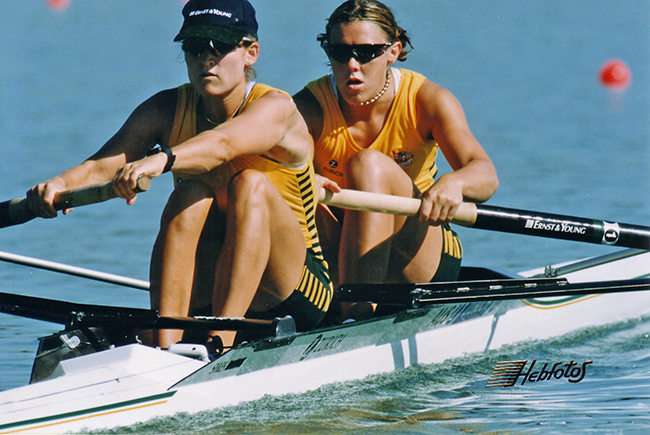
Rachel Taylor in the bow of the women's pair at the 1999 World Championships - Bronze Medalist
Expectation and excitement for the home Games were understandably high, given the performance of Australian Crews at the 1999 World Rowing Championships taking seven medals.
The selection process began at the National Time Trial at Penrith in December 1999, in which Victorian athletes were fastest in four of the events, setting the standard and outlining the strength of the VIS Rowing Programme. Following a period of intense preparation and training, it was back to Penrith for national selection trials held in conjunction with the National Championships at the Sydney International Regatta Centre, upon which the Games would be raced. At the end of a week of tumultuous weather, Victoria emerged to win the Zurich Cup at the Interstate Regatta.
Following further selection trials held in April and May, an impressive 15 Victorians were selected into the Sydney 2000 Australian Team.
Drama and heartbreak occurred at the World Cup in Lucerne, at which the reigning world champion in the Men’s Pair and Mercantile Athlete, Drew Ginn suffered a reoccurrence of a back injury and had no choice but to withdraw from competition. What followed could only be described as amazing as Mathew Long, who had missed out on selection in the Men’s Eight, took the seat of Ginn and rowing on bowside opposed to his natural stroke side, and won the World Cup. Following the team’s return to Australian soil and upon seeking medical opinion, Drew Ginn had to tragically withdraw from the Games and Mathew Long and James Tomkins were selected as the Men’s Pair for the Games. Drew no doubt immediately set his sights on the long road ahead for Athens 2004.
2000-01
Upon the culmination of the Sydney Olympic Rowing Regatta, the president of FISA proclaimed it to be the best Olympic Regatta ever, as excellent conditions saw history be made with Steve Redgrave winning his record breaking fifth consecutive gold medal.
Whilst there were no gold medals won by Australian Crews, this did not subtract from their inspiring and impressive performances. Victorians Mathew Long and James Tomkins claimed a bronze medal in the Men’s Pair. An astounding row was had by Michael McKay and Christian Ryan to claim silver in the Men’s Eight, as well as Anthony Edwards’s and Robert Richards Silver in the Lightweight Men’s Four, and Rachael Taylor’s triumphant silver Women’s Pair. Special mention must also be given to Katie Foulkes, Emily Martin, Jane Robinson, Bronwyn Thompson, Rachael Kininmonth, and finally Georgina Douglas for their fifth places finishes in the Women’s Eight and Single, respectively.
%20650.jpg)
2000 silver medal lightweight four stroked by Rob Richards and with Anthony Edwards in the two seat
Drew Ginn of the reigning “Oarsome Foursome” unfortunately withdrew from the Olympic Team due to a back injury but his contribution was not forgotten by the team. Nor was Peter Antonie, who announced his retirement from major competition. Drew Ginn and Nick Green’s efforts in conducting rowing seminars for local clubs and schools this season is also widely remembered and appreciated.
Another two medals were earned at the 2000 Non-Olympic World Championships in the women's lightweight quad with Victorian Eliza Blair in bow and the men's lightweight eight with Victorian Matt Russell also in bow.
This year was one of continuing progress for Rowing Victoria. The first National Selection Trials to be held in Victoria were conducted at Nagambie Lakes in March 2001 alongside the State Championships. This was an invaluable rehearsal for the National Championships to be held in 2002. The number of competitors at Victorian regattas continues to grow, worth nothing is the record 130 entries in the legendary Head of the Yarra Race.
Rowing remained a key program at the Victorian Institute of Sport and the partnership between Rowing Victoria and the VIS ensures that the ideals of the VIS program are enhanced through elite development athletes and the State Rowing Team. The VIS Head Coach, Noel Donaldson, took on an additional role in early February as the Rowing Australia National Men's Head Coach. The VIS affiliation with the national body stayed strong with both supporting coaching funding that has benefited the program.
The APS Head of the River made the historic move from the Barwon River to Nagambie Lakes in 2001. This regatta had been held continuously on the Barwon from 1948 to 2000, and prior to that alternating with the Yarra River as far back at 1879. The Head of the Schoolgirl regatta continued to grow and thrive under the leadership of Susie Palfreyman.
At the 2001 Interstate Regatta held on the Wivenhoe Dam in March, the Victorian Team produced some astounding results. The winning of the third consecutive Zurich Cup, proudly accepted by president Peter Fraser, occurred following wins in the Kings Cup, Governor General’s Plate and Wilkinson Cup.
%20650.jpg)
In the 2001 Australia Day Honours List, Corio's Bob Morell was recognised with a Medal of the Order of Australia for service to rowing, particularly in the development of masters' rowing as a coach and administrator.
2001-02
The 2001 World Championships on the Rotsee in Lucerne marked the commencement of a period of great success in women's rowing. Australia won gold in both the women's four, eight and lightweight quad. Melbourne Rowing Club member Jane Robinson raced in both the four and eight and Wendouree Ballarat Rowing Club's Emily Martin raced in the eight.
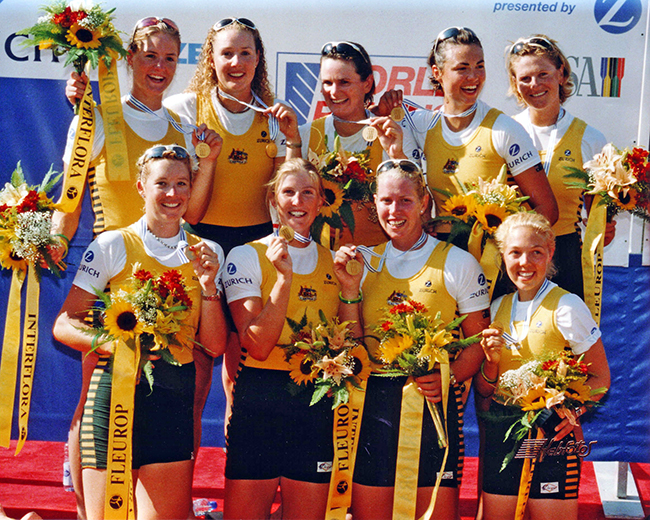
2001 World Champions, Jane Robinson centre back and Emily Martin front send from left
The Victorian Institute of Sport at this stage required its scholarship holders to race under VIS colours, not their Club colours. Therefore key races at the State Championships featured wins by the VIS. The State Championships showed the depth of Victorian rowing at the senior level with the elite women's events fought out by Mercantile and MUBC. The women's eights championships was won by MUBC with Mercantile taking out the men's eights championship. In the under 21 races, MUBC came out on top in both the men's and women's championships.
Geelong College girls took out both the Head of the Schoolgirls eights and the APS Girl's Head of the River, and Melbourne Grammar won the Boy's Head of the River.
In the Interstate Championships, Victoria won only the King's Cup but was competitive on all other races. This was sufficient to again take out the point score award for the fourth time in succession.
Hawthorn Rowing Club's Frank Dennis was recognised in the 2002 Queen's Birthday Honours List with a Medal of the Order of Australia for services to the hospitality industry, and to rowing, particularly through the Hawthorn Rowing Club.
2002-03
The 2002 World Championships in Seville Spain delivered not only a continuation of the great performances of the women, but also our first official para world championship gold medal, adaptive gold medal as it was then known. Victorian Hannah Every Hall stroked the lightweight women's quad and Jane Robinson again medalled in the women's eight along with fellow Victorian Rachael Taylor.
The APS Schools embraced Nagambie, drawing 9000 spectators before, during, and after the Senior Regatta, making it a memorable year for rowing in Victoria. The Geelong College achieved a remarkable double by winning both the boys' and girls' first eights. The girls' victory was expected and delivered in fine style, while the boys' victory came as a surprise with a negative split, an uncommon feat in school rowing. The stroke of the winning boys' crew from 2001 even dived in to celebrate with his sister, who stroked the winning girls' crew in 2003.
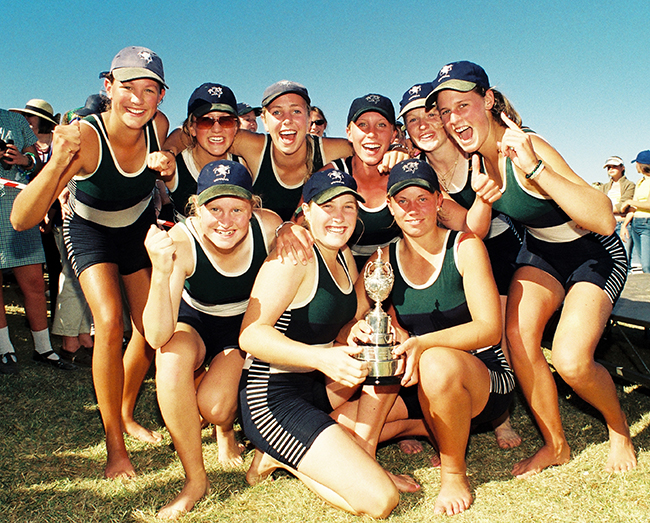
Geelong College winning both Heads of the River
The 19th Head of the Schoolgirls Regatta, sponsored by Sykes Racing and supported by the City of Greater Geelong and the Corangamite Catchment Management Authority, set new records for participation. With 1820 competitors, a 10% increase from the previous year's record, and 317 races over two days, the event was a success, thanks to the efforts of Rowing Victoria Officials, Herb and Roz Ellerbock, the event management team, and Geelong Rowing Association volunteers.
At the Interstate Championships, Victoria won the King's Cup but not any other race. NSW took the Rowing Australia Cup for the first time. The rise of NSW was evident for all to see.
Peter Fraser relinquished the Presidency at the end of this season after a five year term marked by great enthusiasm, professionalism and administrative competence. He did an excellent job and was ably supported by his Vice-Presidents Brian Vear and Eric Waller. His successor was Hawthorn Rowing Club's David Deeble who had done such a superb job making their annual Head of the Yarra regatta an iconic event, capable of being replicated annually with a high degree of competence and reliability. Again Eric Waller supported David well as his Vice-President.
2003-04
In 2003, Victorians Drew Ginn and James Tomkins proudly represented Australia at the World Rowing Championships in Milan, securing another gold medal. The women's quad scull containing Jane Robinson also won gold.
Notable highlights included the boys' and girls' heads of the river races at Nagambie Lakes. The boys' race saw Scotch College securing victory in a closely contested event, coached by Jeff Watt, who has now coached four out of five of the last Heads of the River. The girls' race witnessed Carey winning for the first time, breaking the Geelong Grammar/College monopoly. The Head of the Schoolgirls Regatta on the Barwon River attracted participants from various sectors and emerged as the largest single-sex regatta in the Southern Hemisphere, with Geelong College claiming victory in the Open School Eight.
For the first time is long period of time, Victoria did not win an Interstate Championship nor did it win the Rowing Australia Cup despite being competitive is all races.
The administration of the Association received a boost with the appointment of Grant Cosgriff as CEO in November 2003. Grant was a rising star in sports administration and his time a Rowing Victoria demonstrated that talent. Incoming President David Deeble continued the work of Peter Fraser and strengthened the administration of the Association.
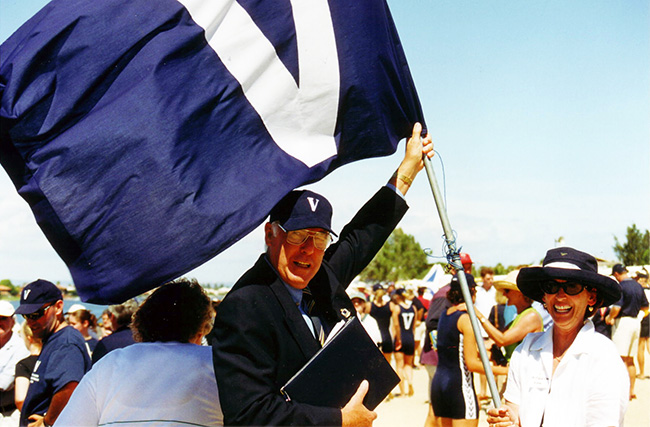
Peter Fraser in 1999
2004-05
Victorians Michael McKay, James Tomkins, Drew Ginn, Chris O'Brien, Anthony Edwards, David Crawshay, George Jelbart, Catriona Oliver, and Noel Donaldson represented Australia at the 2004 Olympic Games in Athens. The Games showcased outstanding performances by Victorian rowers, with gold for Ginn and Tomkins in the Men's Pair, silver for Edwards in the Lightweight Four, and bronze for McKay in the Men's Eight. These achievements added to the rich history of rowing in Victoria.
 650.jpg)
Drew and James celebrate with family after their win in the Olympic Pairs
Victorians Tim Smith and Marc Douez won bronze in the lightweight eights at the World Championships for non-Olympic events in Banyoles, Spain.
In 2005, Rowing Victoria experienced growth in all aspects of the sport, achieving notable results at the elite level and securing victories in prestigious competitions. Victoria proudly held the Rowing Australia Cup, in doing so claiming the Victoria Cup, Bicentennial Trophy, and the Queen Elizabeth Cup. Of note was the win in the Queen's Cup as it was the first of fourteen in a row. The Inaugural Victorian Rowing Open Day, supported by Sykes Racing and the Victorian Institute of Sport, successfully introduced over 400 newcomers to rowing.
The development of the Rowing Victoria Score (RVS) in collaboration with Sandy Mitchell and Herb Ellerbock marked a significant milestone in the 2005-06 calendar season. The RVS, addressing the needs of competitors, provides a flexible grading system, promoting lifelong participation in rowing. The initiative, eagerly awaited, considers age, racing distance, and frequency of wins to determine a competitor's RVS. This innovative approach reflects Rowing Victoria's commitment to transparent communication and continued development of the sport.
2005-06
The 2005 World Championships were a superb event for the women with gold medals in the four and eight, silver in the pair and bronze in the double. Victorians dominated the seats in the eight with Robyn Selby Smith, Emily Martin, Fleur Chew, Pauline Frasca, Sarah Heard, Lizzie Patrick and coach Bill Tait. Three of these rowers and coach were in the four. Marc Douez also coxed the gold medal winni9ng coxed pair. High performance director Noel Donaldson was very pleased with the results.
Given the change to a point score system, or as it is now known Grade Rowing, grade races were conducted at the State Championships for the first time. Despite some teething problems, it was received well and was a success.
The Rowing Victoria State Championships, including the Senior School Championships, were successfully held at Nagambie Lakes in February, featuring 720 boats and a total of 2603 seats. Rowing Victoria managed the Head of Schoolgirls Regatta and provided support for the Associated Public Schools (APS) Head of the River.
In 2006, Victoria's elite rowers achieved excellent results, securing victories in the National Youth Eight, Lightweight Quad Scull, and Women’s Eight (Queen Elizabeth Cup), with the Men’s Eight (King’s Cup) also performing exceptionally well. Congratulations were extended to the rowers, coaches, selectors, and support groups, with 20 Victorians out of a total of 80 Australian rowers achieving national selection.
The inaugural Head of the Schoolgirls' President Susie Palfreyman stood down at the 2005 annual general meeting and made way for incoming President Josie Millard. The record of Susie Palfreyman was exceptional in building the regatta to such importance. The incoming President Josie Millard, was a successful competitor in the first regatta in 1985.
%20650.jpg)
Josie Millard at a subsequent Head of the Schoolgirls Regatta address the VIPs
Acknowledging the vital role of volunteers, Rowing Victoria conferred Life Member Awards on Jim Lowe and Brian Vear for their outstanding contributions to rowing in Victoria. Jim Lowe had been finance director of the Association from 1989 to 2005, a superb contribution to the sport. Congratulations were extended to Jim and Brian for their dedication and commitment.
2006-07
The 2006 World Championships were held at Eton Dorney in the UK. The women's crews continued their successful run with two gold, two silver and a bronze medal. Victorians Robyn Selby Smith, Catriona Sens, Kim Crow, Sarah Heard, Emily Martin and Lizzie Patrick shared in that success. Drew Ginn returned to the pair with a gold medal, this time with Queenslander Duncan Free.
David Deeble handed over the Presidency to Andrew Guerin at 2006 annual general meeting as he prepared for greater things at Rowing Australia. Sadly for David and the sport, illness prevailed and this progression was not made. Sadly also Grant Cosgriff moved on in 2007 and the Association lost two good people in relatively quick succession. David and Grant had made excellent progress embedding systems and processes into the administration of the sport and most importantly, introduced the Rowing Victoria score system for grade rowing.
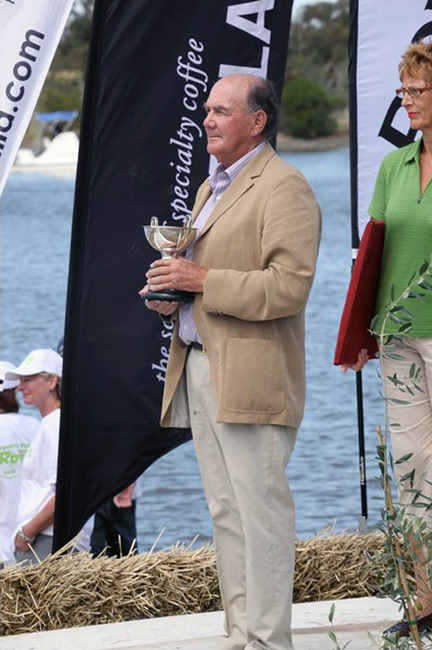
David Deeble in 2010 presenting the Nell Slatter Trophy
Andrew Guerin continued their good work and continued to add more professionalism and governance which by this stage was demanded of all sporting organisations.
In the 2006-07 season, rowing in Victoria experienced continued growth and development, attributing its success to the dedication of the Board, volunteers, staff, and the rowing community. Notable highlights include the implementation of the coxswain education program, increased participation numbers, the development of a Safety Code, higher participation in coaching courses, and successful performances by the Victorian state team at various championships.
Key achievements encompassed the conduct of the 2007 Australian Rowing Championship, the creation of the State Development Coordinator position, and the organization of the Club Development Workshop. Special congratulations were extended to the Victorian state team for their accomplishments at the Interstate Championships. This year spectators witnessed gallant performances from both the Interstate Men’s and Women’s Eights to claim victories for Victoria. As well as tremendous races in the Interstate Men’s Single Scull and Women’s Youth Eight which both saw Victoria triumphant. Needless to say, Victoria took home the Rowing Australia Cup.
A significant focus in the 2006-07 season was on development initiatives aimed at increasing participation and raising the standard of rowing in Victoria. These programs included "Starting Out," a grassroots initiative supported by funding from Sport and Recreation Victoria, targeting boys and girls aged 14-18 in schools without formal rowing programs. "Rising Athletes" aimed to accelerate the development of successful under 17 & 19 rowers, while "Tomorrow's Gold" focused on identifying and developing athletes for inclusion in national and state teams through coordinated elite underage training programs. The collaboration between Rowing Victoria, the SDC, VIS, and designated training centres aimed to provide a comprehensive program for elite underage athlete and coach development.
2007-08
The 2007 annual general meeting witnessed the election of Roger Wilson as a life member of the Association. Roger has been a rower, and long term school coach. However he is best known for been course commentator in Victoria, Australia and internationally for over 40 years. His commentary was a hall mark of Australian rowing.
The 2007 World Championships in Munich Germany provided Victorians with another chance to shine with Drew Ginn taking gold again in the pair coached by Chris O'Brien, Kathryn Ross became the first Victoria's Para rower medallist in the mixed double scull, Phoebe Stanley and Emily Martin coached by John Cumper took bronze in the four, and Alice McNamara took gold in the lightweight quad scull. Noel Donaldson was again high performance director and Dr David Yates Chairman of Selectors.
A noteworthy initiative involved Rowing Victoria and Melbourne Water developing a river education program aimed at promoting healthy waterways and altering litter behaviors within Melbourne Water’s jurisdiction. The program targeted school rowers, providing each rower with a distinctive reusable water bottle to reduce the use of disposable ones often left on the banks and in litter traps. The program engaged 27 schools and over 2000 school rowers.

Victorian Queen's Cup crew on the podium with the Governor-General
From the right: Lisa Szatsznajder, Robyn Selby Smith, Pauline Frasca, Fleur Chew, Kim Crow, Phoebe Stanley, Catriona Sens, Sarah Heard, Lizzie Patrick. Governor General in front
Victorian crews excelled at the Interstate Championships, with a special commendation for the dominating performance of the Queens Cup eight and the victory of the men’s youth eight. Congratulations were also extended to New South Wales for holding off a strong challenge from Victoria to win the King’s Cup. Sadly Victoria's ownership of the Rowing Australia Cup ceased with NSW taking the point score honours.
Given the reliance of the sport on its volunteers, President Andrew Guerin commenced a wide range of volunteer recognition initiatives. The most obvious were the commencement of prestigious annual awards. The William Waterfield Award for outstanding service to Victorian rowing, the Kath Bennett community rowing award, the Bob Duncan outstanding service to umpiring award, and the Susie Palfreyman outstanding service to school rowing.
2008-09
The season marked a period of reaping rewards from past efforts and strengthening foundations for even greater success.
Drew Ginn and David Crawshay emerged as Beijing Olympic Champions, with Ginn achieving the remarkable feat of a third Olympic title. Notably, Ginn triumphed despite a debilitating back injury that prevented him from getting into a boat between heats and the semi-final, showcasing incredible resilience. VIS head coach Chris O’Brien, who coached the pair, solidified his status as one of Australia’s most successful coaches.
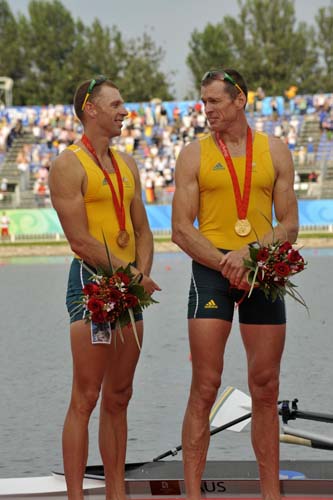
2008 Podium with Drew Gin on the left
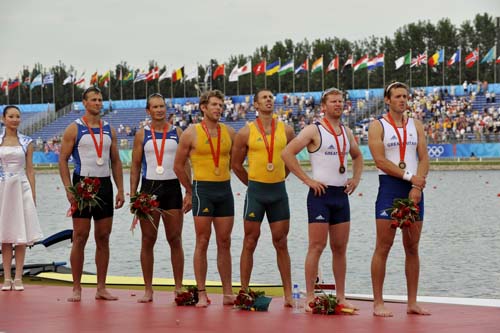
David Crawshay on the podium
Further celebration ensued with the exceptional silver medal in the four by James Marburg and Cameron McKenzie-McHarg, demonstrating well-deserved success. The disproportionate number of Victorians involved in racing and coaching Olympians underscored the state's significant contribution.The World Championships added another World Champion to the roster, with Alice McNamara securing gold in the lightweight quad. Lisa Szatsznajder earned a bronze medal in the under 23 lightweight quad scull.
At the Interstate Championships, Victoria emerged as the most successful state, although missing out on the King’s Cup to the state of New South Wales, to whom congratulations were extended.
Special mention was given to the Victorian team's outstanding performance, particularly the winning women’s eight, men’s youth eight, and men’s sculler, David Crawshay. Victoria won back the Rowing Australia Cup.
The 'Oars for All – Inclusive Rowing' program saw further development in collaboration with VicHealth and various community organizations. This initiative aims to enhance opportunities for participation across all levels of sport and active recreation, with a specific focus on individuals with disabilities and those from disadvantaged backgrounds. Throughout the season, a partnership was established with Victoria Police, Victorian Aboriginal Sport and Recreation, Melbourne Aboriginal Sport and Recreation, Yarra Yarra RC, and Carey Grammar School. A three-day learn-to-row program was offered for police and Aboriginal youths, seeking to forge connections between law enforcement and Aboriginal youth while providing an avenue for active recreation. The initiative was deemed successful by all involved.
The voice of Victorian rowing, Roger Wilson, was recognised with a Medal of the Order of Australia the Queen's Birthday Honours List for service to the sport of rowing, particularly as a media commentator, to business, and to the community.
Melbourne University Boat Club in September of 2009, celebrated 150 years of existence with a grand ball and a splendid written history. This was the first club in Australia to reach this milestone.
Footnotes
1. Primary source has been the Victorian Rowing Association annual reports - refer appendix 16
2. All images from the Hebfotos collection
< previous Chapter 14
> next Chapter 16