

History of Rowing Victoria Inc
- Introduction
- 1: Rowing in a young Victoria 1838-1859
- 2: Formation of the Association 1860-1875
- 3: Growth of the Sport 1876-1889
- 4: Years of great success 1890-1899
- 5: The rise of Australian Henley 1900-1909
- 6: The War Years 1910-1919
- 7: Women's rowing and the modern era 1920-1929
- 8: The Depression Rebuild 1930-1939
- 9: War and rebuilding 1940-1949
- 10: Expansion years 1950-1959
- 11: The search for international success 1960-1969
- 12: Combining the Associations and lightweight success 1970-1979
- 13: The new national program 1980-1989
- 14: Golden years 1990-1999
- 15: Professionalism 2000-2009
- 16: Yet More Growth 2010-2019
- 17: Changing Times 2020-2026
- 1: Life Membership and other important awards
- 2: Patrons and Presidents
- 3: Office Bearers
- 4: Clubs and their histories
- 5: The Oarsmen's Centotaph and WWI Roll of Honour
- 6: WWII Roll of Honour
- 7: Premierships
- 8: State Championships
- 9: Hall of Fame Inductees
- 10: Victorian Olympians
- 11: International representation
- 12: Intercolonial and Interstate Racing
- 13: School rowing
- 14: University rowing
- 15: Histories of Victorian Rowing
- 16: Annual Reports
This chapter is under construction
As foreshadowed in the previous chapter, both Victorian and Australian rowing blossomed in the 1990s culminating with the nation's best ever Olympic Games result in 1996 with two gold, a silver and three bronze medals. The 1992 Games results were also outstanding with two gold medals, our first sweep Olympic gold and our first Olympic double sculling gold.
Victorian rowers were integral to this success both on and off the water. Our rowers will be outlined below. Our off water contributors included Noel Donaldson, Brian Richardson, Brian Dalton and Lyall McCarthy as coaches, Reg McKay as Rowing Australia President, Dr David Yates as Chairman of Selectors, and Andrew Guerin as rowing team manager of both the 1992 and 1996 Games. There were many others of course but Victorians contributed substantially both on and off the water.
The other development which commenced in 1985, was the restoration of the Australian Henley Regatta. It was during the first half of this decade that the regatta hit the world stage with FISA being persuaded to hold a sculling World Cup at Australian Henley and on a river course.
1989-90
The season was marked by numerous highlights, spanning from the development of rowing in Victoria to the accomplishments of Victorian rowers in elite competitions.
The focus began with the success of Australian crews at the World Championships in Bled, the World Junior Championships in Szeged, and the Trans-Tasman Senior B series in New Zealand. The Junior Women's Four particularly stood out, securing a Gold Medal with a convincing win.
At the Interstate level, Victoria maintained its leading position with victories in the King's Cup, Penrith Cup, Wilkinson Trophy, and Victoria Cup events, along with second-place finishes in two other Interstate events at the Australian Championships held at Lake Barrington in Tasmania. Victorian Club and School crews also excelled, winning thirteen out of the forty-nine National titles contested.
The organisation and execution of the Australian Interstate and National Championships Regatta at Lake Barrington, despite initial challenges and unusual windy conditions, were commendable.
At the local level, recognition was extended to the Melbourne Amateur Regatta Association for organizing five international crews, contributing to the success of the Grand Challenge Cup at the Australia Henley Regatta. The vision of this organising committee was ‘to give Victorian and Australian rowing a boost by inviting international crews to compete at Australian Henley’. The costs were significant; nearly $60,000 was donated to the British, German and American clubs competing for travel costs. The restoration of this regatta was near complete.
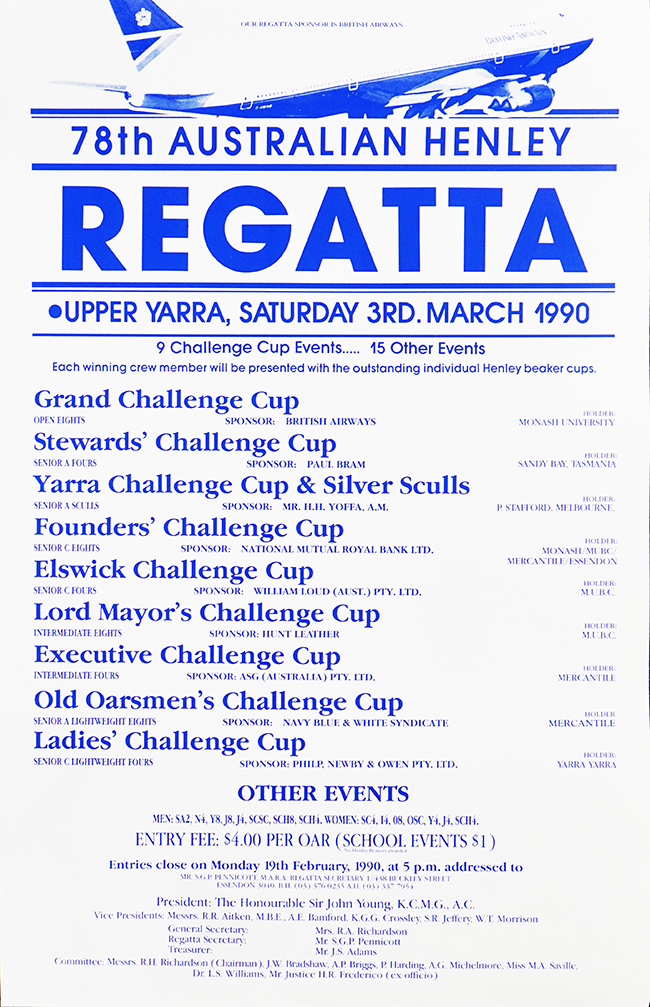
Several new innovations were introduced during the season, including the successful Pilkington Eight-oared Sprint Championship of Victoria for both men and women, conducted over 500 meters at the Melbourne Regatta, and prizes for winners of the State Premierships.
1990-91
The highlight of the season was the highly successful conduct of the World Rowing Championships at Lake Barrington in Tasmania, marked by Australia's unprecedented success with a gold, a silver, and two bronze medals, and five other finals contested. Victorian rowers comprised half of the Australian Team, contributing significantly to the medal-winning crews, including the all-Victorian Gold medal-winning Coxless Four.
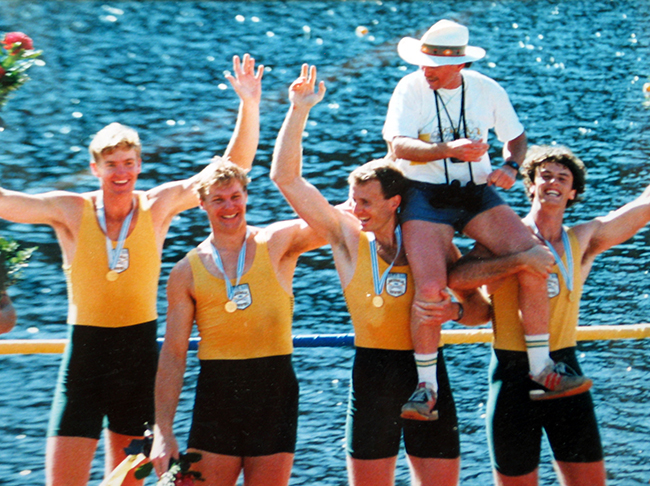
World Champion Four from Victoria
From the left: James Tomkins, Michael McKay, Sam Patten, Noel Donaldson, Nick Green
Victoria maintained its premier position at the interstate level, securing a historic win in the King's Cup and victories in the President's Cup and Victoria Cup events. Additionally, Victorian Club and School crews excelled, winning twelve of the forty-nine National titles contested.
Special recognition was given to Bank's Noel F. Wilkinson, who received Membership of the Order of Australia in the Queen's Birthday Honours list for his services to rowing administration and the Olympic movement.
1991-92
At 1991 Annual General Meeting of the Association, MUBC's Harvey Nicholson was election a Life Member of the Association.
The 1992 season saw notable developments and highlights from the achievements of Victorian Crews in Australia to the impressive performance of Victorian rowers in elite competition.
Special mention must first be made of the all Victorian Coxless Four of Nick Green, Mike McKay, Andrew Cooper and James Tomkins coached by Noel Donaldson, who won a Gold Medal at the World Rowing Championships in Vienna, Austria.
For the first time in seven years, the National and Interstate Championships were held in Victoria, at the National Water Sports Centre, Carrum, Victoria’s own world class rowing facility. Australian Crews had the privilege of welcoming competitors from Brentwood College, Canada. Victorian rowing stood out once again at the championships, exemplified by retainment of the King’s and Victoria Cup and also the Bicentennial Trophy for Women’s Youth Fours. Victorian Club and School crews were victorious in fourteen of the forty nine contested events. The achievement of Victorian Rowers did not go unrecognized amongst the wider Victorian Sporting Committee, with the efforts of the Men’s Coxless Four earning them the Herald-Sun Caltex 1991 Sports Star of the Year Award and the Victorian Eight winning the 1992 Vicsport Team of the Year Award.
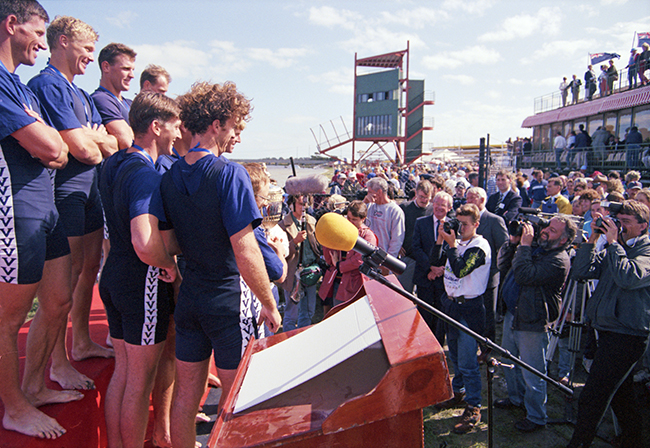
The new course at Carrum with Victorian crew taking the honours in the King's Cup
Many coaching courses and seminars were held in Victoria this year, enabled by the generous funding of the Department of Sport and Recreation and the Commonwealth Bank of Australia. Another highlight of the season was the success of the Ballarat Talent Identification Program hosted by Ballarat City Rowing Club. Mrs Kate Elliott was undoubtedly proud to receive a Prime Ministerial Women & Sport Awards Merit Certificate in recognition of her efforts.
This year, Roger B Wilson was honoured with the role of calling the Rowing events for ABC Radio at the 1992 Barcelona Olympics, of which many Australian Crews would go to battle in.
The Australian Henley Regatta continued to attract many foreign crew with the Lithuanians taking out the Grand Challenge Cup, the Japanese taking out the Lord Mayor's Challenge Cup and the University of California Berkeley winning the senior pairs.
Finally, it is worth mentioning the efforts of members of the Old Xaverians, Hawthorn and Richmond Rowing Club, who heroically combined on the Australia Day weekend to break the world record for longest distance rowed in 24 hours.
1992-93
This season will indeed go down as one of the proudest in Victorian Rowing’s history, with the special contribution of it’s oars people to the success of the Australian Rowing Team at the 1992 Barcelona Olympic Games and the greatest Australian result of all time at the World Lightweight and Junior Championships, as well as the securing of major sponsorships for the Victorian Rowing Association.
The all Victorian Men’s Coxless Four coached by Noel Donaldson, soon to be known as the “Oarsome Foursome”, as well as Peter Antonie in the Men’s Double Scull coached by Tim McLaren, did their state incredibly proud in Barcelona winning Gold Medals. Victorians Deirdre Fraser, Marina Cade, and Brian Dalton made up the Gold Medal winning Women’s Lightweight Four and Duncan Ashby was part of the Men’s Junior Pair who claimed a Silver Medal at their respective World Championships.
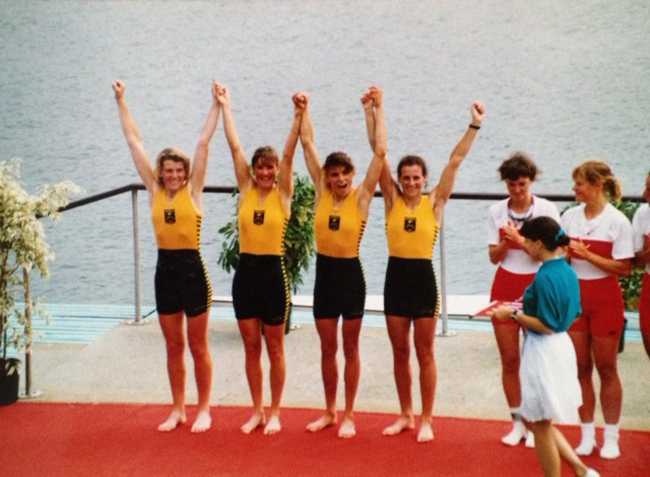
World Champion Women's Lightweight Four
From the left: Deirdre Fraser, Virginia Lee, Elizabeth Moller, Marina Cade
%20650.jpg)
\Olympic Champions Peter Antonie and Steve Hawkins
At Lake Wivenhoe, Queensland, Victoria cemented it’s premier position amongst Australian States in retaining the King’s Cup and Victoria Cup events along with a victory in the ULVA Trophy at the Interstate Regatta. Furthermore, Victorian Club and School Crews won eleven of the forty nine National Titles on offer at the Australian Championships.
The 81st Australian Henley Regatta was also, for the first time in the Southern Hemisphere, a FISA World Cup Race for single sculls. The Regatta was the first in a series of seven World Cup regattas for scullers to compete in throughout 1993, and therefore in addition to the 1660 competitors at Australian Henley, there were 54 entries from Australian and international scullers. Peter Antonie won the sculling event. The other highlight of the entries list was two British crews, Oxford University Boat Club in the Grand Challenge Cup and Eton College in the Senior A Pairs, who were assisted by primary sponsor British Airways in their journey to the Regatta.
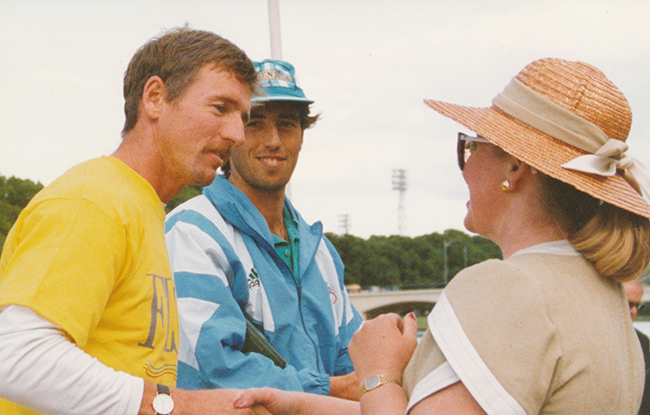
Peter Antonie being congratulated by Rosemary Richardson at Australian Henley
On the back of the successful season Australian and Victorian Rowing had enjoyed, the ensuing high profile of rowing in the nation helped secure sponsorship deals for the Victorian Rowing Association from Carlton and the United Breweries Limited, as well as the Victorian Health Promotion Foundation for the conduct of a regatta program and support for clubs through community open days.
At the 1993 Annual General Meeting of the Association, long serving Association committee man David Boykett, coach, selector and promoter of youth rowing, was elected a Life Member of the Association. His contribution to the sport was immeasurable.
In the Australian Day Honours List, MUBC's Nick Green was awarded the Medal of the Order of Australia in recognition of service to sport as a gold medallist in the Men's Coxless Fours rowing event at the Olympic Games, Barcelona 1992.
1993-94
This year Victorian oars people did not fail to shine at the highest level of national and international rowing, highlighted by the widespread success of the Australian national crews at the World Championships in the Czech Republic and Victorina State and Club Crews back home at the Australian Championships.
Nineteen Victorians were part of an Australian Team which brought back a gold and two silver medals in the Men’s Lightweight Double Scull, Men’s Lightweight Single Scull and Women’s Coxless Pair, respectively.
At the Interstate Regatta, Victoria continued making history retaining the King’s Cup, alongside winning the President’s Cup for the Men’s Single Sculls and the Noel F Wilkinson Trophy for the Men’s Youth Eights. Unexpectedly, Victoria were unsuccessful in continuing their sixteen year long succession of wins in the Victoria Cup for Women’s Lightweight Fours.
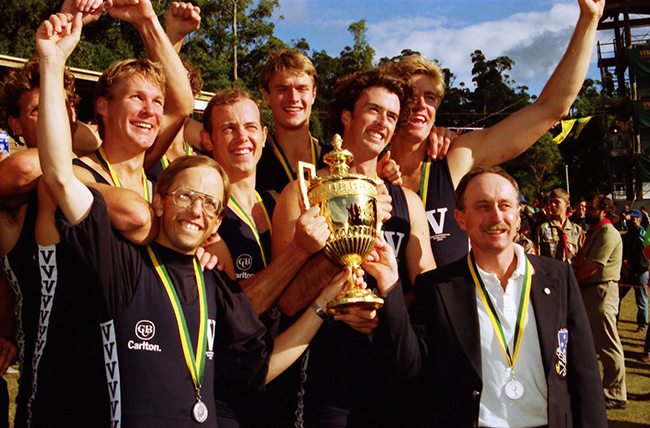
Winning Victorian King's Cup crew
At the National Championships Regatta held at Lake Barrington in Tasmania, Victorian Clubs and Crews won ten of the fifty two events on offer.
1994-95
Inspiration at the beginning of the season was not hard to find, as over 22 Victorian athletes and coaches featured in the successful Australian Rowing team at the World Championships in Indianapolis, USA. The Australian team returned home with a silver medal in the Men’s Lightweight Coxless Four, bronze in the Men’s and Women’s Coxless Pair, and a further bronze in the Women’s Coxless Four.
The Australian Championships were successfully held at Wellington Dam in Western Australia, in which members of Victorian clubs and crews were successful in winning twenty of the sixty two National Championships. Moreover, Victoria were triumphant in retaining the King’s Cup for the eighth consecutive year in a very close finish, alongside further wins in the ULVA Trophy for the Women’s Four and the Lightweight Men’s Four’s Penrith Cup.
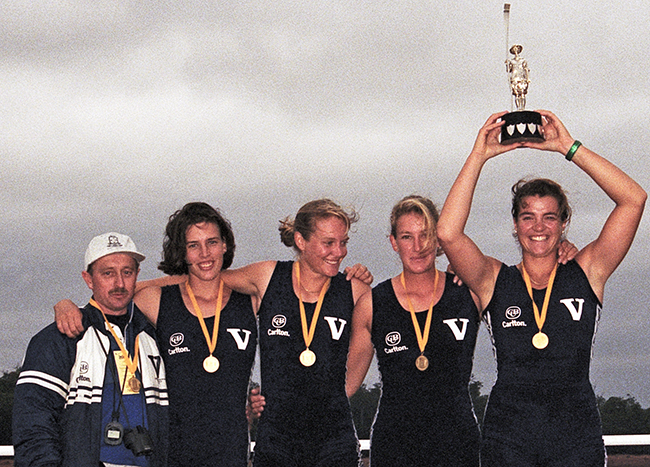
Victoria winning Interstate Women's Four Champions
Cch: Noel Donaldson, Bronwyn Thompson, Fleur Spriggs, Karina Wieland, Georgina Douglas,
1995-96
The 1995 Australian team contained many Victorians as usual. Sadly the team was riddled with problems which showed in the results. The finances of the team were a mess and after these Championships, the Australian Sports Commission withdrew their high performance funding which left Rowing Australia no choice but to hand over this area to the Sports Commission to run. A team of three people comprising John Boultbee, Doug Donoghue and Matt Draper ran the 1996 Australian teams.
However there were some highlights at the 1995 World Championships at Tampere Finland with wins in the women's pair and Victorian Rebecca Joyce in the women's lightweight scull. In the minor medals, Victorian Anthony Edwards won bronze in the lightweight double.
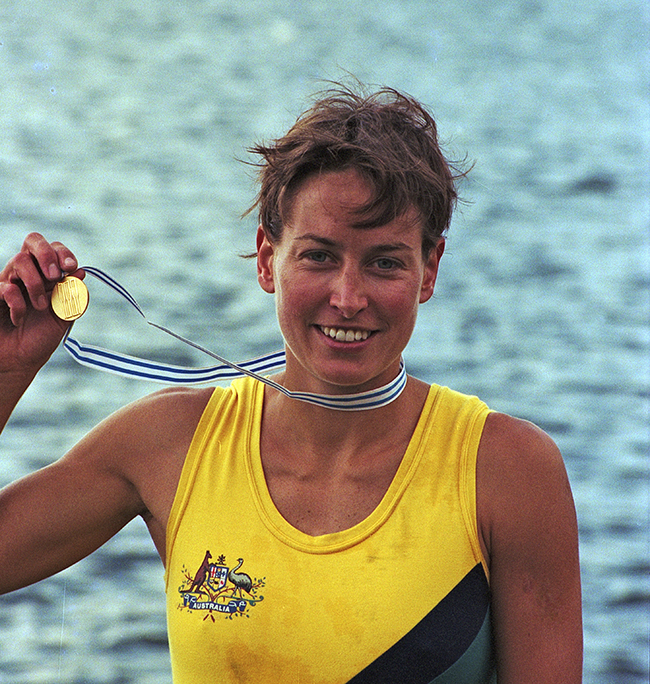
Rebecca Joyce is world champion in the lightweight scull
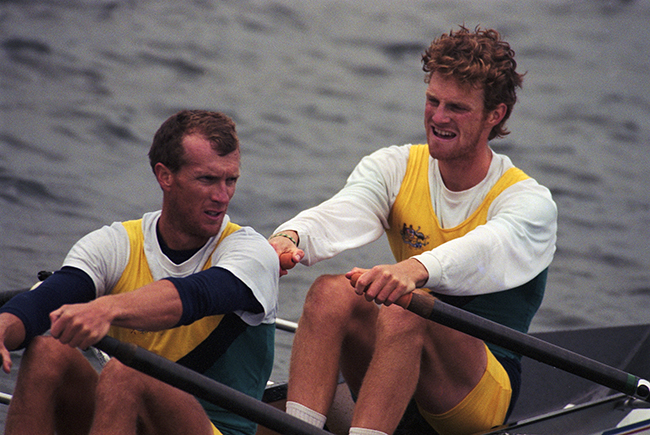
Anthony Edwards in bow seat takes bronze in the lightweight double scull
Further evidence of the strength of Victorian Rowing was to be found at the 1996 Australian Rowing Championships held at Penrith, the venue for the 2000 Olympic Regatta. Victorian rowers won or were part of 16 Australian titles, and the Interstate Men’s Eight extended their dominance in the iconic King’s Cup where Victoria claimed their 11th consecutive victory since 1985.
1996-97
The year 1996 marks the culmination of an unprecedented level of success for rowing in Australia, with Victoria continuing to set the standard for aspiring athletes. Mention must first be made of the remarkable success at the 1996 Atlanta Olympics, in which Australia claimed a record breaking haul of two gold, one silver and three bronze medals. The “Oarsome Foursome” of Victorians Mike McKay, Nick Green, James Tomkins and Drew Ginn along with their coach Noel Donaldson have firmly established themselves in the annals of rowing history. Special mention must be made of the many other Victorians who made up the team, Anthony Edwards, Jason Day, Georgina Douglas, Ben Dodwell, Jane Robinson, Bronwyn Thompson, Brett Hayman and Peter Murphy, the other Victorian coaches Brian Dalton and Lyall McCarthy, and Andrew Guerin in his role as Team Manager.
This was a truly legendary display of rowing in Australia, and has no doubt inspired many up and coming athletes to take to the water and dream.
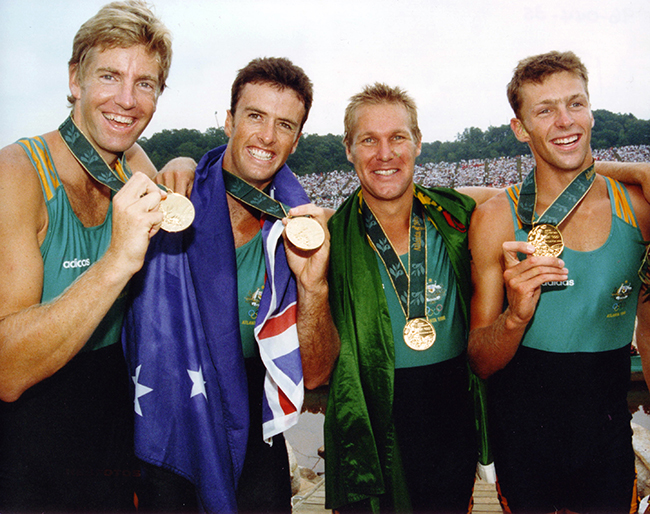
Olympic Champion Four from Victoria
From the left: James Tomkins, Nick Green, Michael McKay and Drew Ginn
Australian and Victorian rowing enjoyed a fantastic season, still likely riding the euphoria from the success of Australian Crews at the 1996 Olympic Games in Atlanta.
As well as having 13 title winning crews in the Australian National Championships, the Interstate regatta witnessed gallant wins in the Women’s Coxless Four, and Women’s and Men’s Youth Eights.
However, Victoria for the first time in 14 years, was unsuccessful in winning the King’s Cup, losing out to ACT in an exciting race.
Worth highlighting is the incredible work of Noel Donaldson and John Cumper with the Victorian Institute of Sport, who have contributed massively to the success of Victorian rowers on the international stage.
Mercantile's Drew Ginn was recognised with a Medal of the Order of Australia in 1997 Australia Day Honours List for service to sport as a gold medallist at the Atlanta Olympic Games 1996.
1997-98
At the 1997 Under 23 Nations Cup in Milan, Sarah Chibnell of MULRC claimed a gold medal in the Women’s Coxless Four, Tom Paul of MUBC took silver in the Lightweight Men’s Coxless Four whilst Noel Donaldson’s Men’s Eight comprised of five Victorians came in fifth place.
Incredibly, out of 38 athletes selected to represent Australia at the World Rowing Championships, 16 were Victorians, with 4 out of 10 coaches also coming from the Big V.
The spectacular Australasian regatta was held at the Sydney International Centre in 1997, and witnessed a team of nineteen Victorian athletes competing to win the Castaway Cup. Leading into the final day of the regatta Victoria led the race in terms of points and had the ultimate prize in their sights, however were overtaken by a strong NSW team as the racing came to an end. New Zealand claimed the Rusty Robinson Trophy with a two point margin over Australia.
On the 8th of March 1998, the Nagambie Lakes course was officially opened via an extravagant ceremony in front of a large crowd as a prelude to the National Championships. What followed was a memorable regatta held in flawless conditions and set the precedent for many future races to be held at Nagambie. The significance of staging such a well run regatta at a course that was barely completed upon the event’s commencement should not be understated.
At the 1998 Annual General Meeting of the Association, Hon Justice Hubert Frederico stood down as President after a very successful nineteen years in that role. He had seen through the amalgamation of the men's and women's associations, represented the association at all levels of government to great effect, overseen the growth and professional management of the Association with particular reference to school and women's rowing, overseen the creation of two new courses during his term, namely the new Carrum and Nagambie courses, the holding of National Championships at both these venues, and also personally pursued some projects which he deemed important to Victorian rowing such as the renaming of Jeffries Parade to Boathouse Drive to cement the position of the boat clubs. His legacy to the sport is still enjoyed today. Peter Fraser from the Banks Rowing Club took over the helm as President.
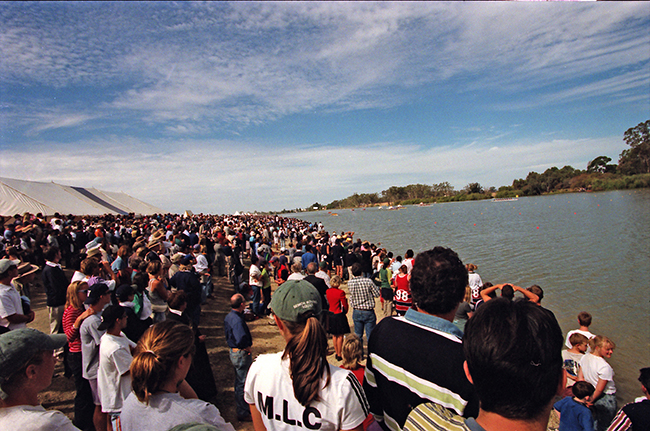
The view down the new course at Nagambie during the 1998 King's Cup race
1998-99
The best result from 1998 World Championships came from the Victorian Oarsome Foursome who were on the first year of their comeback racing in multiple events. They won the coxed pair and four and finished second in the coxless pair. There were only two other medals for the Australians, a bronze in the women's quad which included Victorian Jane Robinson and the men's lightweight four containing Victorians Anthony Edwards and Rob Richards, both from Ballarat.
As anticipation for the Sydney 2000 Olympic Games builds amongst Australian rowers, Victorians continue to put in inspiring performances at the State and International level.
Our State Team, led by Noel Donaldson, was competitive in all events at the Interstate regatta in Adelaide, recording 3 first and 4 second placings. Following this Victorian Rowing President Peter Fraser accepted the inaugural Zurich Cup on behalf of Victoria for the most successful state at the Interstate regatta.
%20650.jpg)
Peter Fraser receiving the Zurich Cup for the most successful state at the Interstate Championships
Moreover, 23 athletes and a further 4 Victorian coaches achieved selection to row for Australian Teams in 1999. The highlight of which being the World Championship gold medal won by James Tomkins, Drew Ginn and coach Noel Donaldson at the World Championships in St Catherine’s in August.
In April, the strength of the rowing programme at the Victorian Institute of Sport was highlighted as the Junior Development Squad, sponsored by Ausrowtech, displayed impressive performances at the Super 5 Championships in New Zealand. Held at the iconic Lake Karapiro, Victorian crews won nine of the eleven races they competed, in some nail-biting races that came down to the line. The success of the event and the program which enabled it highlights the positive working relationship that exists between Victorian Schools and Rowing Victoria.
At the 1999 annual general meeting. three members were elected to life membership of the Association, the Past President Hubert Frederico, Yarra Yarra's Ted Woolcock, and Corio Bay's Bob Morell.
Footnotes
1. Primary source has been the Victorian Rowing Association annual reports - refer appendix 16
2. All images from the Hebfotos collection
< previous Chapter 13
> next Chapter 15