

History of Rowing Victoria Inc
- Introduction
- 1: Rowing in a young Victoria 1838-1859
- 2: Formation of the Association 1860-1875
- 3: Growth of the Sport 1876-1889
- 4: Years of great success 1890-1899
- 5: The rise of Australian Henley 1900-1909
- 6: The War Years 1910-1919
- 7: Women's rowing and the modern era 1920-1929
- 8: The Depression Rebuild 1930-1939
- 9: War and rebuilding 1940-1949
- 10: Expansion years 1950-1959
- 11: The search for international success 1960-1969
- 12: Combining the Associations and lightweight success 1970-1979
- 13: The new national program 1980-1989
- 14: Golden years 1990-1999
- 15: Professionalism 2000-2009
- 16: Yet More Growth 2010-2019
- 17: Changing Times 2020-2026
- 1: Life Membership and other important awards
- 2: Patrons and Presidents
- 3: Office Bearers
- 4: Clubs and their histories
- 5: The Oarsmen's Centotaph and WWI Roll of Honour
- 6: WWII Roll of Honour
- 7: Premierships
- 8: State Championships
- 9: Hall of Fame Inductees
- 10: Victorian Olympians
- 11: International representation
- 12: Intercolonial and Interstate Racing
- 13: School rowing
- 14: University rowing
- 15: Histories of Victorian Rowing
- 16: Annual Reports
This chapter is under construction
10. Expansion years 1950-1959
Chapter 10 page 1 2 3 4
By 1950, rowing was again in full swing after WWII with clubs again having developed new rowers and the rowers from schools now entering into the Clubs after a normal school education.
Focus was now on both the Helsinki and Melbourne Olympic Games, and the Empire Games of 1950, 1954 and 1958. Plenty of opportunities arose for aspiring rowers. Further, the home Olympic Games in 1956 focused the community on Olympic sports with positive publicity.
The interest in rowing grew and so also the prestige of it. Whilst numbers grew, the relative strength of the sport continued to decline with the growth of the media coverage devoted to the big sports of football and cricket. The introduction of television for the 1956 Games did nothing to abate this relative decline.
The decline of the importance of the Australian Henley regatta was also noticeable. Some of the wise old heads at that time blamed the extremely long construction period of the Swan Street Bridge as part of the cause. They apparently added that the bridge itself blocked the once superb view up the course and so much of the vista and grandeur of the regatta was lost.1
1949-50
There was no shortage of rowing action this season for athletes and spectators alike with the addition of three new rowing events at Camperdown, Nagambie, and Bendigo. The Camperdown regatta in particular was a remarkable success, with a total of 253 participating oarsmen rowing on the magnificent course, a large lake in the crater of an extinct volcano.
Worth highlighting were the efforts of Bendigo Rowing Club in making strong efforts to resuscitate rowing at their centre, in time for the 1951 season in which Bendigo would be celebrating their centenary.
Unfortunately the Bairnsdale and Sale Regattas, which usually attract high quality competition, had to be cancelled due to abnormal rains which caused flooding that made the roads impassable.
Many significant races were held on Victorian waters this year. Lake Wendouree, Ballarat was chosen as the test venue to select who would represent Australia in the four-oared event at the British Empire Games held in New Zealand, in which the Haberfield Rowing Club from New South Wales were successful.
Similarly the King’s Cup was rowed over a course of two and half miles on the Lower Yarra in May, which provided competing oarsmen with perfect water, despite the grey skies and persistent showers.
Prior to the race, there was a parade of oarsmen led by the interstate eights and scullers and followed by local rowers. It was quite a spectacle.
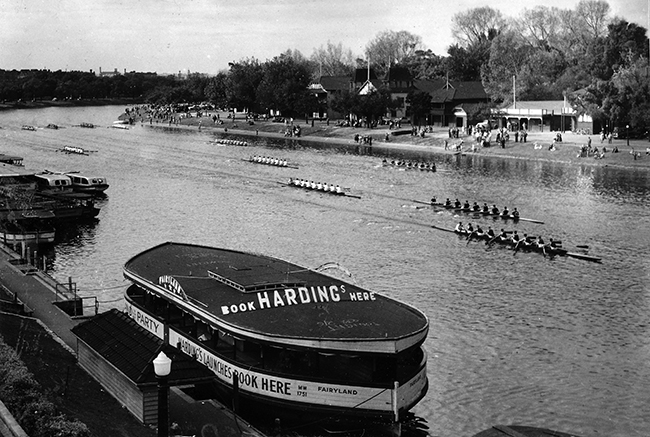
Interstate Competitors lead the Oarsmen's Parade
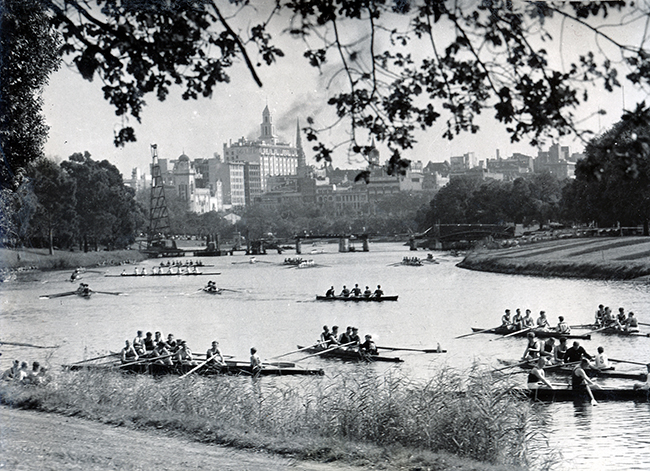
The start of the Oarsmen's Parade showing the partially constructed Swan Street bridge in the background
The Victorian crew, comprising oarsmen from Mercantile, Melbourne University, and the Melbourne and Preston Rowing Clubs, were unable to challenge the tremendous crew from New South Wales, who won comfortably with four and a half lengths, setting a course record on the Lower Yarra of 12 minutes and 40 seconds.
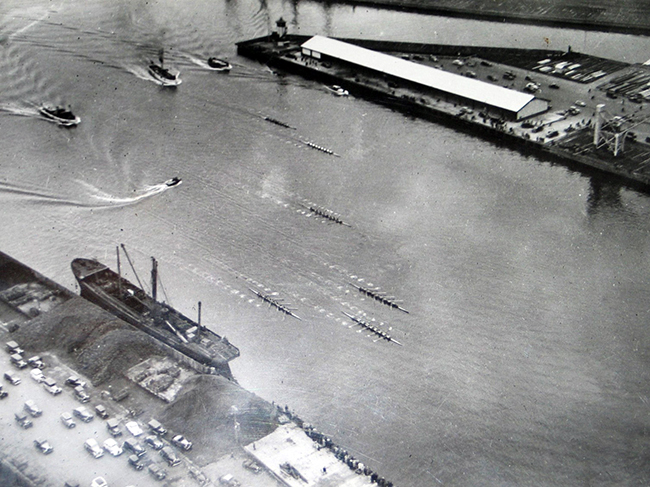
The finish of the King's Cup
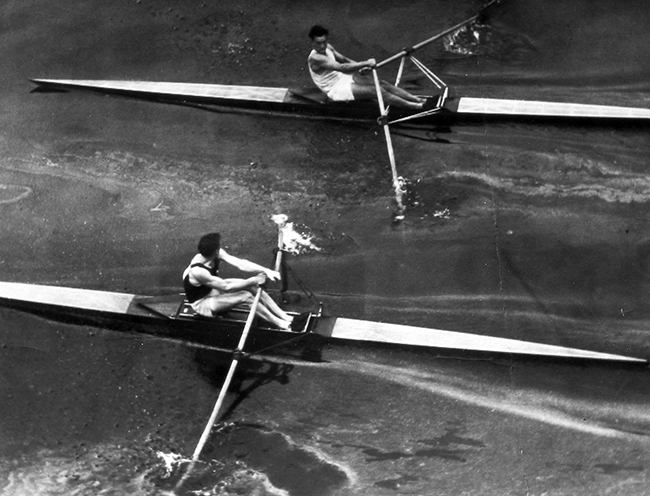
The fierce race between an injured Merv Wood and Victorian Ron Rawlins
Ron V Rawlins was but one foot away from victory in the President’s Cup, losing to the legendary Merv T Wood from New South Wales.
The women's Interstate Championship was conducted on the Parramatta River with NSW successful again in the four. Victoria finished in second place a length behind.
Finally, the Lower Yarra also hosted the Australian Universities Race for the Oxford and Cambridge Cup, in which Melbourne University stormed to victory with three lengths to spare on home waters.
1950-51
This season the Victorian Rowing Community grew with increasing an increasing number of members and participating clubs, including a new club formed at Yea. Members hence identified an increasing need for more country regattas and championship events, and it was decided to add the Champion Junior Four to the roster of Victorian Championship races.
The Championship races were spread around quite evenly.
Champion Eight - Mercantile
Champion Four - Corio Bay
Champion Pair - Preston
Champion Scull - Ron Rawlings of Melbourne
Champion 2000m Scull - Ron Rawlings of Melbourne
Champion Junior Eight - Banks
Champion Lightweight Pair - Mercantile
Champion Lightweight Four - Corio Bay
Champion Lightweight Eight - Nagambie
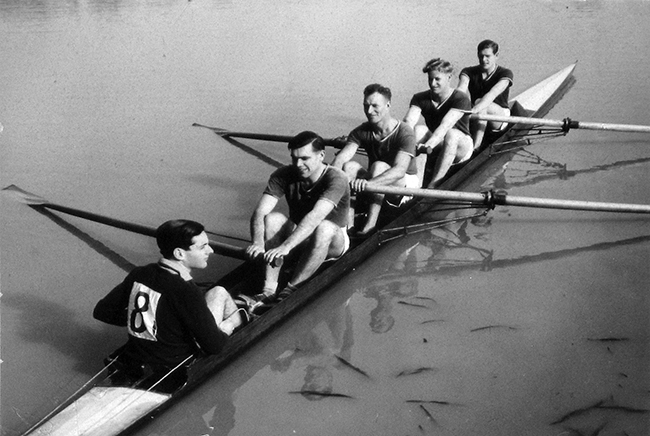
Corio Bay's Victorian Champion Four
Bow, P. N. Everist; 2, S. G. Thomas; 3, Tom G Hoffman; Str., Ian C. Everist; Cox., D. R. Salmon; Coach, Albert R Bell
Superb performances were observed from Australia abroad this year, including the first meeting of Australian and Amercian eight-oared crews at the Canterbury Centennial Regatta at Christchurch, New Zealand in January. The two crews met three times and the Australians won on each occasion. Worth mentioning was Mr M T Wood’s successful defence of his title to the Philadelphia Gold Cup against the American John B Kelly and A D Rowe of England, winner of the Diamond Sculls in 1950.
Oarsmen from Mercantile, Preston, Melbourne University and Corio Bay made up the 1951 Victorian King’s Cup crew. Despite finishing in second place, Victoria certainly made a remarkably fine effort in finishing only one and a half lengths in rough conditions behind the supreme New South Wales Crew, which bar the exclusion of one oarsman, was the same combination which defeated the University of California eight-oared crew abroad.
Ron V Rawlins rowed a brave race and represented Victoria proudly in the President’s Cup, finishing second to Merv T Wood, who won for the sixth successive time.
Normal transmission continued with NSW again taking out the women's four championship with Victoria in second place.
At the fifty-seventh Australian Universities Race for the Oxford and Cambridge Cup on the Huon River in Tasmania. Spectators couldn’t believe their eyes when the magnificent race ended in a dead-heat between Melbourne University and Sydney University, this being the first dead-heat in the history of the Championship. Simultaneously both crews broke the course record in a time of 14 minutes and 46 seconds.
1951-52
The strength of Australian and Victorian Rowing was never in doubt this season as many impressive performances were observed at home and abroad.
Close contests were once again the case in the battle for premierships, with Mercantile Rowing Club victorious in the Senior and Lightweight Premiership. The result of the Junior Premiership was in doubt until the last regatta, with Yarra Yarra winning the title from Banks and Mercantile. Significantly, this was Yarra Yarra’s first premiership.

Yarra Yarra's Champion Junior Four in December 1951 - first sweep oared championship win for 50 years
Bow: Jim Wilson, 2: Dave Evans, 3: Bill Burton, Str: Trevor Charles, Cox: V Good
Fans of Victorian Rowing were delighted at the events that unfolded at the King’s Cup Regatta, which was rowed over a three mile course on the Nepean River at Penrith, N.S.W, on a day when the weather was favourable. Victoria had the herculean task of racing the New South Wales crew, the holders for the last four years that would claim a Bronze Medal for Australia at the Helsinki Olympics.
New South Wales wasted no time getting away from the blocks, but were pursued by the brave Victorian crew. By the three-quarter mile mark, Victoria had drawn level and would soon take the lead. They matched New South Wales stroke for stroke mid race, before making their move over the last mile, ferociously crafting themselves a lead of four lengths to win in style. There was much debate in the press as to whether the Victorian crew should be substituted for the already selected NSW crew. To their credit, the Victorians Victorians took no part in this debate and recognised the NSW crew as the Olympic crew. The Australian selector Joe Gould maintained his faith in the crew. The crew had taken their travel injections just prior to this race and several had suffered badly from them including stroke Phil Cayzer.
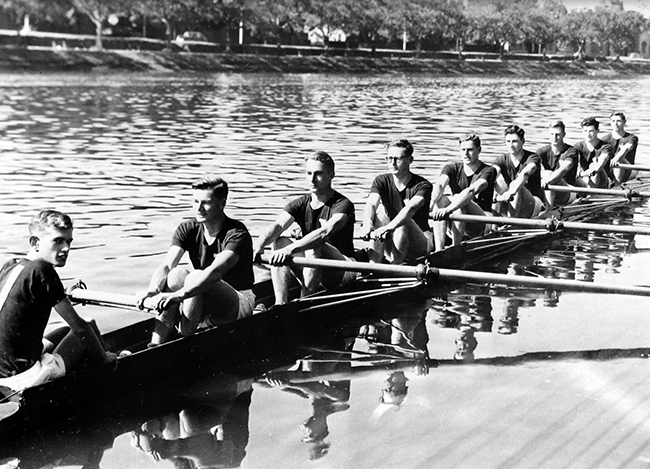
1952 Victorian Men's Eight
Bow: William L Wallace, 2: Brian J Doyle, 3: Harry D Duncan, 4: Warwick O Granowski, 5: P Neil Everist, 6: W Neville Howell, 7: A G (Paddy) Barrett, Str: Robert R Aitken, Cox: W Max Bailey
The Victorian women's four again raced at the Interstate Championship and sadly finished last. The regatta was conducted on Town Reach of the Brisbane River in Queensland.
Following this magnificent result, and the continued success of the Melbourne University Crew in the Inter-Varsity Boat Race at Murray Bridge, the future prospects of Victorian Rowing in the coming season were deemed to be very promising.
The Swan Street Bridge debacle
A bridge over the Yarra River at what was then Swan Street was conceived in the 1930s which explains its Art Decor design. The construction of the bridge was to be the first step toward the relief of traffic congestion in the city. It would provide an outlet along Alexandra Avenue for traffic that passes through the city on its way to Richmond and other eastern suburbs. Other bridges have been proposed at Russell street and William Street.
The Depression put an end to the start of the Bridge and it was deferred. By 1938, the Melbourne City Council approved construction of the bridge at a cost £50,000. However the commencement of the bridge was next delayed by WWII.
In 1948, finally construction began and caused considerable disruption to rowing and all river traffic. However postwar shortages of materials, contractors, skilled labour and even CRB engineering staff caused numerous construction delays. The Swan Street Bridge over the Yarra took five years to complete (1948-52).
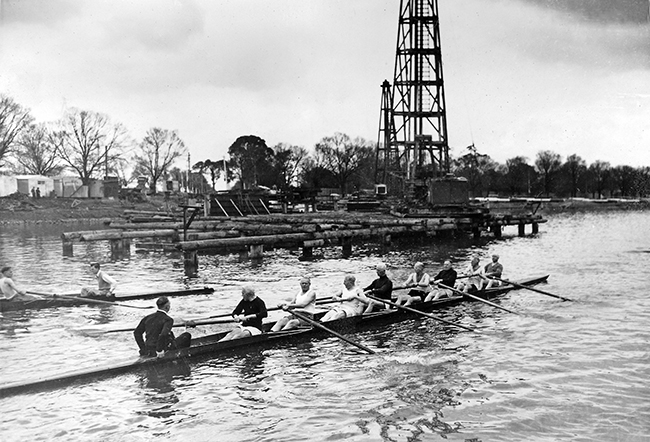
This 1949 image of the Mercantile over 60's crew rowing past the site demonstrates the level of disruption
The Australian Henley Regatta, already struggling to regain it's position on the Melbourne sporting scene after the Depression and WWII, particularly suffered. Many rowers of the 1950s rate Swan Street Bridge as the reason the regatta lost all its charm and much of its general public popularity. The construction phase and the loss of the sweeping upstream views were a great loss to the regatta.
The bridge finally was completed in 1952 much to the relief of rowers.
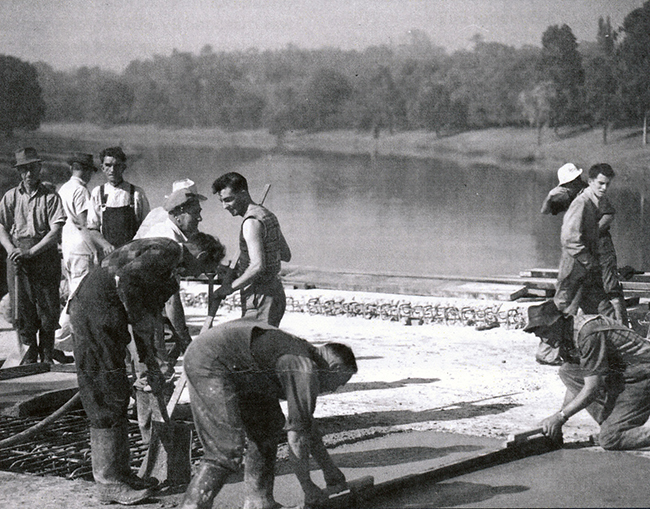
1952 - Laying the final layer of concrete on the Swan Street Bridge.
1952-53
Victorian Rowing had much to be proud of during the 1953 season, from the success of interstate crews and university teams, to astounding performances from clubs on the domestic scene. But perhaps the highlight of the season was the return of the Henley Regatta to the Yarra River.
With the completion of the Swan Street Bridge, it was made possible for the regatta to be resumed on the Henley course and returned to its Carnival Regatta, which proved highly successful with a large interstate entry and extensive attendance of an enthusiastic public. The resumption of the Henley Carnival did much to reawaken interest in the sport and spectacle of rowing.
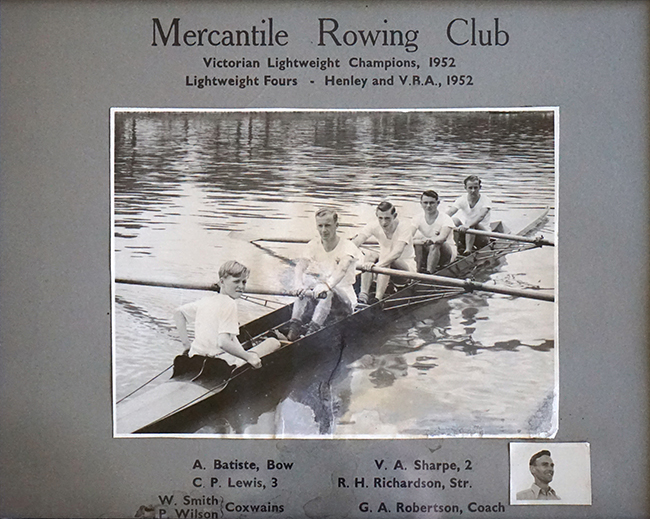
Mercantile Rowing Club achieved the remarkable feat of winning the Senior, Junior and Lightweight Premierships this season, the first club to win the Treble Premiership. Albert Park performed valiantly all season to place second. The Footscray City Rowing Club made a fine showing in the Junior Premiership in rising from a lowly place on the rankings two years prior to second in the aforementioned season.
The successful organisation and conduct of the State Championships throughout the season was helped tremendously by Messrs. Walsh and Nicholls, of the Little Ships Club, who attended all Championships in the Lower Yarra in Mr. Walsh’s fast motor launch, providing accommodation for the umpire and a safety precaution against accident to crews.
Melbourne University were once again victorious in the Oxford and Cambridge Cup over the three-mile race on the Nepean River at Penrith in June, whilst Geelong Grammar were successful in winning the Head of the River.
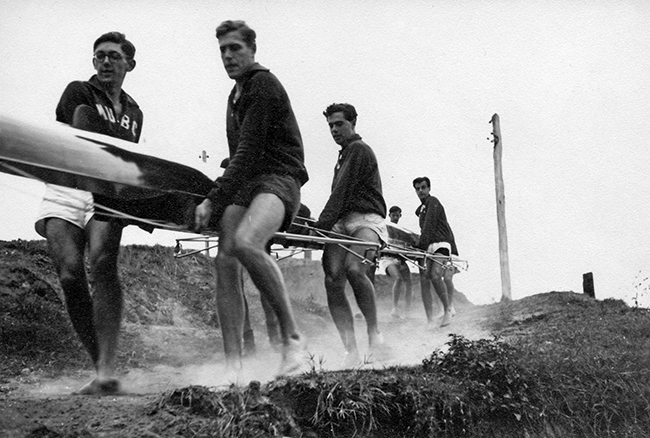
The Melbourne University crew at Penrith heading for the staging
Bow: Stuart N Johns, 2: J Tim C Hewitson, 3: Roderick H Carnegie, 4: M Frank A Robertson, 5: Adrian C Monger, 6: James C Howden, 7: John P Hall, Str: P Neil Everist, Cox: John N Button, Cch: David R Salmon
The season’s ultimate highlight was no doubt the King’s Cup regatta rowed on the Swan River, Perth. Conditions prior to the start of the race were poor but moderated as the crews approached the starting line. All crews got away cleanly, and Western Australia moved early to lead the Victorian crew. By the 2000 metre mark Victoria put a powerful move in the water to move clear, but were pursued by the keen crew from New South Wales. Victoria, underrating their challengers by 4 strokes per minute, comfortably saw off the charge, and when they eventually raised the stroke rate, cruised comfortably to a second consecutive victory in a time of 16 minutes and 20 seconds.
After the race all crews were the guests of the Legion of Oarsmen at a barbeque and dance held at the University Boat Club.
The women's Victorian Four competed at the Interstate Championships on the Parramatta River in Sydney. Alas the crew finished last again.
1953-44
There were many occasions on which the strength of Victorian Rowing was obvious during the 1954 season.
Domestically, the battle for Premiership titles amongst club was hotly contested and entertaining. Albert Park clenched the Senior Premiership from Mercantile Rowing Club, who instead were successful in the Junior and Lightweight Premierships, the latter of which was closely won over Corio Bay. Albert Park this season continued with their tenacious approach to competition in many regattas, and were rewarded for their efforts.
Melbourne University were triumphant in their race for the Oxford-Cambridge Cup on the Swan River, Perth. Geelong Grammar rowed an impressive race to win the Head of the River Race.
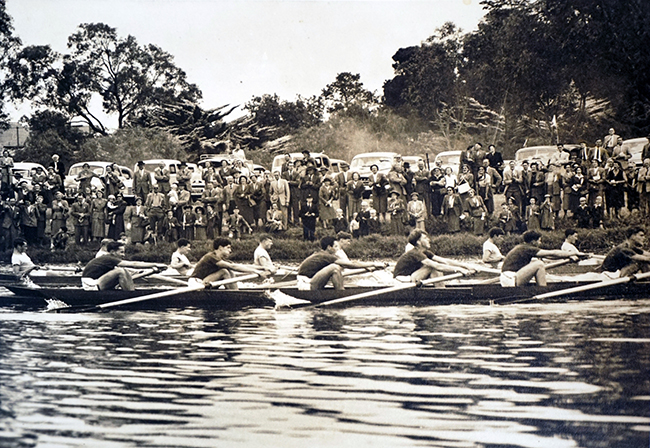
Eventual winners Geelong Grammar in the background, dispose of Wesley College in their heat
Bow: Ian C Kininmonth, 2: Andrew F Chirnside, 3: David R Clutter, 4: John B Sutherland, 5: Peter W Coy, 6: G F Collison, 7: Robin B Ritchie, Str: Ian G Urquhart, Cox: John F Mann, Cch: Roger M Blomfield
The formation of the High Schools Rowing Association during the year was encouraging for rowing in Victoria, in due response the Victorian Rowing Association included a Four-oared event for school crews on the programme for its Melbourne Regatta on Saturday the 20th of November.
With the objective of providing young oarsmen with experienced coaching and quality competition, a series of five events for Maiden Pairs was conducted during the Winter, with the points won by successful crews to count in the battle for the Junior Premiership.
However, the conduct of the Championship races were somewhat disrupted by shipping movements on the Lower Yarra.
Roy W Thursfield aptly managed the Australian crews at the 1954 British Empire Games, in which all crews incredibly won a gold medal.
Turning attention to the King’s Cup, the Championship was rowed on the Derwent River in Hobart, Tasmania and all states competed. Each crew made an impressive start, and after half a mile, Victoria maintained their bold rating of 38 to move out ahead of all other boats, and by half way had a comfortable two length lead. Coming into tumultuous conditions in the last half mile, Victoria showed excellent oarsmanship to maintain their boat speed and win the race in a record time of 14 minutes and 14 seconds, shattering the course record by 16 seconds.
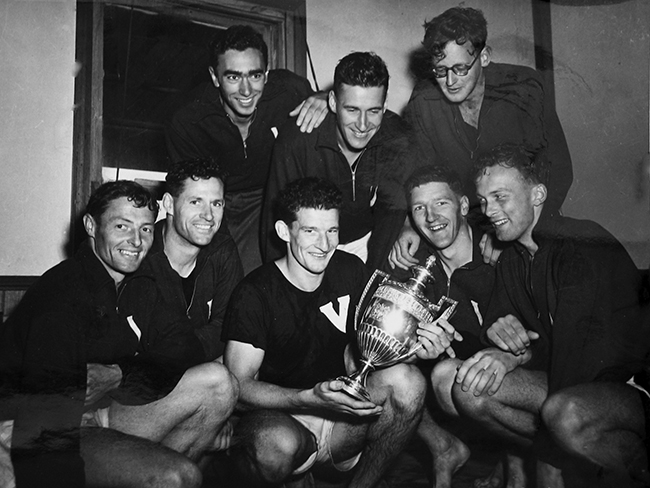
The victorious Victorian crew
Bow: Don M Christie, 2: Lloyd S Williams, 3: Adrian C Monger, 4: Warwick O Granowski, 5: Garth O V Manton, 6: W Neville Howell, 7: John S Rowe, Str: Brian J Doyle, Cox: J Bruce Mitchell
Sadly, the loss of the Victorian Rowing Association’s President Arthur J Shephard occurred this season. A lifelong member and for many years a vice president of Banks Rowing Club, Mr Shephard was a fine oarsmen and coach who contributed a great deal to the advancement of Victorian Rowing. Senior Vice-President Arch Dobbie took over the role. His tenure was also short as he too died a year later.
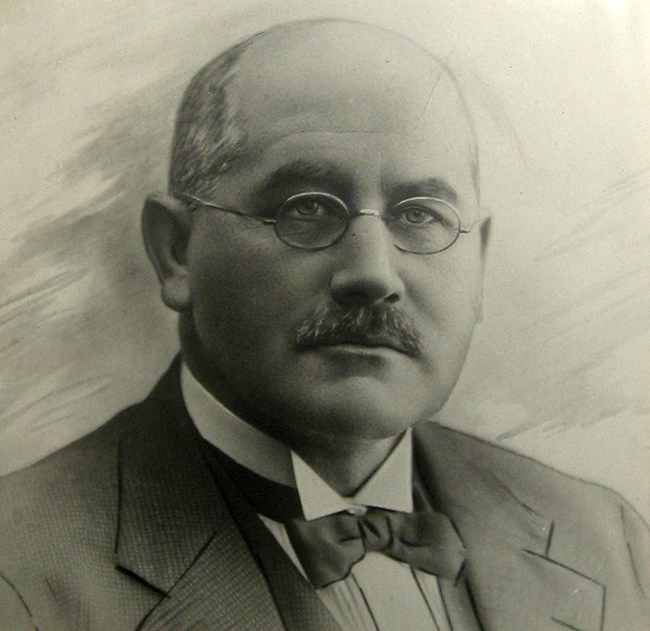
Late Arthur Shepherd
The Victorian women's four finished last in their Interstate Championship with Queensland defeating the dominant NSW crew.
1954-55
The 1955 Senior Premiership battle proved to be one of the most tightly contested and exciting campaigns in recent years, resulting in a tie between Albert Park Rowing Club and Mercantile Rowing Club. Mercantile was once again successful in winning the Junior and Lightweight Premierships for the third successive year, and the first ever Country Premiership was claimed by Ballarat City Rowing Club.
The competition for Senior Eights this year unfortunately attracted entries from only one club and as a result no points were awarded at the Melbourne and Henley Regattas.
Victoria was represented by a supremely talented eight-oared crew at the King’s Cup Regatta this year on the Port River in Adelaide over the three mile race. The men would lead throughout the entire race before the crew from Western Australia launched a herculean sprint to overtake Victoria with only 300 yards to go and win by two and a half lengths. Supporters from various clubs throughout the state were nonetheless proud of their brave performance. In the Australian Pair-Oared Championship, the Victorian Pair of Robert B Duncan and Bruce D. Dickson, coxed by R. Trezise gave a perfect exhibition of pair-oared rowing to win the event.
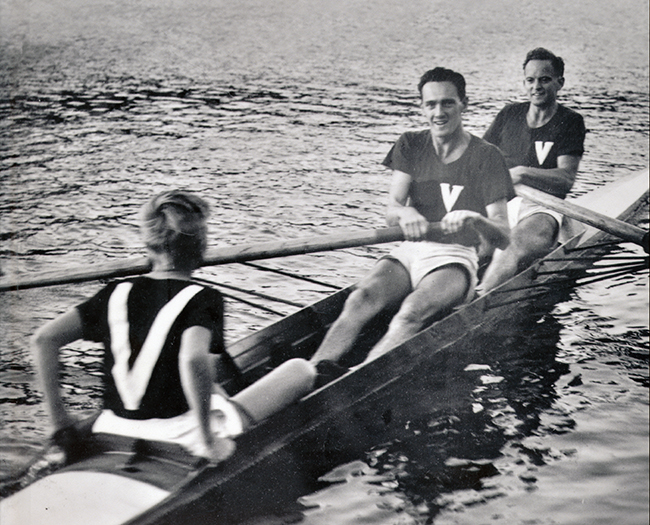
Winning Victorian Coxed Pair from Albert Park
The women's Interstate Championship created far more interest this year with a dead heat between NSW and Victoria and a re-row. In the re-row, NSW won well.
A highlight of the season was the record number of school crews which competed in regattas and the triumph of Wesley College in winning a Maiden Eight Treble. A series of Maiden-Pair Oared Events were conducted throughout the Winter months, taking place on the Yarra River and at Yea. These events saw nineteen crews competing in Metropolitan events and three at Yea, the races proved to be a resounding success. Melbourne University won for the sixth successive year in the Oxford Cambridge Cup, and Geelong College saw off strong competition to win the APS Head of the River Regatta.
Mr. Frank Dennis, the president of Hawthorn Rowing Club, notably secured a radio session dedicated entirely to rowing news each Saturday morning over 3XY during the coming season.
On a more sombre note, this year the Victorian Rowing Association witnessed the loss of their President, the Late Mr. Arch L. Dobbie. During his long association with the sport he competed with Mercantile Rowing Club and also served as their president, on top of acting in numerous roles for the Victorian Rowing Association.
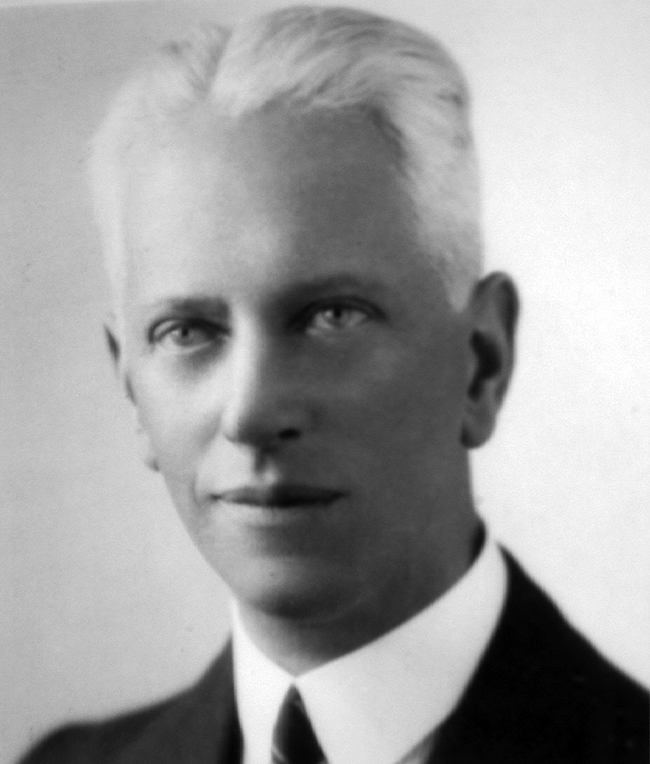
Late Arch Dobbie
1955-56
Olympic Year meant the King’s Cup Regatta conducted at Ballarat was one of the most important races in the history of Victorian Rowing. The King’s Cup Race served as a Test Race over 2000 metres for the selection of the Eight-Oared Crew to compete for Australia at the 1956 Olympic Games also to be held on Lake Wendouree.
Some 10,000 fans of Australian rowing gathered to witness a spectacular final. Western Australia blasted away from the blocks to grasp an early lead but it wasn’t long before the Victorian crew moved out in front, and cruised smoothly down the course before executing a clinical sprint finish to quench the challenges of the chasing crews. Victorian rowing enthusiast were thrilled to see the King’s Cup retained for Victoria and the selection of the crew to row at the Olympic Games.
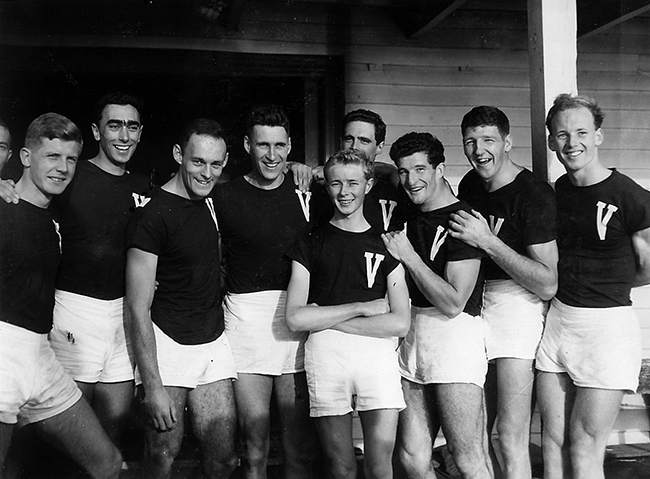
Winning King's Cup crew from Victoria
From the left: A Michael H Aikman, Adrian C Monger, John Morganti, H Neville Howell, Neil Hewitt, James G Howden, Brian Doyle, Garth O V Manton, David H Boykett
In a disappointment, Victoria did not boat a women's four in the Interstate Championships. Women's rowing was subdued at this time and continued for many years before a resurgence occurred.
This season, the decision was made at the domestic level to replace all Senior Rowing with open events and the Senior Premiership was to be abandoned. This was done in order to provide young oarsmen with the opportunity to compete in the highest class of rowing during the Olympic Year without loss of status.
Albert Park Rowing Club, winners of the Senior Premiership in the previous two seasons, built upon their meteoric rise in rowing prowess by winning the tightly contested Junior Premiership. The Lightweight Premiership was claimed by South Melbourne and Wentworth District Rowing Club would be victorious in the Country Premiership. In a record field of seven crews, Melbourne University won for the seventh successive year the Oxford Cambridge Cup on the Lower Yarra over a course of 2 miles. Geelong College were victorious in the APS Head of the River Regatta over Scotch College.
The loss of Edward Kenny, who devoted his life to Australian rowing, was a blow to the morale of the Victorian Rowing Association. The Australian Amateur Rowing Council made the grand gesture of opening a memorial fund which was to be used to provide “Kenny Memorial Medallions” for presentation to the winning crews of the King’s Cup Regatta in the coming season. This tradition has continued until present day. Ted had been the Honorary Secretary of the AARC from int inception in 1925 and almost single handedly managed that organisation including taking on team management and selection duties.
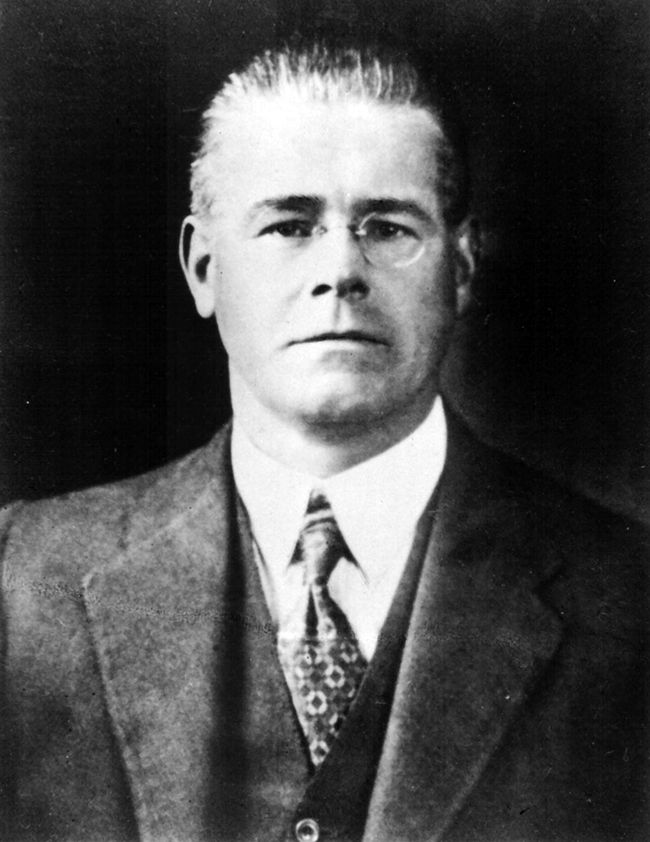
The Late Ted Kenny
1956-57
Perhaps one of the most important years for Australian, and particular Victorian rowing was had in the year previous. The extended and vast Victorian Rowing community combined together to fulfil the responsibility of hosting the Olympic Games Rowing Regatta at Lake Wendouree, Ballarat. Australia duly proved they belong with the best athletes in the world, with five crews contesting finals resulting in a Silver Medal and two Bronze Medals. 30,000 people were present and thrilled by the dramatic nature of the racing. The Australian Eight Oared Crew which claimed a Bronze Medal was comprised largely of athletes from Mercantile, Melbourne University and Banks such as A. Michael H. Aikman, David H. Boykett, James G. Howden, Garth O. V. Manton, W. Neville Howell, Adrian C. Monger, Brian J. Doyle, and H. Neil Hewitt.
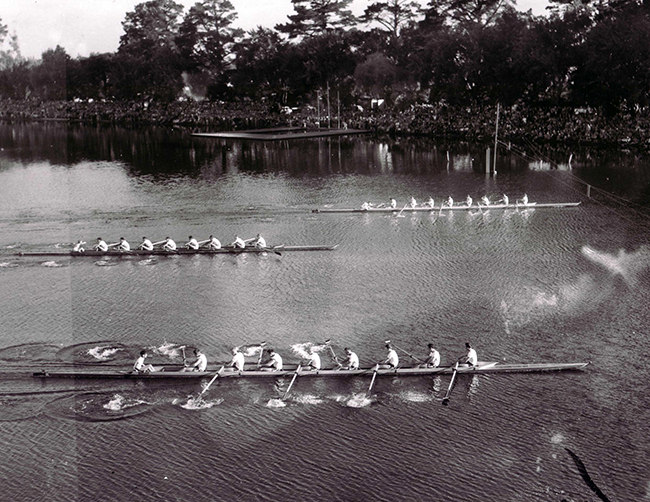
Olympic final of the eights with Australia third
The King’s Cup Regatta provided an equally dazzling spectacle on the Hamilton Reach of the Brisbane River in May. Victoria produced a masterclass in eight-oared rowing, calmy contesting a frantic start by all crews before establishing a dominating rhythm to move out from the field at the half-mile mark. They continued to build on their lead to win by a convincing four lengths from New South Wales. The bow man of the Victorian crew was future President Hubert Frederico.
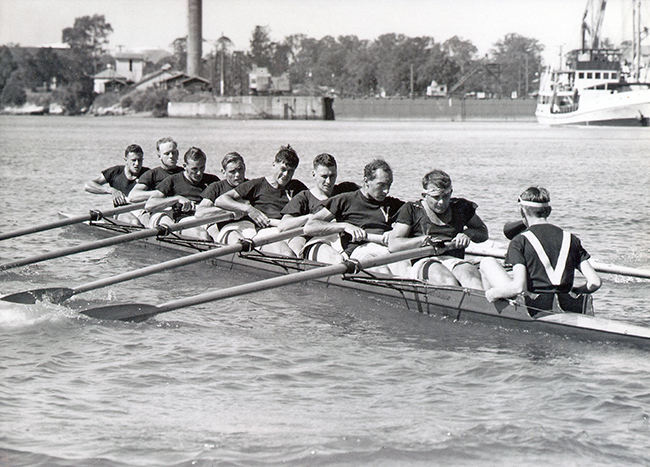
Winning Victorian crew training on the Brisbane River
Bow: Hubert R Frederico, 2: David H Boykett, 3: C Brian Dawes, 4: Robert L Simpson, 5: J Brian Ward, 6: H Neville Howell, 7: John A Hunt, Str: Ian E Douglas, Cox: John Cockbill
Not to be overshadowed by the spectacle of Olympic and Interstate racing, the regatta racing season did not lack for enthusiasm and saw a number of closely contested races and rivalries. Albert Park won its fourth successive Senior Premiership. A dramatic finish to the Junior Premiership saw Banks Rowing Club tied for points with Corio Bay, and Yarra Yarra Rowing Club had a well-deserved win in the Lightweight Premiership.
The University Boat Race for the Oxford-Cambridge Cup was rowed over three miles on the Derwent River, Hobart in June, and was dominated for the eighth successive year by Melbourne University, with Queensland University second. Geelong College would enjoy their third consecutive victory at the Head of the River Regatta, a testament to the eye of their coach, Mr. Albert B. Bell.
1957 was the first year of the Head of the Yarra, an event which started in a small way and is now a national iconic regatta. Of the many people who were involved in the creation of the regatta, Stan Jeffery, Geoff Code, and Frank Dennis have been mentioned.
This year unfortunately saw the passing of LT COL Henry (Harry) E. Butler, secretary to the Victorian Rowing Association for twenty years until 1953.
1957-58
Whilst the Victorian Rowing community was disappointed by the lack of international representation in the Australian team for the British Empire Games, the domestic and national season proved exciting and delightful in many aspects.
As is tradition, the attention of all Victorian rowing enthusiasts was centred upon the King’s Cup Regatta, held this season on the Nepean River in Penrith. All states were represented over the three mile course. Queensland blasted away to take an early lead, but were unable to hold off the Victorian crew, who as soon as they settled upon their textbook rhythm, moved through Queensland and held their lead until the finish line.
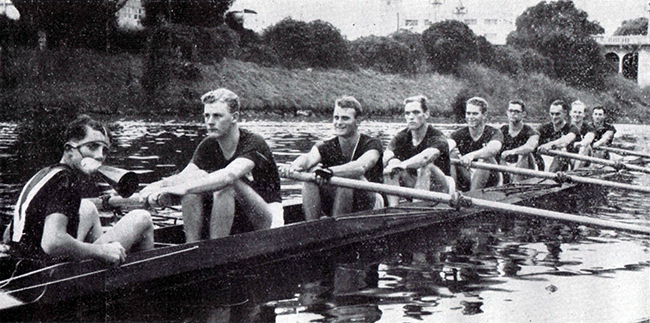
1958 Victoria Eight
Bow: Hubert R Frederico, 2: David H Boykett, 3: Jack Morganti, 4: Terry R Davies, 5: J Kim M Jelbart, 6: Robert L Simpson, 7: Ian E Douglas, Str: Geoff M Taylor, Cox: Rod C Davies
This year saw the introduction of the Australian Lightweight Four-Oared Championship at the King’s Cup Regatta, and proved to be a great success. Victoria won the race on the line after a blistering sprint to overtake the crew from New South Wales.
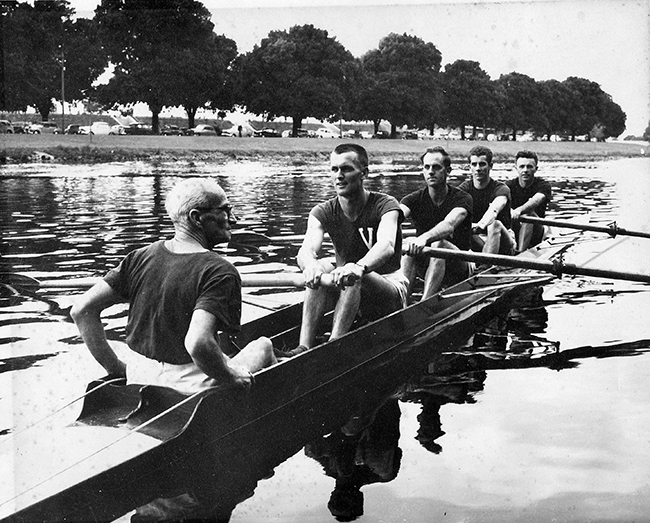
Victorian Lightweight Four
Bow: Robert Tanner, 2: Harry Stevens, 3: George Taylor, Str: Lance Gallagher, Cox: Eddie Jones
Victoria returned to the Interstate Women's Championships but sadly was outclassed by NSW and Queensland.
The battle for Premiership competitions proved to be just as exciting throughout the season. Mercantile Rowing Club claimed the Senior Premiership, Yarra Yarra Rowing Club won the Lightweight Premiership, and the Country Premiership was tied between Barwon and Dimboola. The greatest drama was seen in the quest for the Junior Premiership, which was won by Essendon with six points more than Banks at the last regatta of the season. Adding to the spectacle was the fact that this was Essendon’s first Premiership for 25 years.
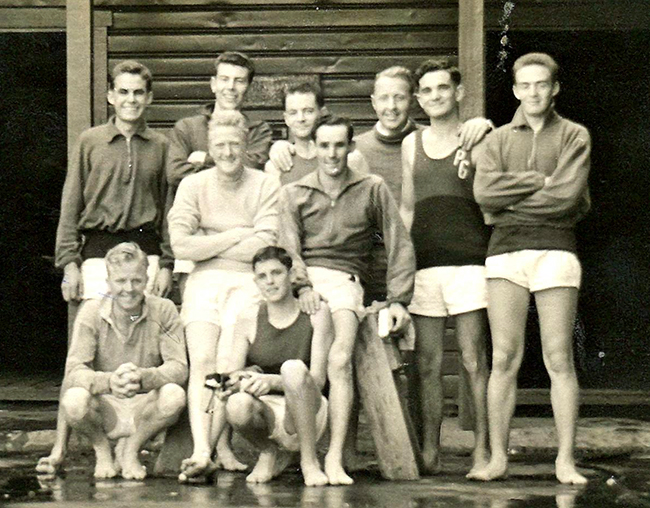
Yarra Yarra's Victorian Champion Lightweight Eight
Back: Barry Lewis, Jim Skidmore, Jim Wilson, Dave Evans, Peter Gill, Allan Rice
Middle: Ron Bulmer, Bill Stephens
Front: Stan Bulmer, Ian Gosling
Heartbreak however, occurred for Melbourne University Boat Club, who for the first time in eight years, lost the Oxford and Cambridge Cup to Queensland University by four lengths in the Annual Universities’ Boat Race. The Head of the River race was again rowed on the Barwon River in Geelong, and was won convincingly by Melbourne Grammar, whose coxswain would go on to steer the Victorian Eight to victory in the King’s Cup.
1958-59
Whilst the 1959 season saw plentiful competition between clubs and schools at various regattas in Victoria, the state was challenged at the Interstate level.
The King’s Cup Regatta was held on the Swan River, Perth over a three mile course. With the intention of settling in and becoming familiar with the course, the eight-oared crew arrived at Swan River 12 days prior to the regatta, only for many of its crew members to become struck down with a viral infection and as a result unable to train for the better part of a week. Dr. Hunt, father of five man John Hunt, was fortunately on hand to administer care and treatment to the afflicted crew members.
On race day, the calibre of the Victorian crew was evident from their blistering start and smooth racing rhythm, but so too was the deep fatigue inflicted in their legs by illness, as their energy began to waver at the halfway mark, allowing New South Wales to draw them in and ultimately pull away to win by four lengths.
The Victorian Sculler and members of the Lightweight four faced a similar fate, struggling with illness in the build-up to the regatta and never troubling the race leaders in their respective events. Onlookers nonetheless described each performance as inspiring.
The women produced one of their finest performances at the Interstate Championships for a number of years finishing second by only half a length in Sydney. Again NSW dominated.
For the second successive year, the Senior Premiership was won by Mercantile. Notably, Richmond Rowing Club won its first Premiership for 20 years in a closely contested season long battle with Mercantile for the Junior Premiership. Essendon, who won the Junior Premiership last season, instead were able to win the Lightweight Premiership. Dimboola were successful in winning the Country Rowing Premiership.
The successful Scotch-Mercantile Regatta proved a resounding success, attracting a record entry of 694 competitors in 137 crews, representing 29 clubs and schools.
Melbourne University Boat Club this season celebrated its centenary, but were unfortunately unable to celebrate victory in the 65th Annual Universities’ Boat Race for the Oxford-Cambridge Cup, which was instead dominated by an incredibly talented crew from Queensland.
At the culmination of the schoolboy season, Mr. Albert B. Bell coached a splendid crew from Geelong College to victory in the APS Head of the River on the Geelong.
Mercantile's Robert Rush was recognised in the 1959 New Years Day Honours List becoming an Officer of the Order of the British Empire primarily for his service to football.
Footnotes and sources
- Reported by Robert Aitken to Andrew Guerin in 1980.
- Primary source has been the Victorian Rowing Association annual reports - refer appendix 16
< previous Chapter 9
> next Chapter 11