

History of Rowing Victoria Inc
- Introduction
- 1: Rowing in a young Victoria 1838-1859
- 2: Formation of the Association 1860-1875
- 3: Growth of the Sport 1876-1889
- 4: Years of great success 1890-1899
- 5: The rise of Australian Henley 1900-1909
- 6: The War Years 1910-1919
- 7: Women's rowing and the modern era 1920-1929
- 8: The Depression Rebuild 1930-1939
- 9: War and rebuilding 1940-1949
- 10: Expansion years 1950-1959
- 11: The search for international success 1960-1969
- 12: Combining the Associations and lightweight success 1970-1979
- 13: The new national program 1980-1989
- 14: Golden years 1990-1999
- 15: Professionalism 2000-2009
- 16: Yet More Growth 2010-2019
- 17: Changing Times 2020-2026
- 1: Life Membership and other important awards
- 2: Patrons and Presidents
- 3: Office Bearers
- 4: Clubs and their histories
- 5: The Oarsmen's Centotaph and WWI Roll of Honour
- 6: WWII Roll of Honour
- 7: Premierships
- 8: State Championships
- 9: Hall of Fame Inductees
- 10: Victorian Olympians
- 11: International representation
- 12: Intercolonial and Interstate Racing
- 13: School rowing
- 14: University rowing
- 15: Histories of Victorian Rowing
- 16: Annual Reports
8. Depression and Revival 1930-1939
Chapter 7 page 1 2 3 4
This page is under construction.
The 1929 Wall Street Crash spun the world into the Great Depression. Australia was not immune from the impacts, and as an export orientated economy, it suffered in many ways more than most. Exports dried up, particularly wool and wheat, leading to many farmers being out of work. Industry ground to a halt leading to mass unemployment. The direct impacts of the downturn trickled down to every part of the economy. Unemployment hit 30% in the major cities like Melbourne. Gardens became a source of food both for family consumption and sale. Those who had produce or saleable items, sold them. Those who did not have such items, went door to door seeking work for food. Your author recalls his grandparents explaining this period. My grandfather maintained modest paying employment albeit largely away from home. My grandmother did not have spare cash to give, but she had a large garden. In return for gardening and odd jobs, she fed a large number of people.
The recovery was slow as it took a number of years for trade to be re-established, manufacturing to recommence and government projects to build up. The events of 1939 did not assist Victoria both with the commencement of WWII and the devastating and widespread Black Friday bushfires.
So as expected, rowing in Victoria was not insulated from the impacts of the Depression. Memberships dropped with members unable to afford the luxury of sport. Also, the 1931 Men's Interstate Championships was cancelled as the State Associations could not justify the expense of sending crews to the Championships. The recovery of sport was long and difficult, and then further interrupted by WWII.
1929-30
The VRA Committee decided that the Four-oared Championship would be rowed on Lake Colac, on Saturday, 14th December, 1929. This action was taken as an experiment in an endeavor to discover a more satisfactory course than the Lower Yarra for future championship and King’s Cup races. The Colac Regatta Committee spared no efforts to make the fixture a success, but unfortunately, the weather on the day of the race was the worst possible from a rowing point of view. Although the crews waited during the afternoon in the hope of conditions improving, it was necessary to postpone the event. It was decided to row the race on the following day on the Lower Yarra, Melbourne. Conditions on the Lower Yarra on the Sunday were such that it was not possible to row the race on that course. Owing to the fact that the country competitors were anxious to return home at the earliest convenience given train timetables, the race was rowed in heats on the Upper Yarra over a course of approximately one mile and a quarter.
University's Ron Jelbart was the men's Victorian Sculling Championship and represented the State in the Interstate event, albeit unsuccessfully. He was well beaten by the winning NSW sculler Jack Scott.
The Albert Park Ladies Four won the Victorian Women's Four Championship and also represented the State in the Interstate Championships finishing second. The winning Interstate Champion Essendon crew of 1929 does not appear to have competed this year.
Given the challenging political and economic state of Australia and the wider world this year, rowing in Victoria still remained strong and the outlook of its members positive. Some might say the state of global affairs, no matter how bleak, could not take away from the Victorian joy of being crowned champions of the King’s Cup for the first time since 1912, on the Murray River at Mannum.
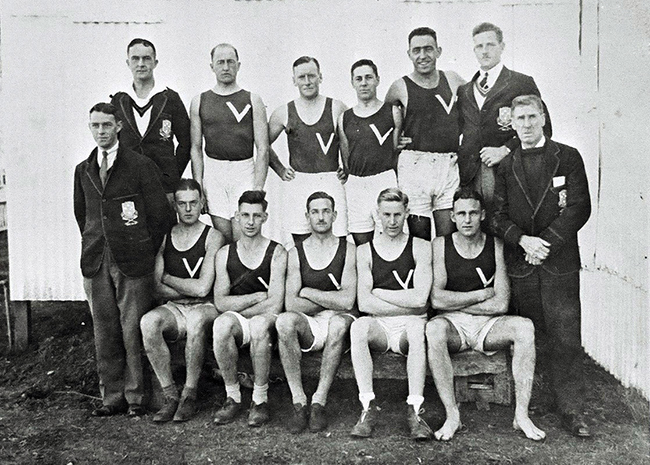
Victorious 1930 Victorian King's Cup eight at Mannum SA
The incredible manner in which victory was achieved made the occasion all the more special. Victoria led from the start, closely followed by Queensland and West Australia. At the half-mile mark they were comfortably enjoying a length from Queensland, and victory looked all but assured. The brave New South Wales crew had a different outcome in mind, and commenced a brilliant sustained run to reduce the Victorian advantage to but half a canvas 400 yards from the finish. The calibre of the Victorian crew was evident however in their expertly timed counter attack, and they pulled away over the final few strokes to claim glory with three feet to spare. This was the states first victory since the historic King’s Cup was became the trophy for the race.
The Victorian Rowing Association hosted a fantastic dinner to the winning crew at the Melbourne Town Hall in June, at which a representative gathering of 130 oarsmen attended. The crew was presented with the oars used in the race, inscribed with names of the crew and the Victorian shield. A copy of the 1930 Commemorative Dinner souvenir can be found through this link.
Regatta entries during the year produced record figures for number of competitors. The Ballarat Regatta in March, created a record for an Australian Regatta with a tremendous 510 competitors, the Maiden Eights providing the magnificent spectacle of sixteen eights racing abreast.
Other highlights of the year included the construction of the Oarsmen’s Memorial Judge Box on the Upper Yarra course, which served as an additional memorial to the oarsmen who lost their lives in the Great War.
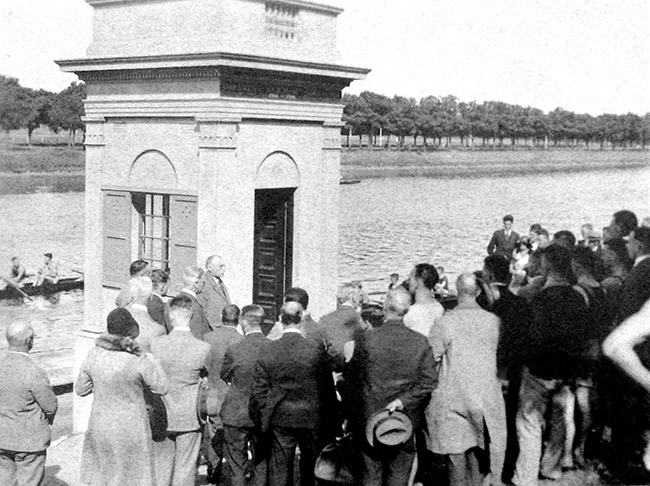
Opening of the Oarsmen’s Memorial Judge Box on 15th November 1930
1930-31
The 1930-31 season featured many positive aspects for Victorian Rowing, on account of a record number of competitors in regattas, highlighting the growing popularity of the sport in the state.
The Champion Fours reverted back to the Lower Yarra after the failure of Lake Colac the previous year with a win for Albert Park. The Champion Eights of Victoria was a great race over 2 1/2 miles on the Lower Yarra with five entrants. Richmond Rowing Club won their first eights championship by a mere canvas from Albert Park then Mercantile. Albert Park Ladies won the Victorian Championship Women's Four and again went onto the Interstate women's Championships finishing last.
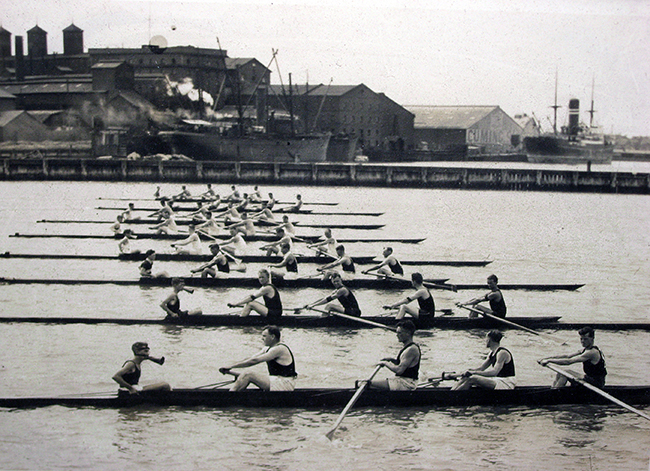
Start of the 1930 Champion Fours on the Lower Yarra
Note that the crew second from the far end has not bothered to await the starters instructions
As there was no Interstate contest during the season, efforts were made to get the winning Victorian Champion Eight-Oared crew to compete in the New South Wales Championship Eights the following week. However, owing to inclement weather necessitating a week’s postponement of the Victorian Championship, this ambition was not realized.
Taking inspiration from the grand Head of the River Race rowed on the Thames in London, the Yarra Pennant race took fruition this season. The race, which was non-classifying, was rowed on the Yarra in September. Twenty one crews entered, and a Pennant was given for the fastest time of the day and an Honor Flag for the fastest time in each division of boats. Started at intervals of 30 seconds, the crews raced against the clock from Church Street Bridge to Princes Bridge, a distance of approximately two and a half miles. Melbourne Rowing Club won the event with the fastest time of 12 minutes and 12 seconds.
It was slightly unfortunate that a severe storm interfered with the race as a spectacle, but it was generally accepted that the innovative race was a distinct success.
1931-32
The community of Victorian Rowers could confidently boast the title of the premier rowing state in Australia this year, on account of their second successive victory in two years in the King’s Cup Regatta, a feat not accomplished by Victoria since 1905. Adding to the splendour of the achievement was the location at which the race was carried out, the Lower Yarra. 10,000 spectators lined the banks to watch Victoria battle it out with the New South Wales crew, from which they pulled away at the half way mark in the race following a magnificent effort. The Victorian crew won by a margin of three lengths, and the King’s Cup was presented to the Victorian stroke Alec W McLeish by Sir George Fairbairn on the balcony of the Melbourne Rowing Club.
A parade of boats was held over the last half of the Henley course through Princes Bridge in the week leading up to the race, and was headed by the six Interstate crews and four Interstate scullers. It was undoubtedly a spectacle to behold on the Yarra.
Worth appreciating was the manner in which Boathouse Drive was utilized in order to accommodate for interstate crews. In leading up to the race, the rowing clubs of Richmond, Melbourne, Mercantile, Banks and Yarra Yarra graciously offered their facilities to accommodate the training demands of visiting crews.
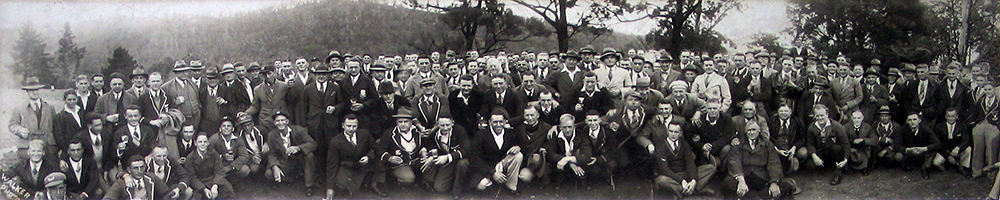
1932 King's Cup Picnic at Ferny Creek at the property of Marcus Burke
The boathouses during the 1932 King's Cup
This season saw the introduction of the Victorian Open Lightweight Eight Championship, and was considered a resounding success on account of the nine entries received and high quality rowing witnessed. It was also decided to alter the distance of the One Mile Sculling Championship to 2000 metres, with the goal of conforming to the distance of the Olympic sculling race. Albert Park Rowing Club celebrated the winning of the Senior Premiership for the second year in succession, and Footscray City claimed the Junior Premiership.
The women's association also introduced a new championship, namely the Junior Four, which was won by Essendon Ladies.
The Preston Club requested and received permission to represent Victoria at the Women's Interstate Championships in Brisbane at the 15th March 1932 meeting of the Ladies Association.2 It appears that the support of that Association was limited to approval. The crew finished fourth.
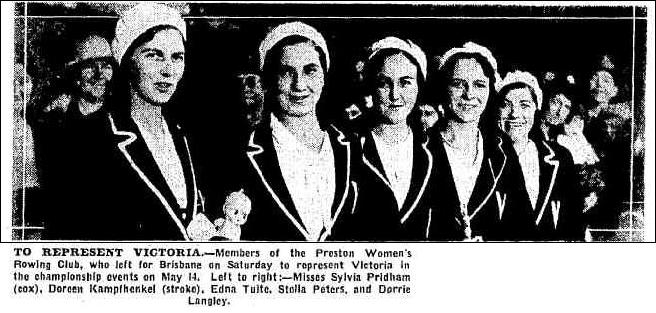
1932-33
The Victorian Rowing Association in 1933 had to swallow the bitter pill of losing the title of premier rowing State of the Commonwealth, which they held proudly for two successive years, by virtue of losing the King’s Cup in a valiant battle against New South Wales. On the Brisbane River, New South Wales rowed the remarkably fast time of 14 minutes 30 seconds, putting into context the high standard of oarsmen at the event.
Domestically there was plenty of quality rowing and racing contests to be enjoyed. Thirteen crews competed in the Yarra Pennant Race that was held over a course of two miles in September and provided hearty competition for spectators to feast their eyes upon. The Victorian Rowing Association Regatta was particularly special this year.
Messrs. W & A Gilbey Ltd presented a striking cup for the Senior Eights race. In addition, they offered to present replicas of the cup to each members of the winning crew. Richmond Rowing Club had the privilege of success in this first race for the “Gilbey Cup”, and received the trophy from Mr Collins at the official presentation.
Other highlights of the season include the erection of Ballarat City Rowing Club’s new clubhouse, and the construction of Power House Rowing Club at Albert Park Lake. Wendouree Rowing Club celebrated its Jubilee Year with a magnificent dinner, at which there was a large attendance of old members.
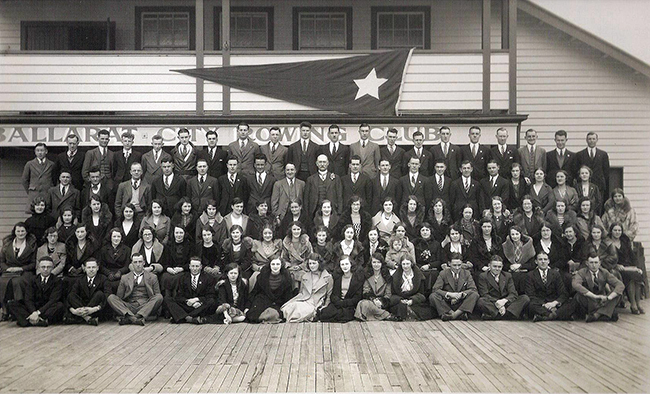
Ballarat City members show off their new shed
Preston Ladies again won the Victorian Champion Women's Four and also won the newly introduced Champion Pairs. The four was again selected to represent the State at the Interstate Championships where they won by 1/3 length after a tight race with the favoured NSW crew. The experience from their disappointment in 1932 obviously paid off.
The men's Victorian championships were spread around evenly with Hawthorn taking out the eights, Richmond the four and junior eight, Ballarat the pair, Yarra Yarra the scull, Banks the lightweight eight. Stan McGorm of Ballarat suffered an equipment failure when well in front in the sculling championship. However e took out the 2000m sculling championship.
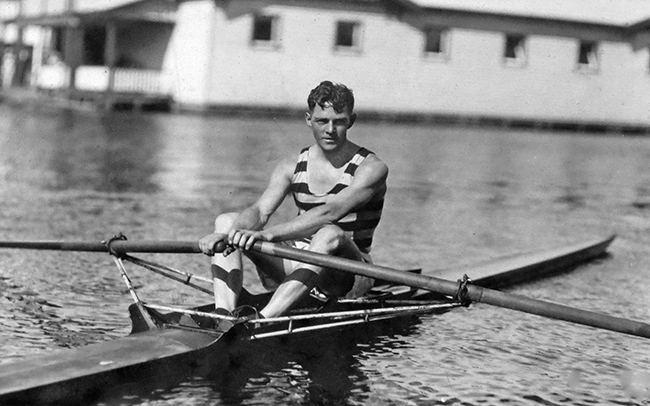
Stan McGorm on Lake Wendouree
1933-34
The season of 1933-34 could only be regarded as challenging in many aspects for the Victorian Rowing Association and wider rowing community in the state. Highlighted by a decrease in the number of members and competitors amongst clubs. Numerous events, including the Giappsland Regattas had yet again to be cancelled due to a paucity of entries. This was undeniably disheartening for those invested in the success and growth of Victorian Rowing, but the optimistic attitude that things would improve in the near future prevailed.
It was a further misfortune that the Victorian Eight-Oared crew, which had shown a great deal of rowing prowess in preparation for the King’s Cup Regatta on the Derwent River in Hobart, be unable to compete effectively in the race, characterised by conditions barely suitable for rowing. Mid way through the race, a series of unusually large wave braced the boat, and prevented it from going any further on account of the water in the shell. It is perhaps unsurprising that, the winning time posted by New South Wales, was the slowest recorded for fifty years. The Victorian crew was based on the Victorian Champion Nagambie crew.
The Victorian Championships again produced some interesting results with Essendon Ladies taking out all three women's championships, the four, pair and junior four. In the men's championships, Yarra Yarra's Carl Peppler won the sculls and the rise of Nagambie was evident with them taking both the four and eight championships. It was that clubs first eight oared championship.
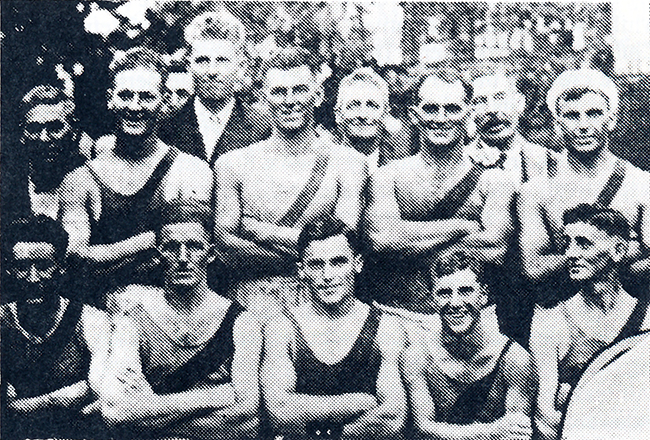
Nagambie's First Champion Eight Win
Back row: W G Lodding, W Verge, O Brensing, F Catlin
Middle: A Lodding, C W Welch, V M Sullivan, S E Gugger
Front: F Furlong, T Coulter, L W Sullivan, A Green (Cox), J Callaghan
While there was perhaps not a great deal to celebrate from the season, brighter times would certainly return in the near future.
1934-35
The outstanding event in Victorian rowing this season was undoubtedly the visit of the London Rowing Club’s Eight. The visit of this crew caused a great deal of interest and excitement from the wider Victorian Rowing Community, as they turned the heads of every oarsmen who witnessed their unique and contrasting style of rowing. A style evidently effective, as they easily won the Grand Challenge at Henley-on Yarra and the Victorian Eight-Oared Championship.
The 1934 Australian Henley Regatta was an important celebration of the centenary year of the foundation of Melbourne. As such, it had arguably the most impressive entry list of any Australian regatta until that point. The highlight of the regatta was the entry of London Rowing Club, who won the Grand Challenge Cup. The Association were particularly pleased to report that: ‘after so many years of effort, the first English crew to visit Australia was seen at Henley on this occasion, thus achieving one of the main objectives in the formation of the Association. The standard of rowing was high, as demonstrated by their easy wins at Henley and a week later at the Victorian championship, but apart from their rowing ability the men were a credit to the sport and the esteem of all those whom they met whilst in Australia.’
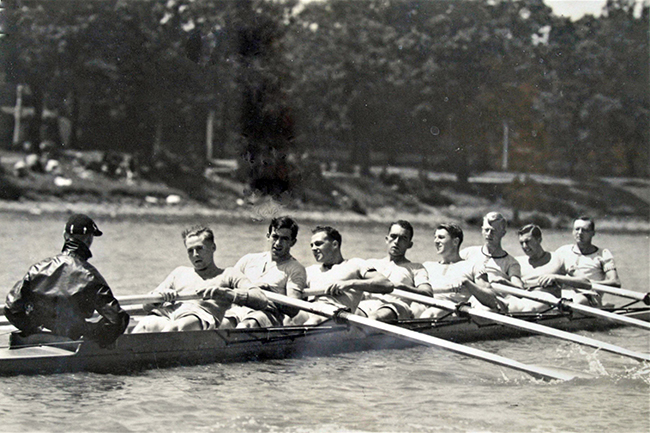
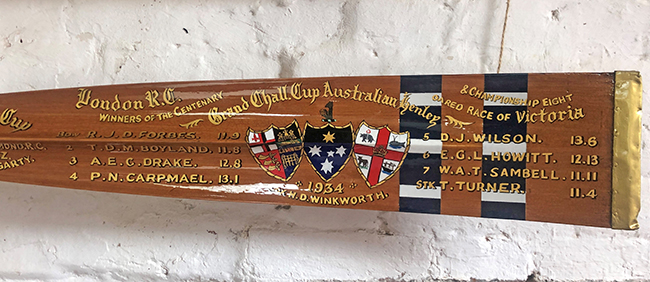
The burden of being a water sport is that it is weather dependent. Weather events regularly bring many rowing centres to a halt. December 1934 was no exception with much rain causing flooding. Fortunately it arrived after the London Rowing Club races in November.

Steady, organic growth of the Victorian Metropolitan Rowing Clubs continued to be the case in the 1935 season, encouraging the wider community as a whole. Regattas continued to attract a great deal of quality oarsmen, with number of Senior, Maiden and Junior competitors showing a substantial increase. Perhaps unsurprisingly, with the revival of the beloved Gippsland Regattas, after a lapse of four years. The Bairnsdale and Sale Regatta Committees worked tirelessly to ensure the efficient function of these events and catering for the substantial number of competitors. In the light of the heavy rains and floods that preceded these regattas, the success of each was truly remarkable.
The Victorian Championships produced some interesting results with London Rowing Club taking the eight with an earlier regatta date of November 1934 to allow the visiting crew to race. Carl Peppler continued to dominate the sculls for Yarra Yarra but Preston won the pairs in a big field followed by Wahgunyah. Nagambie kept up their winning ways in the four, Melbourne the lightweight eight and Richmond the junior eight.
Essendon Ladies were again successful in the women's four championship and represented the state in the Interstate event on the Port River in Adelaide. The crew finished third in an extremely tight finish for the top three crews.
The Nepean River at Penrith was to be the battleground for the King’s Cup Regatta this year, and all states were represented. Victoria would put in a fine display of rowing in the ideal conditions that prevailed, however were unable to challenge New South Wales for victory. A similar result befell the women's four in their championship race on the Port River in Adelaide.
1935-36
The year was characterized by a slight but positive increase in the number of maiden and junior competitors at the many well organized regattas across the state. The United Services Regatta, Public Service Challenge Shield, Head of the River and Inter-Faculty race saw tremendous competition and impressive feats of rowing from the likes of the Melbourne University Rifles, Metropolitan Fire Brigade, Geelong College, and the Medical Faculty eight-oared crew.
Richmond Rowing Club won both the Senior and Junior Premiership, being only the third club to do so. Albert Park and Mercantile had previously achieved that result. At the end of the season, Mercantile invited Richmond members to a complimentary smoke social in honour of Richmond's successes during the season. The Richmond Rowing Club annual report noted their appreciation of this goodwill and said that good fellowship is the best tradition of the sport of rowing.
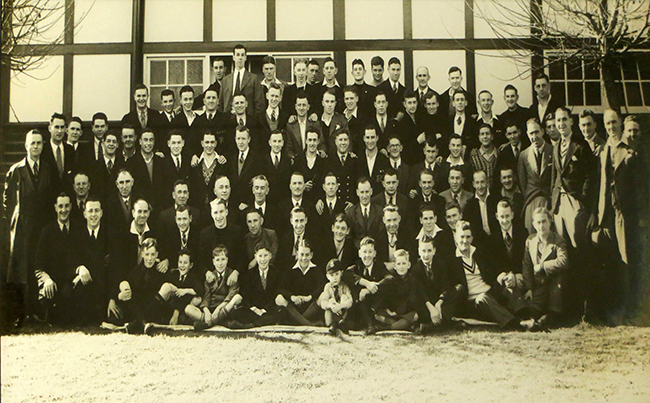
Richmond Rowing Club - 1935-36 Senior and Junior Premiers
A new regatta was introduced during the year at Shepperton, rowed in December as a tremble with the Nagambie and Rutherglen Regattas. It was well supported and proved highly successful, with encouraging turnouts and quality racing.
To assist in raising money to finance the visit of the Victorian eight-oared crew to compete in the King’s Cup race in Perth, the Victorian Rowing Association staged a highly contested Combination Eight Race, which saw 18 crews compete, made up of the best Victorian rowing had to offer.
The King’s Cup Regatta was rowed on the Swan River in Perth, however Victoria struggled to make an impact. Under fast conditions, New South Wales and West Australia contested for the win, whilst the Victorian crew struggled to replicate the fine quality of rowing they had been showing in training. This did nothing to damper their spirits however, and they immediately turned their attention to the future and how they would acquire the boat speed they were currently lacking. New South Welshman Cecil Pearce won the single scull.
As a result of the these results and the selectors recommendations, an all NSW Olympic rowing team was selected. Funds were again a problem with the eight selected on the proviso that it could be funded from sources outside the normal revenue sources of the Australian Olympic Federation. The NSW Police Club intimated that it would have no difficulty in raising the funds to send the eight. Funding came from the NSW Police Federation and the police force itself with all policemen in NSW being levied two shillings per week from their pay.
However the Victorian women's four won their Championship on the Upper Yarra River easily. Victoria led from the start but had to withstand a push by Tasmania who got within a length at one stage. The Victorian crew went on to win by 4 lengths. Given the crew composition, it appears to have been from the Essendon Ladies Rowing Club.
1936-37
This year was marked by a marginal yet definite growth of Club members affiliated with the Victorian Rowing Association, encouraging the community that rowing in Victoria was continuing to progress to greater heights.
The Footscray Regatta Committee was unable to hold its Annual Regatta, as a consequence of the bridge building operations on the Maribyrnong River. In order to preserve the “January Double”, the Victorian Rowing Association decided to hold a regatta on Australia Day, as a Double with the Upper Yarra Regatta. Permission was obtained from the City Council to enclose the boat sheds area on each day and make a charge for admission and to build a stall for refreshments. The weekend was delightful in all aspects and made for some thrilling spectacles of racing. Owing to unfavourable weather, the Colac Regatta had to be abandoned.
Richmond Rowing Club continued on their successful way taking out the Champion Four and Eight. Four members of the club were selected into the Victorian King's Cup crew. This club remained successful both through to WWII and for a couple of years thereafter.
All states were represented in the coveted King’s Cup Regatta, held over a course of three miles on the Murray River in South Australia. The weather conditions were perfect for eight-oared racing, however Victoria were not privy to the battle for the title, and finished in fifth place. The win for South Australia however, was all the more meritorious in the context of them not having won the race since 1923. L A Purves finished in a respectable second place in the President’s Cup.
Our women also were unsuccessful finishing third in Brisbane. The YWCA crew represented Victoria after winning the State Championships easily from Essendon and Warrnambool.
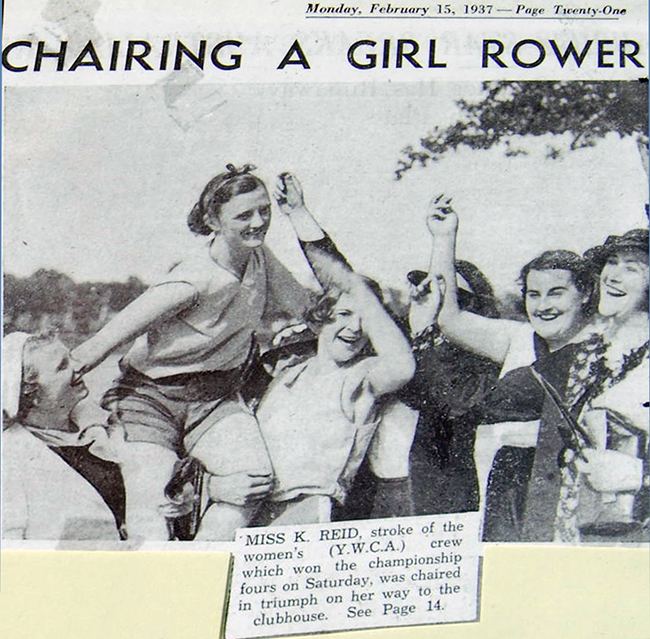
Worth highlighting was the conduct of Combination Eights by the Association in October to raise funds for the purpose of establishing a Sportsmen’s Ward at the Prince Henry’s Hospital, where all sportsmen who are injured whilst participating in their sport would receive attention. A splendid response was received, with 220 individual entries for the event. Trophies were donated by Councillor A Crofts.
1937-38
The rowing activities of the season gone were delightful from the nations perspective, as well from the Victorian state’s point of view. The momentous occasion was undoubtedly the arrival of crews from England, Canada and New Zealand for the purpose of competing at the British Empire Games of 1938, held in Sydney. The State had four oarsmen selected to represent Australia at the Games, one of whom rowed in the winning crew in the Four-Oared Event.
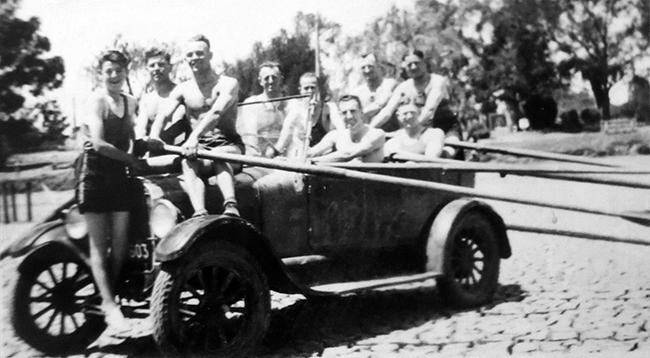
The period of 1937 and 1938 were subject to droughts, and in the case of Bendigo, their worst drought on record. Without water in Lake Weeroona, rowing ceased. At least the rowers had a sense of humour.
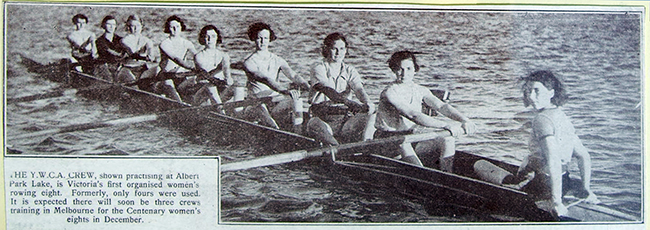
 Women's eight racing was commenced in 1937 with an eights race in December. Pictured below in February 1937 is the YWCA crew in training for the December event.
Victoria had the privilege of hosting the King’s Cup Race on the River Yarra in May. All states were represented and it was said that the rowing was the best observed on the river in some years. A herculean contest was witnessed between New South Wales and Western Australia, the latter of whom would win by a canvas. Victoria unfortunately were not privy to this clash, finishing four lengths behind in fourth place to Tasmania in third. L A Purves was heartily congratulated on his second placing in the Presidents Challenge Cup.
Worth remembering is that Mr Aaron Beattie voluntarily offered to conduct physical training classes for selected oarsmen, which took place two evenings per week over six weeks. These classes were highly beneficial and contributed to the supreme physical conditioning of the Victorian eight-oared crew.
Challenges to the association this season included the infantile paralysis epidemic, which prevented the Sale Regatta from taking place on Easter Monday.
Until this year, the Victorian Ladies Rowing Association insisted that the winning Victorian Championship Four won the right to represent Victoria at the Interstate Championships. This was changed on the annual meeting of the VLRA and thenceforth, composite crews will could be selected to represent Victoria.x The Victorian selectors went with an experienced crew which included some older rowers. Mrs Walsh from Essendon in the two seat was a grandmother and Mrs Bennell was a mother. Alas they were not able to match it with the other crews.
VLRA office bearers for the ensuing year included:— President, Mrs. Rose Pyke; honorary secretary. Miss M. Drewett; honorary assistant secretary. Miss M. Mason: honorary treasurer, Miss M. Jolly; correspondent, Miss Peters: delegates Y.W.C.A., Miss D. Healey and Mrs. T. Avent; Albert Park, Miss B. Dockrey and Mrs. Mitchell; Warrnambool, Mrs. D. Laird; Essendon, Misses M. Wilson, J. Doolan.y
1938-39
The highlight of the 1938-39 season could only be the satisfactory return of the Henley Grand Challenge Cup to the state after a lengthy absence, following the victory gained by Mercantile Rowing Club over Haberfield Rowing Club of New South Wales. Mercantile were also victorious in the Senior Premiership domestically.
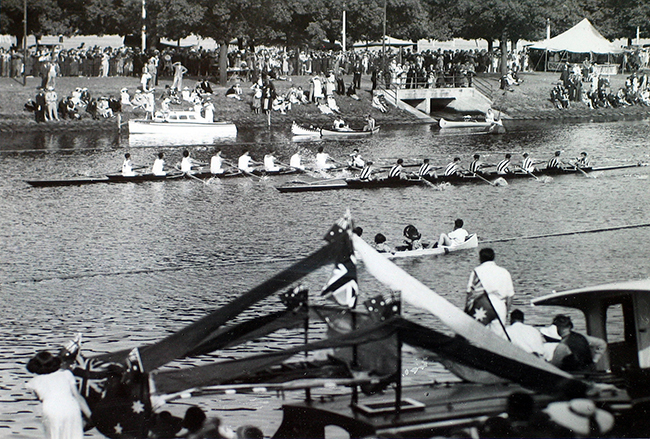
1938 Australian Henley Grand Challenge Cup final - Mercantile def Haberfield
The strength of Victorian Rowing was observed at the King’s Cup Regatta on the Hamilton Reach of the Brisbane River. After being left at the start, the Victorian Eight settled into a smooth, beautiful rhythm, and had established a lead by the quarter mile mark. This would remain the case until the last mile, when Queensland executed a magnificently sustained burst and finished the race half a length in front.
The Victorians were however disqualified for passing a buoy at the end of the first mile, thus being deprived of a place in the final standings. The official time for the race was 14 minutes and 30 seconds, equal to the course record. Despite the circumstances, this powerful performances highlighted the strength of oarsman in Victoria and if were not for the grim spectre of war, the display would have paved the way for success in the near future.
Melbourne University claimed the coveted Oxford and Cambridge Cup, defeating Sydney University by a length and a half on the Nepean River at Penrith.
The women's championships were conducted by the Victorian Ladies Rowing Association on the lower section of the Henley course on the Upper Yarra as usual. Also as usual, the championship fours were used as the selection event for the Interstate crew.
The Albert Park Ladies Rowing Club were the most successful club taking three of the four events on the program. This led Albert Park to also take the club premiership for the season. The championship pairs was won by Essendon easily from Albert Park.
The winning Albert Park Ladies crew comprised bow: J. Smith (bow) L. Fahey, Jess Manton, D. Pettiona (stroke), D Hassell (cox). A composite Victorian crew was selected to represent the State at the Interstate Championships and comprise bow: Jess Manton (Albert Park), 2: Nell Walsh (Essendon), 3: Merle Bennell (not known), Str: D Pettiona (Albert Park), Cox: R Pyke, Emerg: J Fahey, Cch: Mr E O'Brien. This crew went onto to win the Interstate Championship.
Footnotes
- Victorian Rowing Association annual reports
- VICTORIAN LADIES' ROWING ASSOCIATION. (1932, March 16). The Age (Melbourne, Vic. : 1854 - 1954), p. 7. Retrieved July 30, 2024, from http://nla.gov.au/nla.news-article205093933
x The Age, Wednesday 15th June, 1938, page 6.
y WOMEN'S ROWING. (1938, June 15). The Age (Melbourne, Vic. : 1854 - 1954), p. 6. Retrieved April 8, 2025, from http://nla.gov.au/nla.news-article206958859
< previous Chapter 7
> next Chapter 9