

History of Rowing Victoria Inc
- Introduction
- 1: Rowing in a young Victoria 1838-1859
- 2: Formation of the Association 1860-1875
- 3: Growth of the Sport 1876-1889
- 4: Years of great success 1890-1899
- 5: The rise of Australian Henley1900-1909
- 6: The War Years 1910-1919
- 7: Women's rowing and the modern era 1920-1929
- 8: The Depression Rebuild 1930-1939
- 9: War and rebuilding 1940-1949
- 10: Expansion years 1950-1959
- 11: The search for international success 1960-1969
- 12: Combining the Associations and lightweight success 1970-1979
- 13: The new national program 1980-1989
- 14: Golden years 1990-1999
- 15: Professionalism 2000-2009
- 16: Yet More Growth 2010-2019
- 17: Challenging Times 2020-2026
- 1: Life Membership and other important awards
- 2: Patrons and Presidents
- 3: Office Bearers
- 4: Clubs and their histories
- 5: The Oarsmen's Centotaph and WWI Roll of Honour
- 6: WWII Roll of Honour
- 7: Premierships
- 8: State Championships
- 9: Hall of Fame Inductees
- 10: Victorian Olympians
- 11: International representation
- 12: Intercolonial and Interstate Racing
- 13: School rowing
- 14: University rowing
- 15: Histories of Victorian Rowing
- 16: Annual Reports
This chapter is under construction
Two significant changes took place this decade which changed the sport forever for the better.
The first was the completion of the merging of the men's and women's rowing Associations throughout Australia. The process was completed for Victoria in 1981 and nationally shortly thereafter. Combined regattas had commenced at an earlier date.
The second change took place in 1979 with the arrival of Reinhold Batschi as the Australian coaching director. The changes he brought to the sport were lasting and significant. Specifically, he introduced regular racing through three selection regattas, vastly different training methods focusing on endurance capability, a common technique, and finally a far more objective selection process. By 1986, Batschi coached a young group of athletes to a world championship in the men's eight for the first time and changed how Australian crews were coached, trained and selected. He was the driving force behind rowing being introduced into the Australian Institute of Sport.
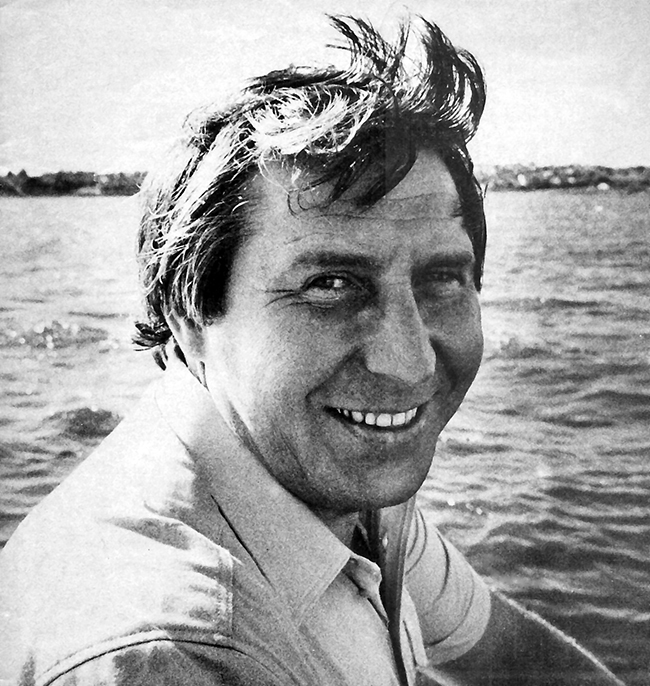
Reinhold Batschi in 1979
The appointment arose after Australia's poor performances at 1972 and 1976 Olympic Games. 1976 team manager John Coates realised that change was required for Australian rowing and started the process of persuading the State Associations of the need for an international coach to be hired to show us how to improve. Being a purely amateur sport with conservative administrators, this was not an easy task. With help from a respected President Robert Aitken, the States were persuaded. The choice of Reinhold Batschi was inspired and Australian rowing have not looked back on unsuccessful days ever again.
1979-80
The 1980 Victorian Season was busy, exciting and successful in many a sense. Many agreed that the highlight of the year was the presentation of the Australian Interstate and National Championships at Lake Wendouree, Ballarat, in March. The five-day regatta was proclaimed by many to be the best Australian Championships ever presented, and the greatest display of rowing in Ballarat since the Olympic Regatta of 1956. The regatta reached fever pitch for the blue-ribbon event, the Interstate Men’s Eight, in which Victoria emerged triumphant by a narrow margin to claim the coveted King’s Cup for the second year in succession.
The spectacle was witnessed by Sir Zelman Cowan, Governor General of the Commonwealth of Australia and Lady Cowen.
In addition to this, Victoria brought home the Wilkinson Trophy, ULVA Trophy, Victoria Cup and the Slatter Trophy.
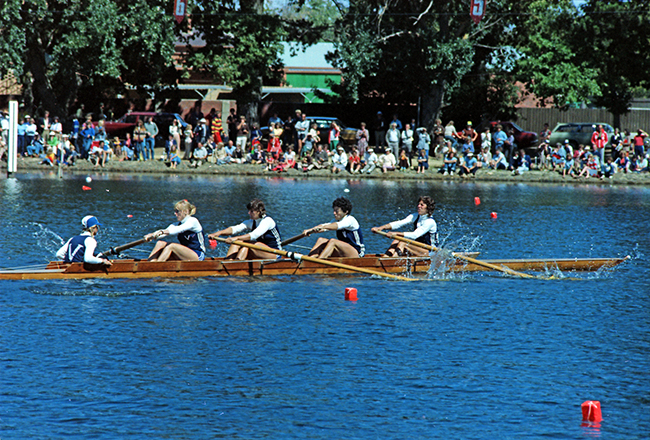
Victorious Victorian women's four
Early in the season an astonishing 23 Victorian athletes and coaches represented Australia at the World Rowing Championships in Bled, Yugoslavia. Whilst no medals were won, impressive performances were nonetheless evident from the Men’s Eight who placed 4th, Women’s Four who came 6th, and the Lightweight Eight and Four placing 6th. Many of these athletes would take a short period of respite before beginning preparations for the 1980 Olympic Games in Moscow, Russia.
Members of the Victorian Rowing Association took great pride when it was announced that Mr Robert Aitken was to be made a member of the Most Excellent Order of the British Empire in the New Year’s Honours list for his services to Rowing. Recognition was also extended to Mr Ray Todd, a life member of the Association who had the new judge’s box at Lake Wendouree named after him for his services to rowing.
In the State Premierships, Melbourne University Boat Club were successful in winning the Champion Club and Senior Premierships, whilst Powerhouse Rowing Club lay claim to the Lightweight Premiership. Banks Rowing Club took home the Junior First Division Premiership whilst Yarra Yarra Rowing Club won the Junior Second Division Premiership.
Melbourne Grammar along with coach Mr Tony Smith, built on last year’s success by winning the APS Head of the River Regatta in a time of 4:36.0.
This year, The Old Oarsmen’s Association of Victoria, on behalf of Mr Noel F Wilkinson, made the significant gesture of donating a perpetual trophy for the Youth Eight-oared Championship of Victoria.
1980-81
After many years of discussion, special meetings of both the Victorian Rowing Association and the Victorian Ladies Rowing Association were held to approve the amalgamation of the Associations. There was some reluctance by the women's Association due to the fear of being swamped by the larger men's association. Special mention to the respective Presidents for guiding through this process, namely Hubert Frederico (and before him Bob Aitken) and Dorothy Rycroft.
This year saw a number of standout performances from Victorian athletes and some significant developments in the structure of the Victorian Rowing Association.
The Victorian Oarsmen Charles Bartlett and Simon Gillet did their state proud when they made up the gold medal winning Lightweight Coxless Four at the World Rowing Championships in Hazewinkel, Belgium. Victorian Oarsmen also represented Australia at the Moscow Olympics, in which the Men’s Eight and Women’s Coxed Four achieved fifth placings.
The King’s Cup Regatta, held in conjunction with the National Championships on the Hinze Dam in Queensland, saw a brave row from the Victorian Eight, who unfortunately were unable to repeat the success of the previous season and had to settle for a second-place finish. The Victorian Ladies however continued their previous season’s success in style, winning all three Championship events. At the National Championships, Victorian club crews were successful in winning ten of the available Championship races.
Mention must be made of Noel F Wilkinson, Life Member and ex-Treasurer of the Victorian Rowing Association, when it was announced in the Queen’s Birthday Honours List that he had been awarded a British Empire Medal for his service to the sport of rowing.
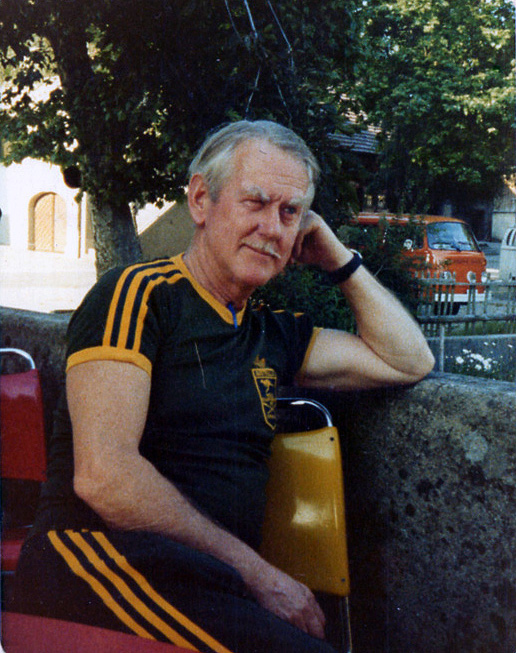
Noel Wilkinson
Another highlight of the season was the first Veterans’ Regatta, successfully conducted by Nagambie Rowing Club.
Such was the increased demand for a regatta of the likes, with the development of Veterans’ rowing continuing in recent years. This season saw a ten-man squad with a coxswain, comprising members of the Banks, Hawthorn, Melbourne University and Richmond Rowing Clubs, travel overseas to take part in the 7th FISA Veteran Regatta in Denmark, where the E Class four-oared crew of Dimsey, Todd, Baddeley, Jopling and cox Pinder won gold medals. These athletes also competed and were victorious in regattas in England, including the 31 mile marathon event in Boston, capping off a spectacular and wondrous campaign.
Melbourne Grammar were successful in winning the APS Head of the River Regatta for the third consecutive year under the watchful eye of coach Tony Smith.
1981-82
Victorian oars people were not lacking for inspiration at the early stages of the season, as Charles Bartlett and Simon Gillet of the Australian Lightweight Coxless Four repeated their success of the previous season in a superb gold medal display to become the only Australian rowing combination to win successive world titles.
Victorian women’s rowing continued to go from strength to strength. At the King’s Cup Regatta held on the Nepean River in Penrith, the ladies’ crews built on their success of previous seasons with wins in all three Australian Championship Events. Andrew Cassidy too had a magnificent row in his single scull to win the President’s Cup.
Planning and work began on the on the State Water Sports Centre at Carrum. In anticipation of it’s completion, a submission was made to conduct the 1985 Australian Interstate and National Rowing Championships as major event to celebrate Victoria’s 150th anniversary celebrations.
In the State Premierships competitions, Corio Bay emerged as the Men’s Champion Club Premiership and by a record points score, the Men’s Junior First Division Premiership. The Ladies’ State Premiership was won by YWCA Rowing Club.
At the Victorian State Championships at Ballarat, the presence of the Mayor, Mayoress and Councillors of the City of Ballarat were much enjoyed and appreciated.
Mercantile, winners of the 1982 State Championship Men's Eight
The Associated Public Schools of Victoria successfully conducted the annual Head of the River Regatta on the Barwon River in April. Melbourne Grammar School, coached by Tony Smith, won its fourth successive Head of the River in a heart stopping finish on the line.
During the season, a number of rowing promotions took place in both metropolitan and country areas, with regattas held at Bairnsdale and Sale, the first for almost thirty years.
In November 1981, a Level One Coaching Seminar was conducted under the watch of Mr Reinhold Batschi, with sixty-seven aspiring coaches in attendance and qualifying for the Level One Standard. The number of schools developing their rowing continues, with 25 schools having initiated rowing programmes as part of their rowing curriculums over the past two years.
1982-83
The 1983 season boasted many impressive performances of Victorian oars people at international competition and proud displays at National and Interstate events. The Senior B Pair of David and Mark Doyle, as well as the Victorians in the Lightweight Women’s Four- Barbara Griffiths, Barbara Phelan, Allison Davidson and coach Brian Dalton were successful in their quest for gold medals at the Senior B Championships in Vienna and World Lightweight Rowing Championships in Lucerne.
Conducted from April 6th to 10th, the National Championships were a credit to the many workers involved, the usual large contingent of Victorian oars people and supporters were somewhat depleted in Perth due mainly to the distance involved, but the performances of Victorian’s were nonetheless commendable. The A.B.C. once again provided excellent national television coverage of the two days of final events, which was enjoyed by all those people unable to be in Perth.
At the King’s Cup Regatta held on the Canning River at Perth, WA, Victoria once again made a clean sweep of the women’s Interstate Events. This marks the fifth year in a row since any other state crew has won an Interstate women’s title and underlines the unprecedented standard of women’s rowing in Victoria. Worth applauding is Mary Renouf’s fifth successive sculling title, as well as the continued dominance of Victorian fours in the ULVA Trophy and lightweight fours in the Victoria Cup.
Mr Daryl Wraith, on behalf of the Bliney Family, made the significant offer of a perpetual trophy in recognition of Mr. Keith Bliney’s long association with rowing, to be presented to the winner of the Victorian Lightweight Single Sculling Championship.
The State Premiership competitions saw Mercantile Rowing Club win the Men’s Champion Club, Men’s Lightweight and Men’s Junior First Division Premierships and Banks Rowing Club winning the Men’s Senior, Women’s State and Women’s Junior Premierships. Powerhouse Rowing Club claimed the Men’s Junior Second Division Premiership, Melbourne University Ladies Rowing club won the Women’s Lightweight Premiership and the Women’s Country Premiership was won by Corio Bay Ladies Rowing Club.
This season witnessed the unfortunate closure of Artemis Rowing Club due to a lack of members, and the temporary disbandment of the Monash University Men’s Rowing Club.
1983-84
As is tradition, the attention of Victorian rowers, club members and family members at the beginning of the season turns to those representing our country at the World Rowing Championships, this year held in Duisburg, West Germany. Sam Patten, David Doyle and Ion Popa were the Victorians who made up the Men’s Eight who won a Bronze Medal, Australia’s first medal in heavyweight rowing since 1968. Australia’s best ever outcome in the Lightweight Eight, a silver medal, was helped to fruition by Brian Digby, Peter Antonie, and Stephen Spurling.
Victorian Crews set the precedent at the King’s Cup Regatta at Lake Barrington, Tasmania. Winning five of the seven Interstate Championship events, the President’s Cup, Penrith Cup, Wilkinson Trophy, ULVA Trophy and the Victoria Cup. The Victorian King’s Cup Eight was named the Pilkington A.C.L in the presence of the company’s entire executive board at the christening outside Banks Rowing Club.
Throughout the season, competition and support were plentiful at many regattas and State Premiership competitions. Mercantile Rowing club won the Men’s Champion Club, Men’s Lightweight, and Men’s Junior First Division Premierships, Banks Rowing club won the Men’s Senior Premierships and Hawthorn owing Club won the Men’s Junior Second Division Premiership. The Women’s Champion Club and Women’s Junior Premiership were won by Ballarat City Rowing Club and The Melbourne University Ladies’ Rowing Club won the Women’s Senior and Women’s Lightweight Premierships.
This year saw the addition of three new rowing schools - St. Mary’s College, Loreto Convent and Sacre Coeur. Notable highlights of the Victorian Rowing season also include the celebration of Wendouree-Ballarat Rowing Club’s 100 year existence, and Brian Richardson and Will Baillieu receiving of the Medal of the Order of Australia (OAM) in the Australia Day Honors list for their part in the successful America’s Cup Challenge.
1984-85
Highlights of the season in terms of Victorian Rowing are plentiful. At the 1984 Olympic Games at Lake Casitas Los Angeles, Victorians were integral in the Men’s Eight claiming a Bronze medal, Men’s Quadruple Scull claiming Silver, and Women’s Four for delivering another Bronze.
The all Victorian Junior Four Crew earned an impressive Bronze Medal at the Junior World Championships, and mention must be made of the Victorian Lightweight men who represented Australia in Senior B competition against New Zealand, displaying dominance in the pair and four.
At the Australian Championships in Lake Wendouree Ballarat, State teams battled with inclement weather as well as valiant crews to mark an impressive performance for Victoria. Victoria regained the King’s Cup and in doing so completed a clean sweep of the four Interstate Men’s Events. Victorian women were not far behind, winning all but one of the three Interstate races. Furthermore, Victorian Club and School crews showed a mirrored the impressive display of rowing by Victoria’s Elite, winning 20 of the 47 events conducted.
The Associated Public Schools of Victoria held their Annual Head of the River Regatta on the Barwon River, Geelong, on 29th and 30th March 1985. Carey Grammar School rowed a magnificently judged race to win the feature event for the first time. The APS did not permit non APS girl's schools to compete at their event this year. This triggered the commencement of the Head of the School Girls Regatta in 1985 and so was a significant milestone in school girl rowing. The schoolgirl event went onto to become a major and important annual event.
1985-86
The dominance of Victorian Rowing was once again truly apparent throughout National and International competition this year.
The Australian Interstate Championships at West Lakes was successfully staged by the South Australian Rowing Association despite variable conditions which proved challenging for athletes and race officials alike. Adverse weather did not discourage the Victorian team from rowing their absolute best, bringing home the King’s Cup, Noel F Wilkinson Trophy, Penrith Cup, ULVA Trophy and finally the Victoria Cup.
At the World Rowing Championships in Hazewinkel this year, Adair Ferguson put in a tremendous display of rowing to win Gold in the Lightweight Women’s Single Scull. This was our first gold medal in a World Championship women's event.
Further highlighting the competence of Victorian rowers this year is the fact that approximately 50% of the athletes, coaches and managers selected to row at the upcoming Commonwealth Games, World Championships, Junior World Championships and the Trans-Tasman Senior B Rowing Series are from the state of Victoria.
1986-87
The beginning of the season saw Victorians and the rest of the Australian Rowing community cast their attention to the Commonwealth Games in Edinburgh, in which Australia won four Golds, five Silvers and one Bronze medal.
Perhaps even more auspicious was the men's eight winning gold at the World Rowing Championships. This was Australia's first sweep gold medal in either Olympic or World Championships. The winning Men’s Eight, featuring Victorians Mike McKay, Mark Doyle, James Tomkins, Ion Popa and the champion Men’s Lightweight Single Sculler Peter Antonie, as well as coach Reinhold Batschi were duly awarded Medals of the Order of Australia in the Australia Day Honours List.
Due to a lack of sufficient water in Queensland, this season’s Australian Interstate and National Championships were conducted at short notice by the Tasmanian Rowing Council at Lake Barrington, which were blessed with flat water and sunshine for the duration of the racing. Victoria were winners of the King’s Cup for the third successive year. Furthermore, Victoria were successful in winning the Noel F Wilkinson trophy, the ULVA Trophy and the Victoria Cup.
The 14th of April 1987 marked a significant milestone for the Victorian Rowing Association, as from then on it became an Incorporated Body, and as such most rowing clubs in Victoria were also incorporated under the Associations Incorporation Act of 1981.
1987-88
The season proved once again to be a positive step in the right direction for Victorian Rowing in terms of grassroot development of rowing to the performance of the state’s elite at top international level. An astounding 22 Victorians were selected to row at the World Rowing Championships in Copenhagen, Denmark.
The status of Victorian Rowing was further boosted by the performances of Interstate crews at the Australian Interstate and National Championships at Penrith New South Wales, a challenging but successful regatta in flood conditions so also wet and muddy. Victoria were successful in claiming the King’s, Penrith and ULVA Trophy and placed second in four other interstate events. The flood gates at the Warragamba Dam were opened after the last race and the Nepean River fully flooded taking with it the course infrastructure. This was the last Australian Championships conducted on the Nepean River. NSW did not host another championships until the Olympic course was built.
The Victorian Oarsmen and Women’s Association continues to be a great asset and support to Victorian Rowing, and this year donated two training sculls and a trailer to the Victorian Rowing Association.
This season marked the reformation of the Victorian Country Rowing Association for the purpose of promoting rowing in Victorian Country areas. The association successfully ran two regattas on the Barwon River at Geelong and at Lake Wendouree Ballarat, in which athletes from sixteen clubs and schools represented their teams.
Worth mentioning is that the season was marked by both disappointment and positive developments. Unfortunately, we recorded the loss by fire of the clubhouse used by the Essendon Ladies' Rowing Club, along with several boats and equipment. On a brighter note, it was gratifying to witness the opening of the Hamilton Rowing Clubhouse and the extensions to the Corio Bay Rowing Clubhouse.
1988-89
The season could once again be described-as one of many highlights which were distributed through most sectors of the Association's activities, from the grass roots development of rowing in Victoria to medal winning performance by Victorians in National crews.
The state and nation held its breath as they watched the Victorian oarsmen and women compete at the Seoul Olympic Games in South Korea. Although the performances were gallant, Australia unfortunately returned with no silverware, in what could only be described as the most competitive Olympic field in years.
The Australian National and Interstate Championships suffered the misfortune to be caught in the path of Cyclone Ned, whose wrath resulted in the abandonment of the regatta soon after the start of the finals, and before any Interstate events could be conducted. However, members of the Victorian Men’s Eight gained some consolation when they later won the Interstate Eight-Oared Challenge which was held at Carrum against the WA and SA crews.
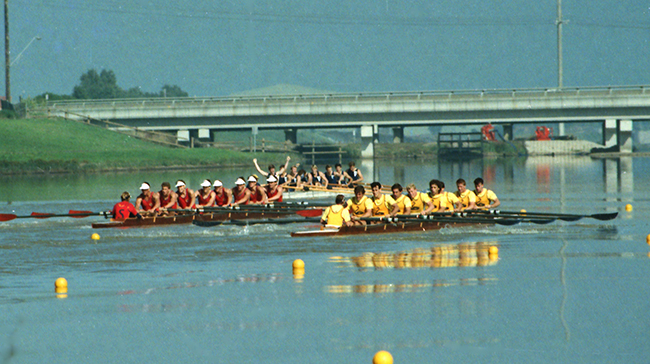
Unofficial King's Cup race at Carrum Victoria
The stage upon which the race was held, the National Water Sports Centre at Carrum, was opened on Sunday the 30th of October 1988 by the Minister for Sport and Recreation Neil Tresize, following on from a tumultuous ten years of planning, frustration and financial and construction problems. Participating in the ceremony were students from St. Paul’s School Woodleigh and Scotch College, as well as 1988 Olympians Hamish McGlashan, Peter Antonie, Paul Reedy and Richard Powell.
Footnotes
1.Primary source has been the Victorian Rowing Association annual reports - refer appendix 16
< previous Chapter 12
> next Chapter 14