
A Short History of Bairnsdale Rowing Club
Chapter 1: The Beginnings
Sports in the Gippsland started early with horse racing starting soon after European settlement in the Bairnsdale district and growing through the 1870s. The first cricket match between Bairnsdale and Omeo took place in 1862. Even athletic competitions were as early as 1863 with prizes available to the young men competing.
One of the most vigorous sports of the 1870s was rowing.
A meeting was called on the evening of 11th November 1872 at which Joseph Day was elected president and B C Jones, the Postmaster, captain. Edward Bull was elected Chair. It was held at Riley's Hotel, the site believed to be somewhere in the vicinity of the present Club Hotel.
The minutes of that meeting record on the motion of Messrs Jones and Meadows, that Mr Doherty's offer of the Bark Hut for a boat house was accepted at the rental of £2 per year. The reason for the low rental is made plain by an addendum to the motion that “information be obtained as to the probably cost of repairs”.
Early prominent members are noted as B C Jones (Captain), Joseph Day and J H Vogt.
The club had 20 members and membership fee of 5/- per quarter with a £1/1/0 joining fee.
This was probably preceded by the first gigs race at Bairnsdale in 1872 won by a crew who called themselves “Nil Desperandum” (never despair). The photograph of the crew is dated 1872 but John Lang in his Victorian Oarsman in 1919 dates the race as November 1873.
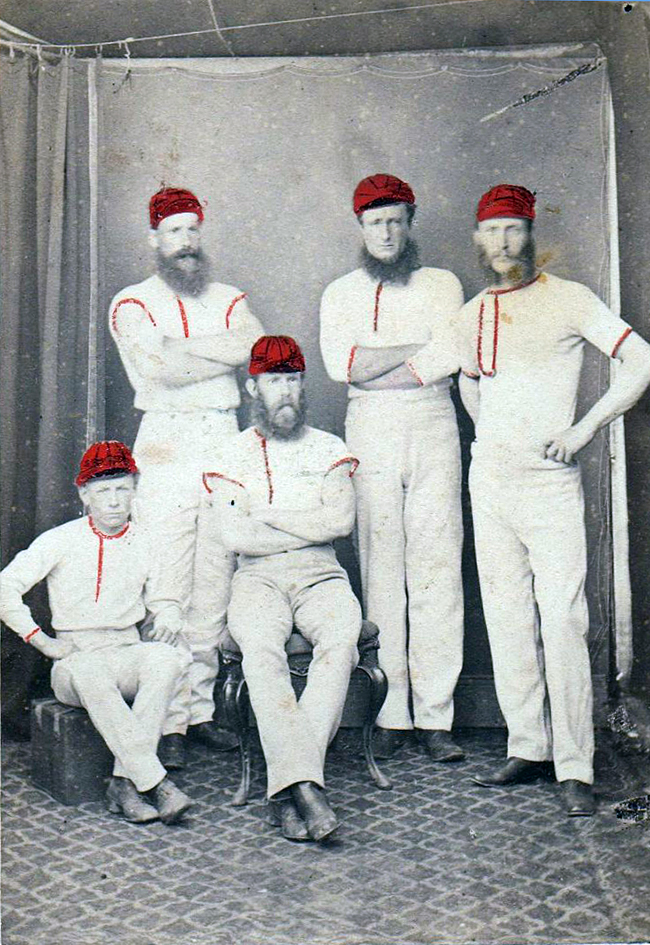
1872 Nil Desperandum crew, winners of the first gigs race in 1872
Messrs B C Jones and J Meadows were charged with the responsibility of calling at the draper's to select colours for a club uniform to be worn on the first opening day, January 15th 1873. White with a royal blue sash was selected.
John Adams in his book Path Among the Years places the first regatta of the club was held in March 1873 before a crowd of 400 people. John Lang and The Bairnsdale Advertiser on 28th October 1927 dates this first regatta as 30th November 1873, so the exact date is unknown. It comprised a race in gig fours on the Mitchell River over 6.5 miles. The “Camelia” stroked by W Guthridge won the race.
Prior to other clubs attending the regatta, crews raced under names such as Nil Desperandum and Mermaid. The racing was confined to local crews and comprised senior and maiden fours, pairs, and sculls.
Enthusiasm grew and public support was gained in many forms to enable good boats to be purchased.
In 1875, the regatta included an indigenous canoe race which was noted by the local correspondent, “…and though it was an impromptu affair, it was provocative of more real fun than any event of the day, every crew being cheered and yelled at to the echo by both sable and white spectators.”
In March 1876 tenders were called for a boathouse, and the stock of good craft began to build up, with two outrigger pair-oared boats purchased in July of that year, and test gigs soon after. By September 1877 there were also four four-oared boats and two clinkers.
An opening of the season event was held in October or November each year and this included rowing, swimming and diving. The local band and caterers added to the carnival atmosphere.
Regattas were only small affairs at the time but the Mitchell River attracted a few Melbourne professional rowers, mostly scullers, on occasions to compete with local champions.
The rowing club progressed with a large membership and a fine collection of boats, and in 1888, a boatshed was erected. Regattas drew rowers from Sale and other parts of the district. As can be expected with the flood prone Mitchell River, the boatshed was subject to regular inundation.
[images of the boathouse]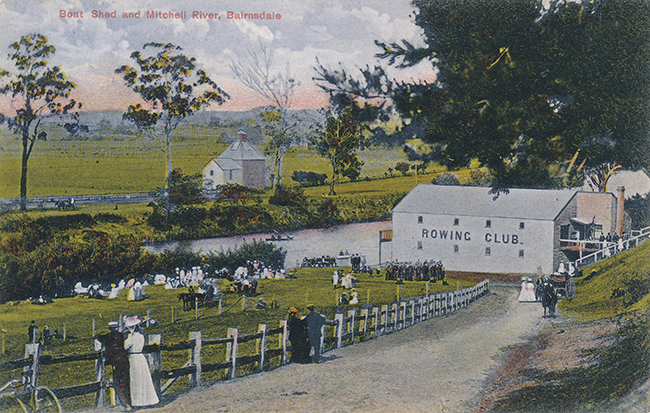
The Club's records reveal that the first entry into Melbourne VRA regattas was in 1891-92 season when a crew comprised of bow: G M Jones, 2: C Hopkins, 3: N Pearson, stroke: H T Arthur raced at the Association's regatta but were beaten in the final by Richmond Rowing Club by a length.
Distressingly at this time, the Postmaster and past Captain B C Jones drowned. A memorial was erected to him in the new boathouse and an eight oared boat named in his honour in 1892.