

Edward R Salamon
Essendon Rowing Club (Vic)
Edward Robert Salamon was born on 28 May 1890 in Hawthorn, Victoria.
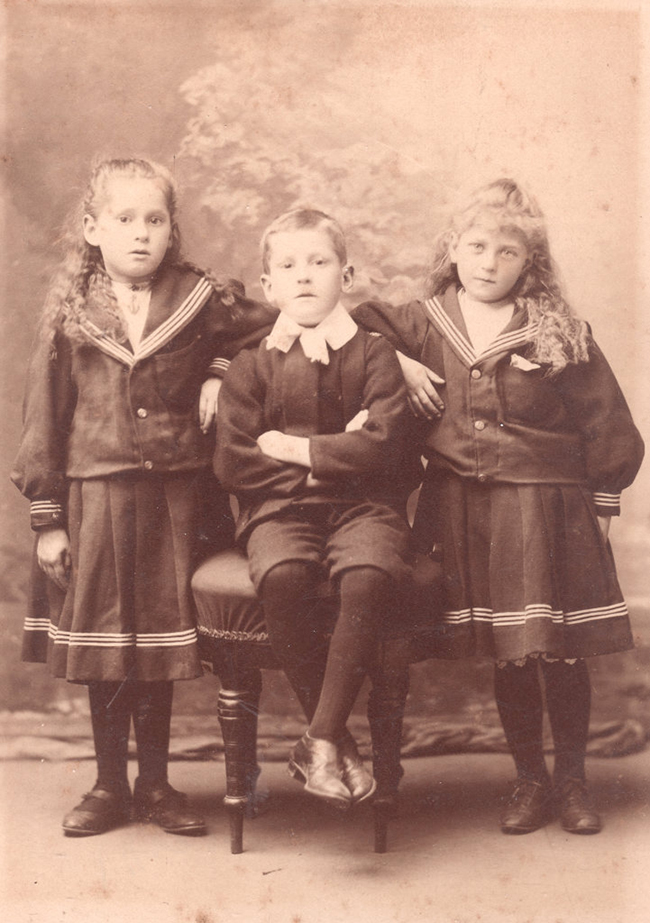
Edward with his twin sister Constance, left, and younger sister Ruby, right
Ted went to Auburn State School in Hawthorn.
The family moved from Hawthorn to Essendon in about 1907.
Ted held a number of roles at the Essendon Rowing Club including the Assistant Honorary Secretary, Honorary Treasurer, Honorary Auditor and on the Committee at various times up to 1915.
He worked as a clerk at E. L. Yencken & Co. Their premises were at 384 to 396 Little Collins Street, Melbourne, and described as Oil & Colour Merchants, also Art & Leadlight.
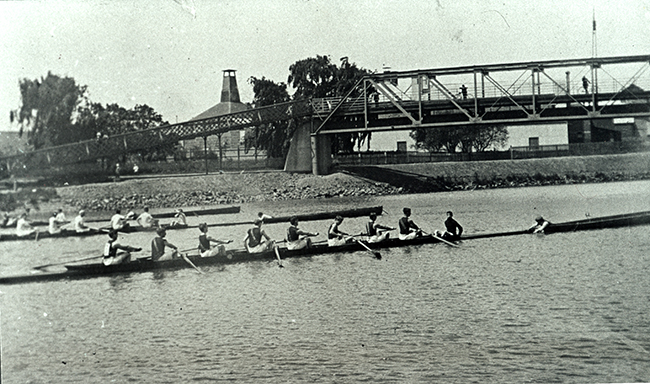
Start of maiden eights at Australian Henley 1914, Ted Salamon stroke
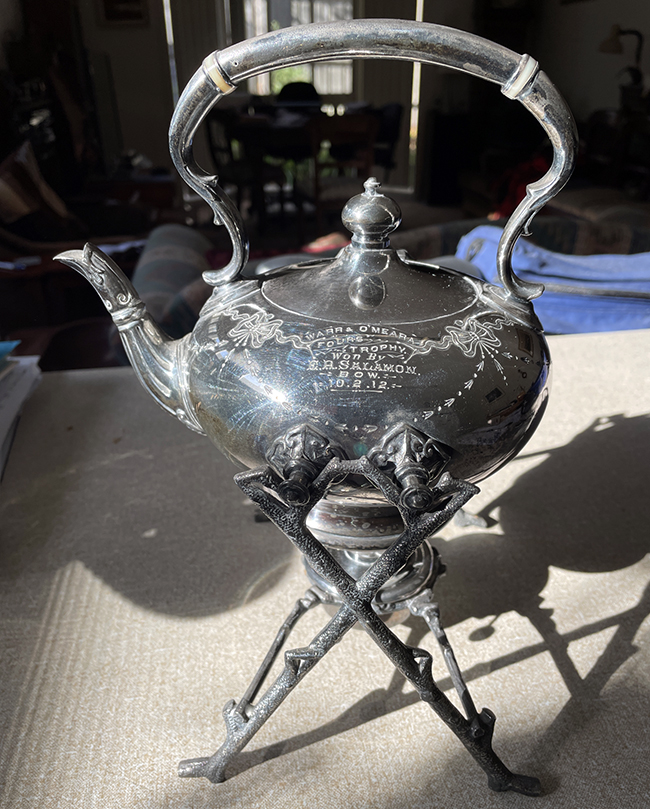
Tea Kettle & Stand Rowing prize awarded to Ted Salamon, 10 Feb 1912
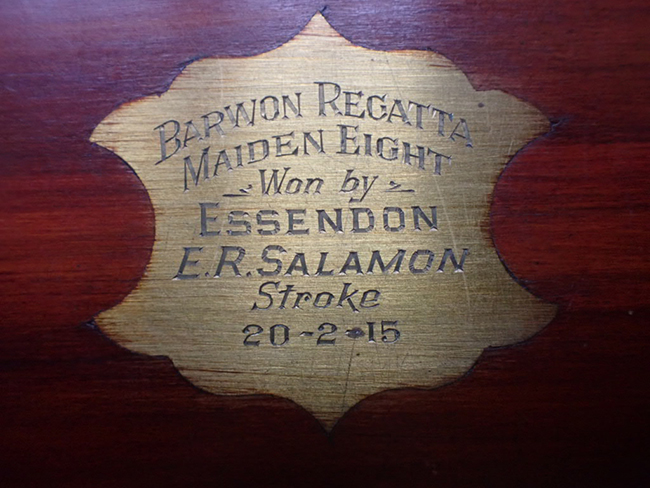
Plaque on Cutlery Box Rowing prize awarded to Ted Salamon, 20 Feb 1915
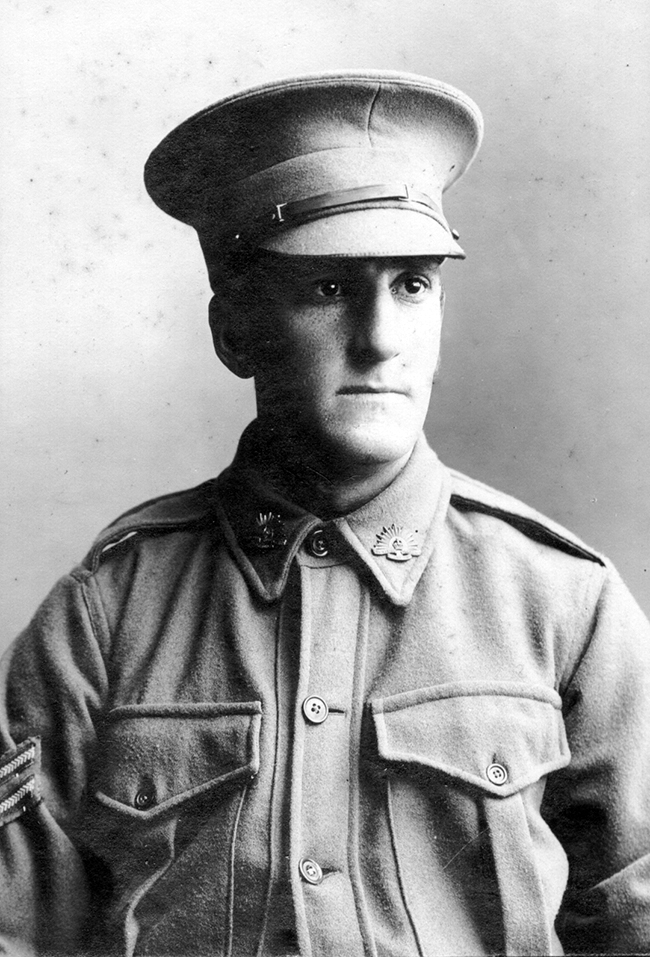
Edward (Ted) Robert Salamon, ca May 1915
Ted enlisted into the Australian Army at the age of 24 years and 10 months on 1 March 1915 at Broadmeadows, Victoria. He was single, height of 5 feet 6.5 inches (169cm), weight 10 stone (64kg) with brown eyes and brown hair. Religion was Church Of England. Distinctive marks were a vaccination mark on his left arm and a small scar on his right forearm. All teeth were artificial.
He served with D Company, 23rd Battalion, 6th Infantry Brigade. Rank of Private from 1 March 1915, then promoted to Corporal from 30 April 1915. Service Number 840.
Training was at Broadmeadows camp. The battalion was at Broadmeadows camp for about 7 weeks. By the end of April 1915 the troops had received sufficient training to move by train to the rifle range at Williamstown for live firing training.
Ted signed a will on 7 May 1915, the day before leaving Melbourne. In the will, in the event of his death, leaving his gold chain & watch & gold sleeve links to his father Albert. His rowing trophies to his mother Annabella. The money in a savings bank account and any back pay to his sister Constance. His bicycle and camera to his sister Ruby.
At 4am on 8 May 1915 the 23rd Battalion arose and after breakfast marched off to Broadmeadows station. The troops boarded special trains which took them to Port Melbourne. The troops then boarded the 15,000 ton troopship HMT Euripedes.
The 23rd Battalion (along with the 24th Battalion) sailed from Melbourne on 8th May.
The Euripedes arrived at Alexandria, Egypt, on 11 June. The battalion then boarded a train to Cairo. The battalion marched 2 or 3 miles to Aerodrome Camp at Heliopolis.
Within 2 days of their arrival in Heliopolis the troops resumed training. It was extremely hot in Egypt, sometimes reaching as hot as 125º F (52º C). Long days on duty from 5:00am to 7:30pm.
On 10th July the Australian Government approved the formation of the 2nd Australian Division, earmarked as reinforcements for Gallipoli, of which the 23rd Battalion was a part.
On 2 September 1915, on transfer by ship from Alexandria, Egypt, to the Australian Army base on the isle of Lemnos, Greece, 60 miles (96 km) from Gallipoli:
He wrote a letter to his mother from Gallipoli sometime in September 1915.
… a sensation was caused by a submarine, which fired at our ship [HMT (His Majesty’s Transport) Haverford], but missed. One of our transports [HMT Southland], sailing two-hours ahead of us, was struck [at about 10am and about 40 miles (65 km) south of Lemnos], and all hands were ordered into the lifeboats. Our captain lowered boats to go to the rescue, and as the first boat was lowered he asked for any man who could row to jump in, so I got in. We rescued 52 men from an upturned raft, when our boat, which was leaking, half filled with water; so we had to put 12 men back on to the raft and made it secure to our boat with a rope, and stood by for some hours, bailing all the time. … a hospital ship [Neuralia rescued them] … and arrived at Lemnos.
Southland was the first Australian troopship ever to be hit by a torpedo. The torpedo created a hole in the ship of 26 ft (8 m) by 30 ft (9 m). There were about 1,200 men on the Southland, most abandoned ship to the 42 lifeboats. Four lifeboats capsized. Many men were swimming or afloat clinging to wreckage. Most men were rescued by one of the other ships in the convoy, however 32 men died, mostly from drowning.
The captain of the Southland and seventeen men volunteering as coal stockers managed to beach the Southland on Lemnos at 9pm that evening.
……..We arrived safely, although bullets were dropping all round us. One cannot imagine what war is until you hear the bullets whizzing past and the big guns booming. .… Yesterday, we were disturbed at breakfast. I was in my dugout with my pot of tea, jam and milk; when the Turks started to shell us. One put dirt in the tea and another put dirt in the jam and milk, spoiling my breakfast; but that was all the damage they did.
Ted finished the letter to his mother with:
……..I am glad to hear some more of the rowing club members are coming forward, for there is no doubt they are all wanted. I am still in the best of health.-Your loving son, TED.
On landing at Gallipoli on 4 September 1915, the battalion's strength was 963 men and 33 officers.
Over the next few month's the battalion spent almost all it's time at Lone Pine or Brown's Dip.
Water and rations were scarce, which was affecting the men's health.
By early November the weather was turning cold and they were getting snow.
On 17 December 1915 the men left the Lone Pine trenches and marched down to the Plateau and Pimple trenches where the men remained for the next two days.
On the night of 18 December most of the men went down to the beaches to board a small lighter and transfer on to the ship Reindeer which took them back to Lemnos.
D Company, of which Ted was a member, remained on Gallipoli as the rear party. On the night of 19/20 December D Company was divided into small parties of 20 men, which withdrew from Brown's Dip and the Pimple and Plateau trenches. The final party reached the beach at 1:30am on 20 December and were shuttled out to the ship Reindeer and sailed to the nearby island of Imbros.
After Gallipoli, through deaths, injury and sickness, and even after three batches of reinforcements of about 240 men, the battalion was now down to 540 men and officers.
They stayed in Sarpi camp on Lemnos from 20 December 1915 till their departure on 6 January 1916 bound for Alexandria, Egypt, arriving on 10 January 1916. They then camped at Tel El Kebir for further training in preparation for France.
On 19 March 1916 they left Alexandria, disembarking in Marseilles, France on 26 March.
From 4 April 1916 Ted was doing the duty of Baggage Guard at the 2nd Australian Division Base in Etaples, France.
On 15 July 1916 Ted marched out to join his unit.
On 4 August 1916 Ted was Killed In Action, Pozieres, France, aged 26 years. He is commemorated on the Australian National Memorial at Villers-Bretonneux, France with others who have no known grave.
In August 1921, two new boats were named “Ted Salamon” and “Ellis Middleton” after the first two members of the Essendon Rowing Club to be killed in the war.
Known rowing record:
1912 [10 Feb] - Essendon Rowing Club, Warr & O’Meara Fours, bow – First
1913 [26 Dec] - Nagambie Regatta, Special Fours, stroke – First
1914 [26 Oct] - Australian Henley, stroke - Not placed
1915 [20 Feb] - Barwon Regatta, Maiden Eight, stroke - First
Bruce Grant
July 2026
Sources:
- ‘Our Soldiers’, Letter from Edward Robert Salamon to his mother Annabella, The Essendon Gazette and Keilor, Bulla and Broadmeadows Reporter, 2 Dec 1915, p3 via Trove http://nla.gov.au/nla.news-article74591055
- Ron Austin, Forward Undeterred : The History of the 23rd Battalion 1915-1918 (Slouch Hat Publications, 1998).
- ‘Story of the Southland’, Daily Herald (Adelaide SA), 26 Nov 1915 p6 via Trove http://nla.gov.au/nla.news-article124893361
- The Weekly Times, 17 Feb 1912, p6 via Trove http://nla.gov.au/nla.news-article223906188
- The Murchison Advertiser, 2 Jan 1914, p2 via Trove http://nla.gov.au/nla.news-article138724823
- The Essendon Gazette, 10 Sep 1914, p6 via Trove http://nla.gov.au/nla.news-article74494297
- The Essendon Gazette, 25 Feb 1915, p3 via Trove http://nla.gov.au/nla.news-article74587871
- The Essendon Gazette, 15 Apr 1915, p2 via Trove http://nla.gov.au/nla.news-article74588444
- Military Record – National Archives Australia – Edward Robert Salamon – Service No. 840 recordsearch.naa.gov.au/SearchNRetrieve/Interface/ViewImage.aspx?B=8074507
- PRO Victoria Probate Files, VPRS7591 P2 Unit552.