

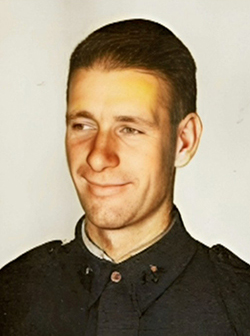
Douglas D Cook
Mercantile Rowing Club (VIC)
The following is extracted from the tribute to PTE Douglas Dunbar Cook at the 2026 Mercantile ANZAC commemoration.
Douglas joined the Club in 1927-28 season as a 19 year old and won an intra club novice four race. Thereafter, he doesn’t appear to have troubled the judges. In the next season he raced unsuccessfully in the Club’s second maiden eight at early regattas.
So we can conclude that he was not a champion rower, but we can also conclude that he enjoyed club life and so was a champion member - he maintained his membership for the next 14 years until his death.
When war broke out in 1939, he immediately enlisted. He was a clerk in civilian life and was trained as a signaler in newly formed 2nd/9th Battalion. In 1940, he was part of small Australian garrison sent to Scotland to help defend it against a possible German invasion. Early in 1941 he was transferred to North Africa where his battalion took part in the Siege of Tobruk before Garrison duties in Syria.
Given the dire situation in the Pacific with the Japanese, the 2nd/9th battalion returned to Australia in 1942. It was re-organised for jungle warfare and then took part in the New Guinea campaign. By this stage his Battalion was regarded as being the Australia’s best fighting force. Their biggest early battle was at Milne Bay.
This battle is often described as the first major battle of the war in the Pacific in which Allied troops decisively defeated Japanese land forces. Although Japanese land forces had experienced local setbacks elsewhere in the Pacific earlier in the war, unlike at Milne Bay, these earlier actions had not forced them to withdraw completely and abandon their strategic objective.
The battle commenced on 25th August 1942. Despite suffering a significant setback at the outset, when part of their small invasion force had its landing craft destroyed by Royal Australian Air Force aircraft as they attempted to land on the coast behind the Australian defenders, the Japanese quickly pushed inland and began their advance towards the airfields. Heavy fighting followed as they encountered the Australian Militia troops that formed the first line of defence. These troops were steadily pushed back, but the Australians brought forward veteran Second Australian Imperial Force units that the Japanese had not expected. Douglas was part of this force. Allied air superiority helped tip the balance, providing close support to troops in combat and targeting Japanese logistics. Finding themselves heavily outnumbered, lacking supplies and suffering heavy casualties, the Japanese withdrew their forces.
Douglas was killed in action on 4th September 1942, only days before the cessation of fighting and the complete rout of the Japanese. Given that he was initially buried at K B Mission, we can assume that he was killed in battles east of that mission on 4th and 5th September. It is likely that he died when a group of the 2/9th moved forward to meet the Japanese after the Japanese had repelled attacks by 2/12th. A heavy fire fight developed. As an aside in this attack, Corporal J A French was posthumously awarded the Victoria Cross for his cool courage under fire killing the crews of three machine gun posts thus reducing Australian casualties and enabling the successful conclusion of the attack.
A great club member was lost in a fierce and famous battle.
Andrew Guerin
April 2026
Sources include:
- Club annual reports
- vwma.org.au website for image and details of the Milne Bay battle
- National Archives - service records of Douglas Cook
- Victory at Milne Bay by Dudley McCarthy