

James Edwards
Victoria
Born London 1829, died Melbourne 16th January 1910, aged 80 years
James was apprenticed to Robert Dean, boatbuilder of London, where he learned his trade. He became an excellent waterman whilst in London racing professionally.
R W E Wilmot in The Australasian on 19th November 1938 reported on James' early years.
He had developed into a successful oarsman, and his ambition was to win the Doggett's Coat and Badge, the blue ribbon of the Thames, competed for annually by the watermen who pulled the King's barge. He was unlucky, for in the year he was eligible to compete, there were so many entrants that a ballot was taken as to who should row. He drew a blank and so had to look on. He came to Australia in the early fifties, and in 1857 built a boatshed on the south bank of the Yarra, just above Princes bridge, and there he established his boat-building business, which eventually became the best known in Australia, and is still in operation. There, in that building, which became a landmark, were born to James Edwards and his wife seven sons and two daughters, and it is remarkable that it was not until November 13,1938, that there was a break, when the second son, Robert, died at the ripe age of 78 years.
Before Melbourne clubs could establish themselves, amateur rowing depended upon the boat builders to house and boat them. The most significant of the boat builders in Melbourne was James Edwards. He hosted the many early clubs in Victoria thus enabling amateur rowing in Victoria to develop strongly, far more than in other colonies. For example, when Banks commenced in 1866, they immediately hired boats and use of facilities from James Edwards. They commenced operations the weekend after their establishment meeting. He was the means by which amateur rowing flourished in Victoria.
The following extract written by "Aquarius" from Melbourne Handbook of Recreations and Calendar for 1873, published by H Thomas 75 Chancery Lane Melbourne 1873 on pages 95 and 96, provides more information Edwards and that he commenced his operations as steam boat operator.
I remember when the proprietor of the pile of buildings which strikes the eye of the onlooker from the bridge, (Mr. James Edwards) first erected his “steamboat waiting room”, it was some 15 years since, and they were in those times mimic steam boats plying between Prince’s Bridge and Cremorne Gardens. Edwards had purchased the fore-deck house of the Expert, steamer, and transformed it into a temporary dwelling with a waiting room attached, which together with a commodious landing stage was a great accommodation. This he followed by the purchase of a few boats, and having been an experienced Thames (London) waterman, his advice and assistance in training and in teaching rowing was sought for by our amateur oarsman, and enabled “Jemmy Edwards”, as he was then familiarly called like Norval's father, to increase his store. The next step towards the formation of his vast boat building establishment (en passant, it has no equal on the Thames) was the initiation of the Melbourne Rowing Club, for the accommodation of which, Edwards erected a very large boathouse, replete with every convenience. This was, however nearly destroyed by the cyclone prophesied by Saxby, and by the great flood of 1863; but Edwards with a persevering energy, surmounted all difficulties, and as rowing came into favour, a reaction after a plethora of cricket, - and regattas were largely patronised, so did his business expand till it had assumed its present gigantic dimensions, undoubtedly the largest in the Australian colonies. The river above the bridge formally presented, as it does now half a mile beyond the boat sheds, it's silvery reflection of the sky on its placid bosom, as on a mirror, save when a slightly angry wind disturbed its smoothness; but its surroundings are wonderfully changed. Where formally all was peaceful, pastoral and a blooming, that busy hammers of the boat builders shops now heard, only varied by the launching or landing of the crack boat clubs; nor is this to be wondered at when we find that Edwards has to supply accommodation for six or seven aquatic clubs, and is building boats for almost every regatta of importance, and for most matches. For instance, the boat in which our Varsity crew achieved so unexpected a victory at Sydney, and the boat sent to Hobart Town for the Intercolonial Champion Gig Race, open to all colonies, three gigs for the Sydney Rowing Club, two for Swan River, and two for Fremantle, were all built under his direction, by the best workmen from England, of the best material, and all the latest and most approved models; and as his boats have been very fortunate, it is not surprising that he is patronised. To meet the growing demand there has been recently erected a leviathan boathouse, 62 feet by 100 feet, with four entrances, a second floor for show-rooms, meetings, baths, dressing rooms, and every other appliance for a boating clubhouse. This building being now completed Mr. Edwards will feel honoured by a visit from any members of clubs, or by the lovers of aquatic sports from the colonies or from old England. I, in conjunction with all other admirers of colonial enterprise, wish him the success in his business which he so eminently deserves. AQUARIUS
He built the first racing eight in Australia which was launched on 23 October 1875 on the Yarra River. Due to the support of boat builders and in particular James Edwards, amateur rowing in Victoria was considerably more developed than in NSW by 1869. For example, the Victorian rowing season opened with ten clubs and 200 oarsmen staging a procession of boats.
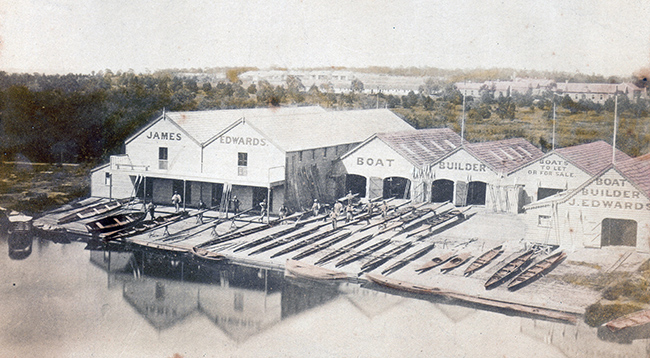
Edwards boatsheds on the Yarra River at Princes Bridge - note Government House not yet built
Edwards was also a notable sculler who raced in the first outrigger sculling race in Australia at the Darling Harbour Regatta on 9th April 1855. It is reported that Issac Howard won this outrigger sculling race from James Edwards, who had just arrived from England. Reports indicated that Edwards was badly fouled in this race. This was the first time outrigged boats had been seen and used, and they were much favoured. John Lang said that in Victoria there were no watermen who could compete with James Edwards. “He was the build of a sculler, and had a finished and powerful style.”
James Edwards stayed in Sydney for some time, and became coxswain of H.M. Customs boat. John Blackman, “Trident” of the Sydney Mail described the local scullers as very strong, but not clever, until they learned from the newcomers such as Edwards.
James Edwards had seven sons who assisted him in the business and many became fine scullers.
Other rowing races
1861 - Geelong and Barwon Regatta, Senior Pair, bow - First
1863 - Ballarat Regatta, Senior Pair, cox - First
1868 - Hobson Bay Regatta, Senior Pair, cox - first
Andrew Guerin 2010