

A Max Cunningham
Swan River Rowing Club (WA)
Cunningham's first King's Cup was eventful for all the wrong reasons. Bill Cooper reports in his WA Rowing history "Home and Dry" published in 2008 as follows.
The King’s Cup was rowed over three miles at Penrith, with the Western Australian crew in a new boat built by Ninham and christened by Association president Jack Howson’s wife Elizabeth in March. The race was both dramatic and disappointing for, during the second mile, Max Cunningham in the four-seat experienced a partial blackout. The crew battled on, however, with the prospect of victory still real until, with 300 yards to row, Cunningham collapsed completely, creating a domino effect upon Francis, Lowry and Child, who all had to stop rowing. The stern four were left to bring the boat home, going down to Victoria by a little over a length. According to Robert Jeffreys, who was there at the time: … the Western Australian crew had shown by its good performance in coming second under difficulties at Penrith last Saturday that it was a good crew. With its knowledge of local conditions, it might win next year.
His success in 1960 left this episode as a dim memory.
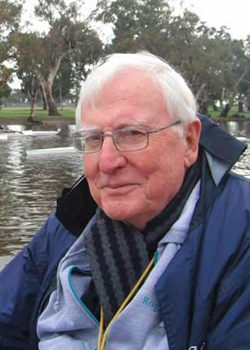
Sadly Max died in December 2025. WA Councillor to Rowing Australia Craig James reflected that Max was a keen all-round sportsman all his life (rowing, tennis, sailing, golf, basketball, Australian Football), but rowing was his life-long interest. He coached at numerous lubs and boys and girls schools in WA and Queensland for over 30 years. Max was gregarious and always open to a chat.
1953 - PSA Head of the River, First Crew (Aquinas) - Third
1954 - PSA Head of the River, First Crew (Aquinas) - Second
1958 – Interstate Men’s Eight Championship four seat – Second
1960 – Interstate Men’s Eight Championship four seat – First
1960 - Olympic Games - Men’s Eight Four seat - eliminated in repechage
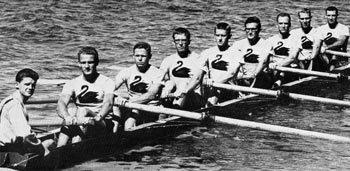
Max in the four seat of the winning 1960 WA crew
Meg Sissian of the Australian Olympic Committee wrote the following tribute in an email to all Olympians in January 2026.
Born in July 1938 and christened Alexander Maxwell, he was a surprise addition to the Cunningham family. Max arrived ten weeks early and was a very small baby. Legend has it he could be held in the palm of his father’s hand.
He grew up in Mount Lawley, attended St Paul’s Primary School. In 1950, he commenced high school at Aquinas College, Manning, initially as a day scholar and then as a boarder. Max’s high school story is one of sport and athleticism. By the age of fourteen, he was already six foot four. Tall, lean, and unmistakably athletic, he threw himself into sport. He played Australian Rules football and tennis, as well as many disciplines of athletics: running, hurdles, long jump and high jump. If there was a physical challenge available, Max was inclined to give it a go, but rowing was where he truly found his place.
He trained with his school friend Herb Elliott; together they rowed in Aquinas’ first eight in 1953 and 1954. In the 1954 Head of the River, the finish was so close it was a judges’ call. Aquinas were given second, and it’s fair to say that a strong sense of justice stayed with him for life. After school, Max continued his rowing with the Swan River Rowing Club.
In 1958, as a 21-year-old, Max was selected for the Western Australian State Eight for the gruelling three-mile (4.8 km) King’s Cup, hosted in Penrith, NSW. The Western Australian crew came second. This was an especially tough lesson for Max. Two years later, in 1960, not yet 24 years old, Max again made the Western Australian State crew for the new 2,000-metre King’s Cup, hosted in Launceston on the Tamar River. That year, the Western Australian crew came first. This meant the crew was selected to compete for Australia in the 1960 Rome Olympics.
Rome was quite overwhelming for the young Australians -the history, the crowds, the scale of it all unlike anything they had experienced. On Lake Albano, the crew finished second in their heat, but in the follow-up repechage race, they did not achieve the qualifying time for the final. What never faded was Max’s connection to rowing and the Olympic movement. The friendships forged in that boat endured for life, with the surviving crew members gathering every year to relive what was a defining chapter for all of them.
His career path after the Olympics often prevented Max from getting into a rowing boat, but when he could, he would. He embraced participation in other sports: football, basketball, golf, tennis, squash, body surfing, and especially sailing.
Max generously gave back. Wherever his work allowed, he threw himself into rowing coaching. He had strong views on the most efficient way to row, based on his own experience. He coached at senior rowing clubs and schools, men and women, boys and girls. He became an accredited coach to stay current with evolving techniques and debated the finer points of rowing late into the night with other coaches. His strong views were always grounded in experience, observation, and genuine care for the athletes. Over his lifetime, he coached at six senior rowing clubs and eight schools, both male and female, in Western Australia and Queensland. He also became involved in local surf boat rowing, coaching surf club crews.
His crews respected him not just for his technical knowledge, but for his kindness, fairness, and quiet direction. He played a role in the creation of the rowing course at Champion Lakes. Into his early 80s, he was still getting up before sunrise to coach.
Max embraced challenges and took career opportunities when he could. This meant that they lived in twenty different homes across Western Australia, Queensland, and New South Wales.
His working life mirrored his personality - energetic, adaptable, and unafraid of change. After briefly studying pharmacy, at his parents’ encouragement, Max decided it wasn’t for him. He joined the State Education Department, then moved to Shell, where his rowing ambitions were supported and his professional skills carefully developed. Marketing and sales became his strength, and those skills proved highly transferable. Over the years, Max worked in real estate, land development, and senior management roles across Western Australia, Queensland, and New South Wales. He worked with visionaries, built teams, took risks, learned hard lessons, and celebrated real achievements. Some ventures succeeded brilliantly; others taught him more than he would have preferred.
In 1956, at a rowing regatta in Bunbury, while staying in a boarding house near the rowing club, Max used the clever excuse of selling rowing club raffle tickets to introduce himself to a group of young women also staying there. One of them was Patricia Williams. Max was tall, lean, confident, and charming and just a little younger than Pat. To avoid being dismissed too quickly, he fibbed about his age. Max and Pat were engaged in 1957 and married in 1958. Together they built a family with four children and a life defined by partnership, resilience, humour, and shared adventure. He renovated houses, ran service stations with his sons, happily putting on the uniform and pumping petrol. He sold real estate alongside Pat, invested in technology, and embraced travel, particularly ocean cruising, with enthusiasm.
Even when circumstances changed, Max continued to find great joy in company, conversation, and especially in time spent with his children, grandchildren, and great-grandchildren.
On 14 December last year, Max passed away at age 89. He leaves behind a legacy of kindness, resilience, curiosity, and genuine human connection, one that will continue through all who knew and loved him.
Andrew Guerin
June 2021 (updated in December 2025 upon his death and again in January 2026 with Meg Sissian's tribute.)