

1863-1872 Intercolonial Championships
4 Feb 1863, Parramatta River NSW
Men's Interstate Four Championship
3 miles 330 yards
Time: 19.25
1st NSW - Bow: William Mason, 2: Henry Freeman, 3: Grantley Fitzhardinge, Str; Arthur
Fitzhardinge and Cox: C Fitzhardinge
2nd VIC - Bow: Henry Woolnough, 2: J Bennett, 3: Martin H Irving, Str: J W McCutcheon, Cox:
J Williams, Emerg: Matthew Byrne
John Lang reports this event in his book The Victorian Oarsman published in 1919:
"The earliest boat race between these two Colonies was rowed in 1863 in gigs over a three-mile course on the Parramatta River, N.S.W. The N.S.W. four won (time, 19 min. 25 sec.).
"In this race the crews were of a representative character, and each crew bore the name of its colony. The Victorian crew was made up of members from the Elswick, Melbourne, and Melbourne University Clubs.
"After the race the differences about the amateur status of oarsmen in the two Colonies became accentuated, Victoria alleging the New South Wales crew were to all intents and purposes watermen, having rowed against watermen and for money prizes. The Victorian definition excluded both sorts of oarsmen from amateur competition."
This definition of amateur was to cause disputes in intercolonial competition for many years. Even after a definition was agreed in 1896, the dispute continued with further attempts to rewrite the definition through to WWI. None of these attempts were successful in gaining the agreement of all States and so the 1896 definition remained.
11 Apr 1868, Yarra River VIC
Men's Amateur Champion Sculling Race
No time taken
1st VIC - Arthur Nicholls
2nd NSW - Henry Freeman
10 Nov 1870, Balmain Regatta NSW
Men's Interstate Four Championship
Margin: 0.5 length
1st Sydney - Bow: Charles Deloitte, 2: Grantley Fitzhardinge, 3: Henry Freeman, Str: Quarton
L Deloitte, Cox: L McKay (it is reported that this cox weighed only 3 stone), Cch: Connor
2nd Tasmania, "Derwent Belle" - Bow: Isaiah Archer, 2: H E Best, 3: C Gaylor, Str: F W Abbott, Cox: J Hopwood, Cch: James Hobson, Emerg: D Lewis
3rd Parramatta River crew, "Osprey" - Bow: F Blaxland, 2: Edmund Barton, 3: R Hays, Str: John Blaxland, Cch: Cavendish
Other crews competing:
Sydney Rowing Club No 2, "Adelphi" - Bow: James Oatley, 2: J Miles, 3: Charles Oliver, Str: C Fitzhardinge
Mr Garvan's crew "Wooloomooloo" - Bow: I R Sheridan, 2: J Sullivan, 3: J Madden, Str: J Garvan, Cch: T Punch
Did not start - Sydney University - Bow: Edmund Barton, 2: Edward Iceton, 3: Richard Teece, Str: Allan Yeomans
John Lang reports this event in his book The Victorian Oarsman published in 1919:
"For some years this break [Ed: the break caused by the diasagreement over an amateur definition] continued, preventing competition by crews really representing the Colonies, though club crews frequently raced in Intercolonial matches, the crews being club crews charged more or less with a mission to win the honours for their Colony. In 1870 a race took place at the Balmain Regatta, N.S.W., which the New South Wales crew won against Tasmanian crews, Victoria not being represented."
The race attracted a prize of 100 sovereigns or trophies to that value at the option of the winner.
30 Jan 1872, Derwent River TAS
Men's Interstate Four Championship
Times: 36.20
37:10
37:30
37:45
39:30
1st Sydney RC - Bow: Charles de B Deloitte, 2: Grantley H Fitzhardinge, 3: Robert A Clark,
Str: Arthur Fitzhardinge, Cox: L McKay, Emerg: John Myers
2nd Parramatta – Bow: Francis H Williams, 2: Edmund Barton, 3: William R Hayes, Str: John G
Blaxland, Cox: J Miller
3rd Hobart Town Light Crew – Bow: W B Jones, 2: H Radcliffe, 3: G Penny, Str: F
Norman, Cox: A Humphreys
4th Hobart Town Heavy Crew – Bow: R Barnes, 2: H E Best, 3: C W Gaylor, Str: F W
Abbott, Cox: J Hopwood
5th Barwon RC - Bow: E Nichols, 2: Charles Shannon, 3: James F Strachan, Str: J Cullen,
Cox: Sidney A Edwards
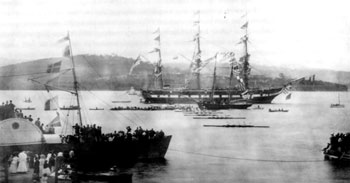
1872 Intercolonial Fours Start
Acknowledgement to Allport Library and Museum of Fine Arts, State Library of Tasmania
John Lang reports this event in his book The Victorian Oarsman published in 1919:
"In 1872 a race was rowed over a five-mile course on the Derwent River, Tasmania, the Sydney Rowing Club winning against the Parramatta Rowing Club, some Hobart Club crews, and one from the Barwon Rowing Club, the time for the course being 36 min. 30 sec.
"The same year over a 7,000 yard course on Sydney Harbour two crews from the Sydney Rowing Club beat a Victorian crew (of an Intercolonial character, the crew being composed of members of various clubs, among whom were members of the Civil Service, University, and Melbourne Rowing Clubs)."
The race was won by 1/4 mile by Sydney before the Governor and some 20,000 spectators. The Governor presented the winners with 100 sovereigns in a white stain purse embroidered by a Tasmanian lady. The Parramatta crew contained our first Prime Minister, Edmund Barton. There was sympathy for the Hobart and Barwon crews who rowed in boats some 50 lb heavier than the Sydney boats.
The Governor's speech was recorded in the newspapers in the following manner:
"The Governor said he had great pleasure in presenting the prize, which had been so honorably and gloriously won. (Cheers) The case before him contained a cheque for £100, which would be found in a purse made by the fair hands of a Tasmanian lady. (Renewed cheers.) His Excellency congratulated the crew on the victory they had so gloriously won. No doubt there might be a sense of regret that Tasmanians had not carried off the victory in a race on their own waters, but that would not prevent the losers from joining in his congratulations. (Cheers.)
"And he expressed the general sentiment when he said now that the intercolonial races had been so successfully inaugurated, he hoped that they would have the pleasure of welcoming visitors on another occasion, and that the intercolonial race would be an annual event (cheers), in which case he hoped the present winners would be able to add fresh laurels, or that Tasmania would regain more than they had lost. (Cheers)
"It had been calumniously said that Tasmanians did not know how to cheer. But to show that it was a foul calumny, he called upon them to give three cheers at the top of their voices on that occasion for the Sydney Rowing Club. (Three most enthusiastic cheers were then given, with 'one cheer more' several times repeated.) His Excellency then gave the winning crew the purse containing the prize in a glazed case, the purse being tastefully made, and ornamented with flags embroided by the fair hands of a lady as the Governor had stated. He also gave a prize of £20 to the coxswain of the Parramatta crew."
One of the Barwon crew, James Strachan from Geelong, had raced for Cambridge in 1870 winning the Boat Race against Oxford.
Sources
- The Victorian Oarsman by John Lang published by Massina & Co 1919
- Image - Allport Library and Museum of Fine Arts, State Library of Tasmania